Learn
Personalized Wellness Plan: How to Build One That Lasts
Learn what a personalized wellness plan is, the science behind it, which biomarkers and habits matter, and how to get started with the right assessments.

You finish a demanding workday, feel your energy disappear by mid-afternoon, and promise yourself that tomorrow will be different. You'll go to bed earlier, exercise before work, eat more vegetables, and stop checking email late at night. Yet tomorrow brings another early meeting, a restless night, an interrupted workout, and the same advice that never quite fits your life.
That's the problem with generic wellness advice after 40. Your schedule, recovery needs, habits, health risks, and responsibilities have changed, but the recommendation often hasn't. A personalized wellness plan starts somewhere more useful: with your actual baseline, your priorities, and the version of healthy behavior you can still follow when the week goes badly.
Table of Contents
- Why Generic Health Advice Stops Working After 40
- What a Personalized Wellness Plan Actually Is
- The Science Behind Personalized Wellness
- Key Components Built From Biomarkers and Lifestyle
- Reading Your Numbers Without Overtrusting Them
- How to Get Started With Assessments and Professional Input
- Building a Plan You Can Actually Keep
Why Generic Health Advice Stops Working After 40
At 45, “exercise more” can mean very different things. You may already walk regularly but lack strength training. You may have a demanding job, children who need support, or an aging parent who calls during the only open hour in your calendar. You may sleep long enough on paper but wake repeatedly because stress, alcohol, travel, or an inconsistent schedule keeps disrupting recovery.
Generic advice treats these situations as if they were interchangeable. It recommends the same meal pattern, the same workout schedule, and the same sleep routine without asking what happens between Monday morning and Friday evening.
That matters because lifestyle risk isn't distributed evenly. In 2022, approximately 1.8 billion adults, or 31% of the global adult population, didn't meet recommended physical-activity levels, with meaningful differences by sex and region, according to the World Health Organization's global physical-activity update. A population-level recommendation can identify a broad concern, but it can't tell you whether your first priority should be movement, sleep, nutrition, stress, or medical review.
This doesn't mean every piece of general advice is wrong. It means the advice needs context. A high-performing professional who travels frequently needs a different routine from someone with a stable workday. Someone with high blood pressure needs a different monitoring plan from someone whose main concern is afternoon fatigue.
A useful starting point is to understand what longevity medicine means, particularly its emphasis on prevention, individual risk, and ongoing review. The practical question is simple: how do you turn broad health principles into a plan that matches your own measurements and real life?
What a Personalized Wellness Plan Actually Is
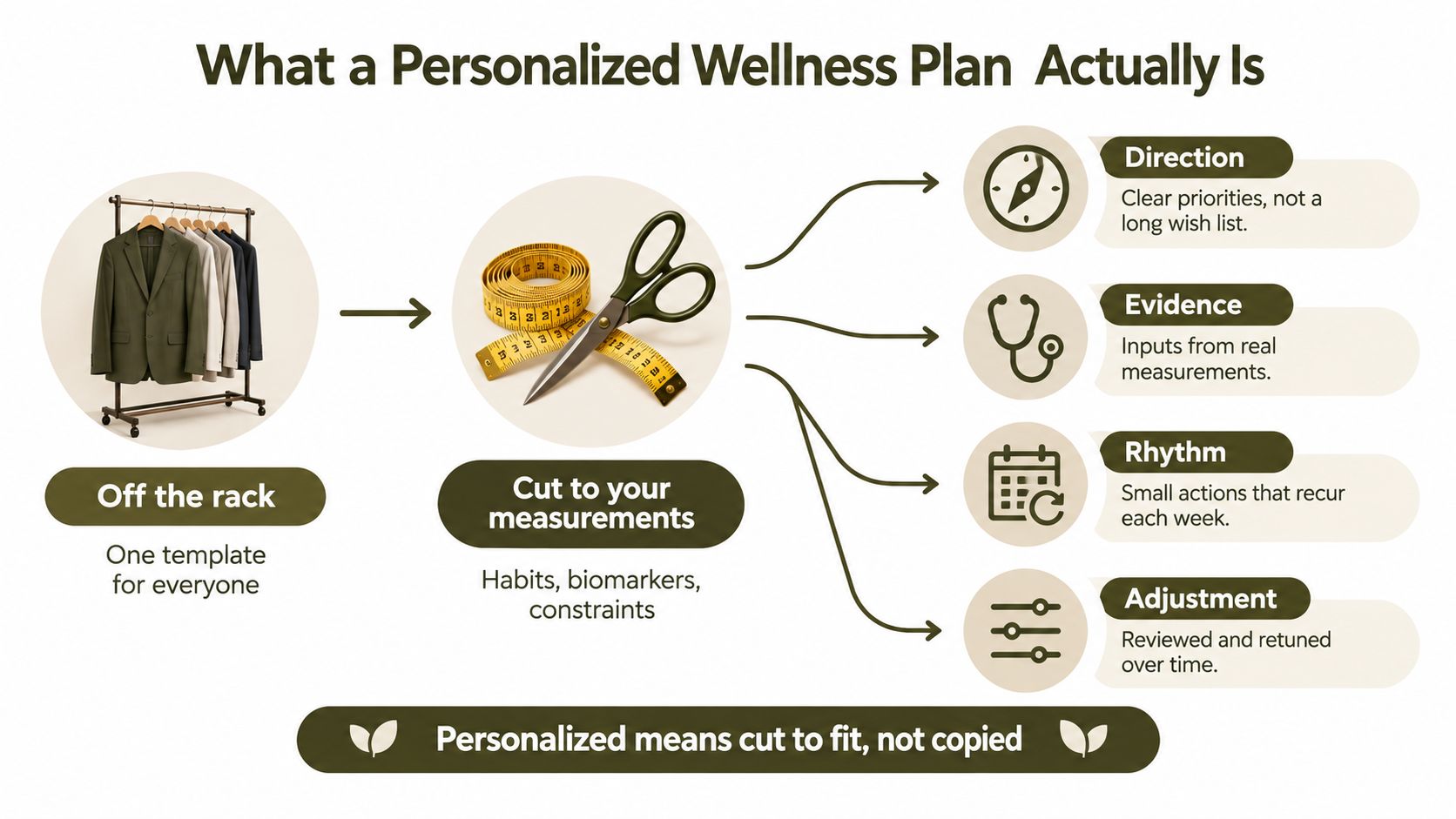
Think of an off-the-rack suit. It may be well made, but the sleeves, waist, and shoulders weren't designed for your body. A custom suit begins with measurements, then gets adjusted when the fit isn't right.
A personalized wellness plan works the same way. It uses information about your habits, health markers, goals, and constraints to choose a manageable direction. It isn't a longer list of rules. In many cases, it's a shorter list with better reasons behind it.
Start with your own baseline
A baseline is a clear description of where you are before changing anything. It might include your usual sleep timing, movement, food patterns, energy, resting heart rate, weight, blood pressure, or medically supervised lab markers. It can also include constraints, such as shift work, frequent travel, pain, caregiving, budget, or limited access to equipment.
Without a baseline, you can't tell whether a recommendation addresses your main limitation. You may spend weeks optimizing breakfast while the core issue is fragmented sleep or an unrealistic evening schedule.
Choose a direction instead of collecting rules
A plan should identify two or three priorities, not every possible improvement. Your priorities might be steadier afternoon energy, better sleep continuity, or improving a marker that your clinician is already monitoring.
Each priority needs an action and a way to review it. “Improve recovery” is too vague. “Keep a consistent wake time on working days and record morning energy” gives you something you can test.
Practical rule: Personalization means choosing what matters most now, then changing the plan when your results or circumstances change.
Use evidence without pretending certainty
A marker can help you notice a trend, but it doesn't automatically explain the cause. A wearable score can support behavior feedback, but it isn't a diagnosis. A personalized plan combines measurable information with sensible interpretation and professional input when medical issues, abnormal readings, or medication decisions are involved.
The defining feature isn't the number of devices, tests, or rules. It's the feedback loop: measure, act, review, and adjust.
The Science Behind Personalized Wellness
Personalization has a credible rationale, but it isn't a magic ingredient. Researchers have tested whether personalized electronic coaching and feedback outperform broad recommendations, and the findings are promising in some areas and neutral in others.
A meta-analysis of 18 randomized trials conducted in the United States, the Netherlands, and Belgium found that personalized electronic-health lifestyle interventions were more effective than general recommendations at increasing fruit and vegetable consumption, as summarized in this peer-reviewed review of personalized lifestyle interventions. In two prospective Dutch trials, personalized electronic coaching was associated with a 20% to 25% relative reduction in estimated 10-year cardiovascular disease risk, using the same source.
Those findings don't mean a personalized app or coaching program prevents cardiovascular disease for everyone. The interventions, participants, and outcomes differed, and estimated risk is not the same as a confirmed clinical outcome. The useful lesson is narrower: feedback that reflects an individual's starting point can make a recommendation more relevant and may improve selected behaviors and risk estimates.
Where customization falls short
Other trials found no meaningful advantage over standard care for physical activity or some dietary outcomes. That counterevidence matters because it prevents a common mistake: assuming that a plan becomes effective just because it includes personal information.
A customized plan can still fail if the target is too ambitious, the instructions are confusing, the person lacks time or access, or nobody checks whether the routine was followed. It can also fail if the chosen measure doesn't reflect the outcome the person actually wants to improve.
The evidence supports a design principle rather than a promise:
A personalized plan should make behavior more relevant, measurable, and adjustable. Customization alone doesn't guarantee results.
For a busy adult, that means setting a realistic target, recording adherence, choosing a meaningful outcome, and deciding in advance when to review progress. If the plan isn't being followed, adjust the routine before declaring the intervention ineffective. If the routine is being followed but the outcome doesn't change, reassess the target, the measurement, or the need for professional evaluation.
Key Components Built From Biomarkers and Lifestyle
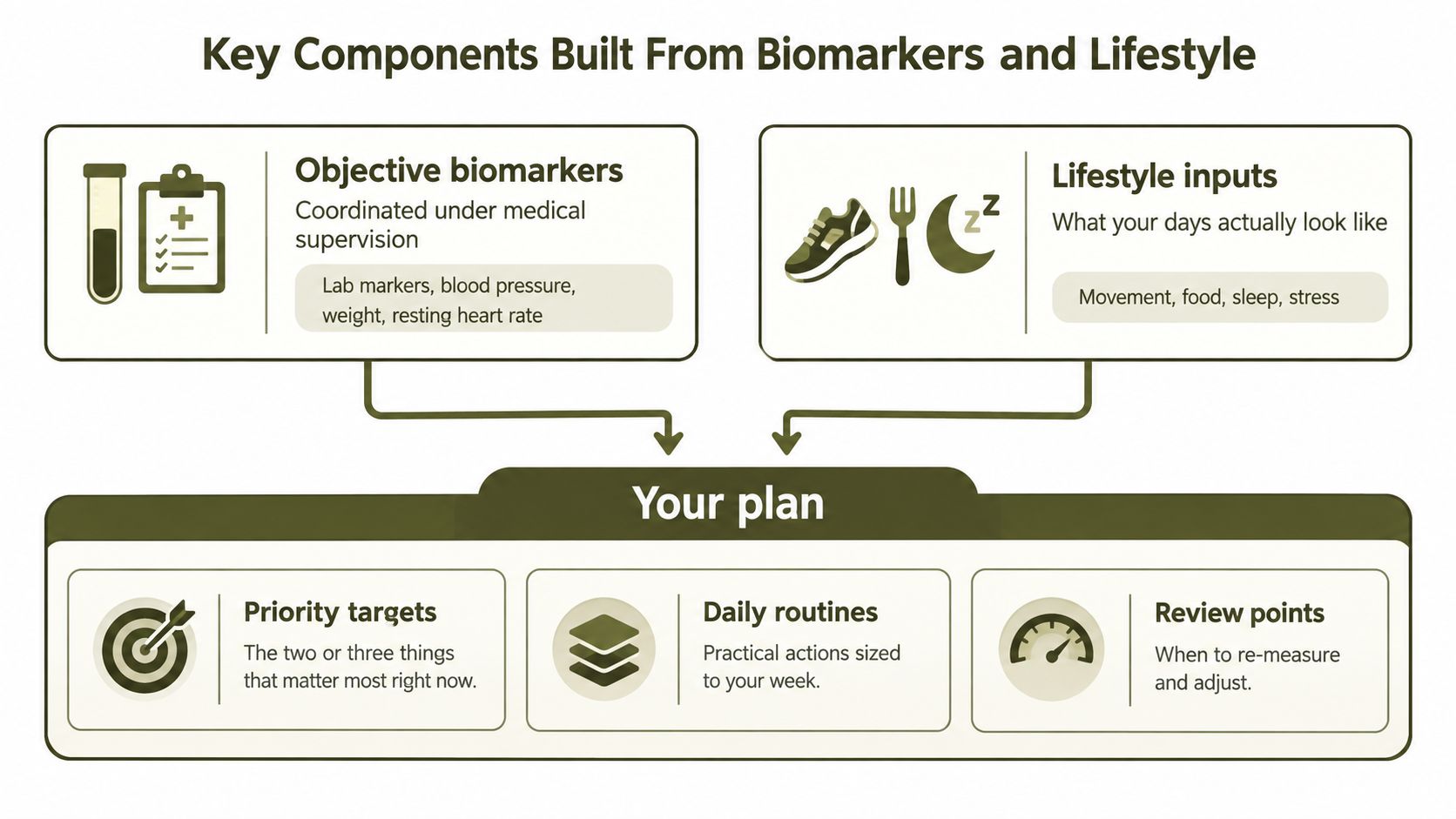
A practical plan draws from two input streams. The first is what can be measured more objectively. The second is what your days actually feel and look like. Neither stream is sufficient by itself.
Objective information may include blood pressure, weight, resting heart rate, and laboratory markers coordinated under medical supervision. If you're reviewing longevity blood testing, the value isn't in collecting an impressive panel. It's in connecting relevant results to a sensible question, such as whether a lifestyle change should be continued, refined, or discussed with a clinician.
Lifestyle information fills in the missing context. Record sleep timing and perceived sleep quality, daily energy, movement, nutrition patterns, stress, and how often you complete the intended routine. A blood-pressure reading may be useful, but it doesn't tell you whether you slept badly, rushed to the appointment, drank caffeine shortly beforehand, or missed several planned walks.
Turn inputs into decisions
The two streams should lead to a small number of plan components:
- Priority targets: Select the two or three outcomes that deserve attention first, such as sleep continuity, blood pressure, or daily energy.
- Daily routines: Translate each target into an action that fits your week, such as a short walk after lunch, a consistent wake time, or a planned meal at a predictable point in the day.
- Review points: Choose when you'll compare adherence with outcomes and decide whether to maintain, simplify, or change the routine.
A systematic review of 31 personalized mobile interventions involving 77,243 participants found improved lifestyle outcomes with a moderate pooled effect. The review also found a larger estimated effect when personalization used system-captured data, such as device-recorded activity or physiological measures, rather than user-reported data alone. Because the evidence was characterized as preliminary, objective tracking should guide refinement, not be presented as proof of disease prevention or treatment. The findings are detailed in this review of personalized mobile health interventions.
Make sleep a measurable target
Sleep is often reduced to a feeling, but it can also be tracked alongside cardiovascular measures. A systematic review and meta-analysis of 21 studies involving 688 participants found that behavioral sleep interventions for adults with poor sleep health reduced systolic blood pressure by an average of 4.91 mmHg, with substantial variation between studies, according to this review of behavioral sleep interventions and blood pressure.
For your plan, that could mean tracking consistent sleep timing, nighttime disruption, morning energy, and repeated blood-pressure readings under comparable conditions. If readings are abnormal, or if medication is involved, review the pattern with a qualified healthcare professional rather than changing treatment based on a wellness tracker.
Reading Your Numbers Without Overtrusting Them
More tracking doesn't automatically produce better decisions. A wearable may show a readiness score, recovery score, sleep score, or stress estimate with several decimal places of apparent precision. That presentation can make a consumer metric feel more authoritative than it is.
A 2025 evaluation found that wearable manufacturers generally didn't disclose the exact algorithms behind composite scores, while few provided peer-reviewed validation for those scores' accuracy or clinical relevance. A separate evidence map identified reliability, technical limitations, cost, privacy, user acceptance, and performance gaps as continuing barriers to broader wearable use, as summarized in this analysis of wearable health scores and evidence limitations.
Use an evidence hierarchy
Start with the measurement closest to the decision you need to make. A repeated, properly collected blood-pressure reading may be more useful for a cardiovascular conversation than a proprietary recovery score. A consistent sleep diary can add context to a wearable's sleep estimate. A lab result should be interpreted with medical context, not treated as a standalone verdict.
Use three filters:
- Look for trends: A pattern across comparable measurements is usually more informative than one unusually high or low result.
- Control the conditions: Note timing, recent exercise, caffeine, illness, travel, and sleep when collecting readings.
- Confirm surprises: Repeat an unusual reading and seek professional review when it remains abnormal, causes concern, or relates to symptoms or medication.
A low score may suggest that you need recovery, but it doesn't prove why. It might reflect a late night, a sensor problem, an unfamiliar device, or a genuine change in your health. Treat the score as a prompt for a question, not an instruction to panic.
Check adherence before changing the plan
A stalled result doesn't always mean the intervention failed. It may mean the routine was followed inconsistently, the target was poorly chosen, or the measurement is too noisy to interpret. Commercial health apps have reported median 90-day retention below 10%, and adherence can fall to approximately 6% after 30 days in some real-world settings, according to digital-health evidence on retention and implementation challenges.
Ask two questions before making a major change: “How often did I complete the intended action?” and “Did I measure the outcome under reasonably similar conditions?” If adherence was low, simplify the plan first. If adherence was high and the trend still concerns you, reassess with qualified support.
How to Get Started With Assessments and Professional Input
You don't need to redesign your entire life before you begin. A useful first week creates a baseline, identifies a priority, and builds a routine small enough to survive an ordinary disruption.
Follow a simple starting sequence
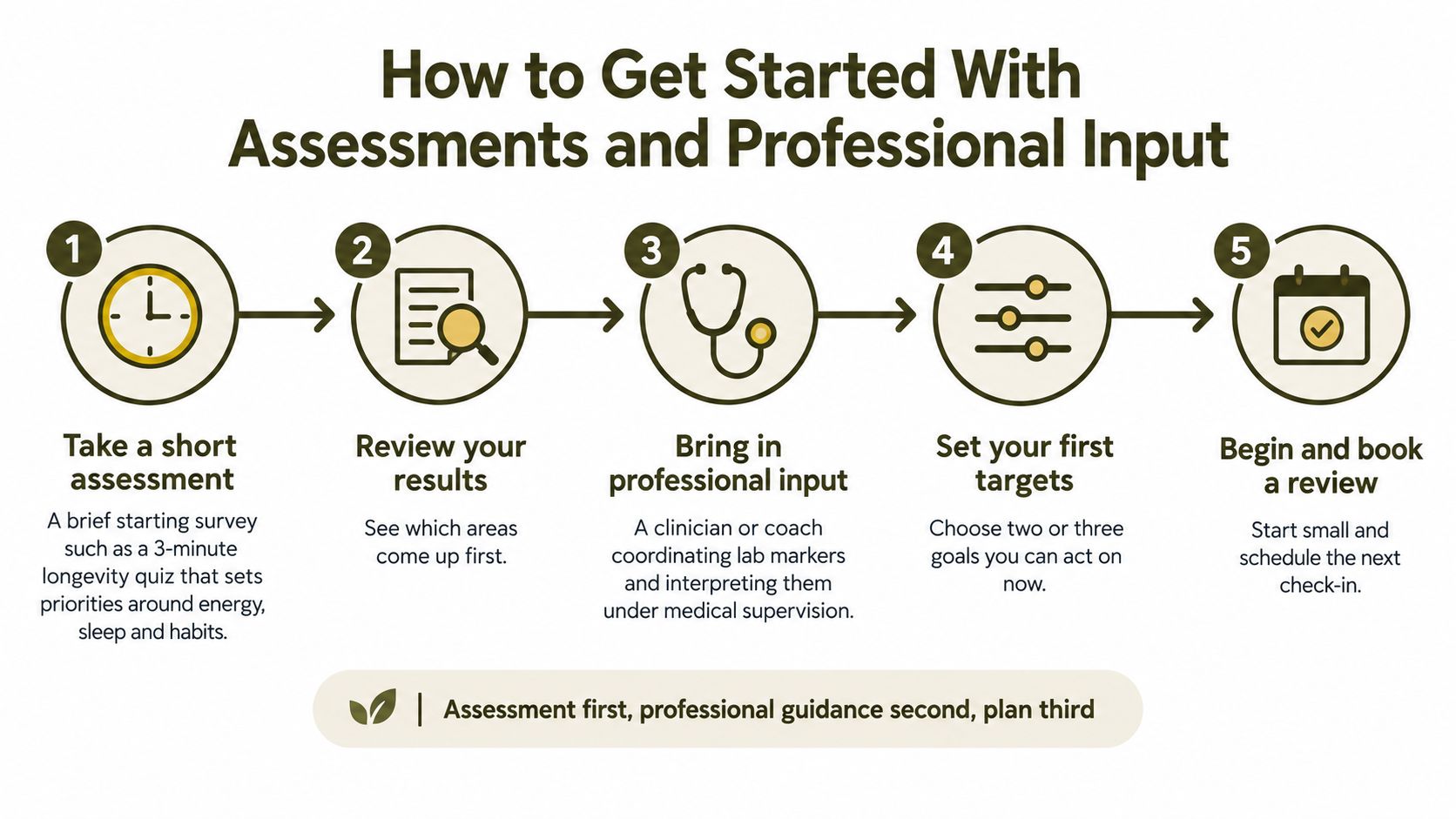
- Complete a brief assessment. A short survey, such as a three-minute longevity quiz, can help organize questions around energy, sleep, habits, and priorities. Treat the output as a starting point, not a diagnosis.
- Collect baseline information. Record your usual habits and relevant measures. Initial laboratory work should be coordinated under medical supervision, especially when results could affect clinical decisions.
- Choose a minimum-effective routine. Define the smallest version of the behavior that still moves you in the intended direction. Create a fallback for travel, caregiving, illness, or a stressful work period.
- Add professional interpretation when useful. A licensed nurse practitioner or other qualified professional can help place results in context and align the plan with your goals. Educational guidance doesn't replace your healthcare provider or urgent medical care.
- Book the review before you start. A fixed review date turns the plan into a process. Compare adherence, symptoms, lifestyle notes, and relevant markers, then keep, simplify, or adjust the routine.
An AI health coach or tracking tool can sit between consultations by helping you record actions, notice patterns, and remember the next review. It should support your decisions, not make medical diagnoses or turn every fluctuation into a new protocol.
The sequence can be summarized like this:
| Stage | What It Involves | What You Get |
|---|---|---|
| Assessment | A brief review of goals, habits, energy, and sleep | A starting set of priorities |
| Baseline | Lifestyle notes and medically supervised measurements where appropriate | A clearer picture of your current position |
| First routine | A small action with a fallback version for difficult weeks | A plan you can test in daily life |
| Professional input | Context for biomarkers, symptoms, and individual goals | Safer interpretation and better questions |
| Review | Comparison of adherence and trends at a planned check-in | A decision to maintain, simplify, or adjust |
The order matters. Assessment comes before measurement overload, professional interpretation comes before major medical conclusions, and the routine comes before optimization.
Use the video as another educational input, then return to your own baseline and constraints. A general explanation becomes useful only when it helps you choose an action you can repeat and a measurement you can interpret.
Building a Plan You Can Actually Keep
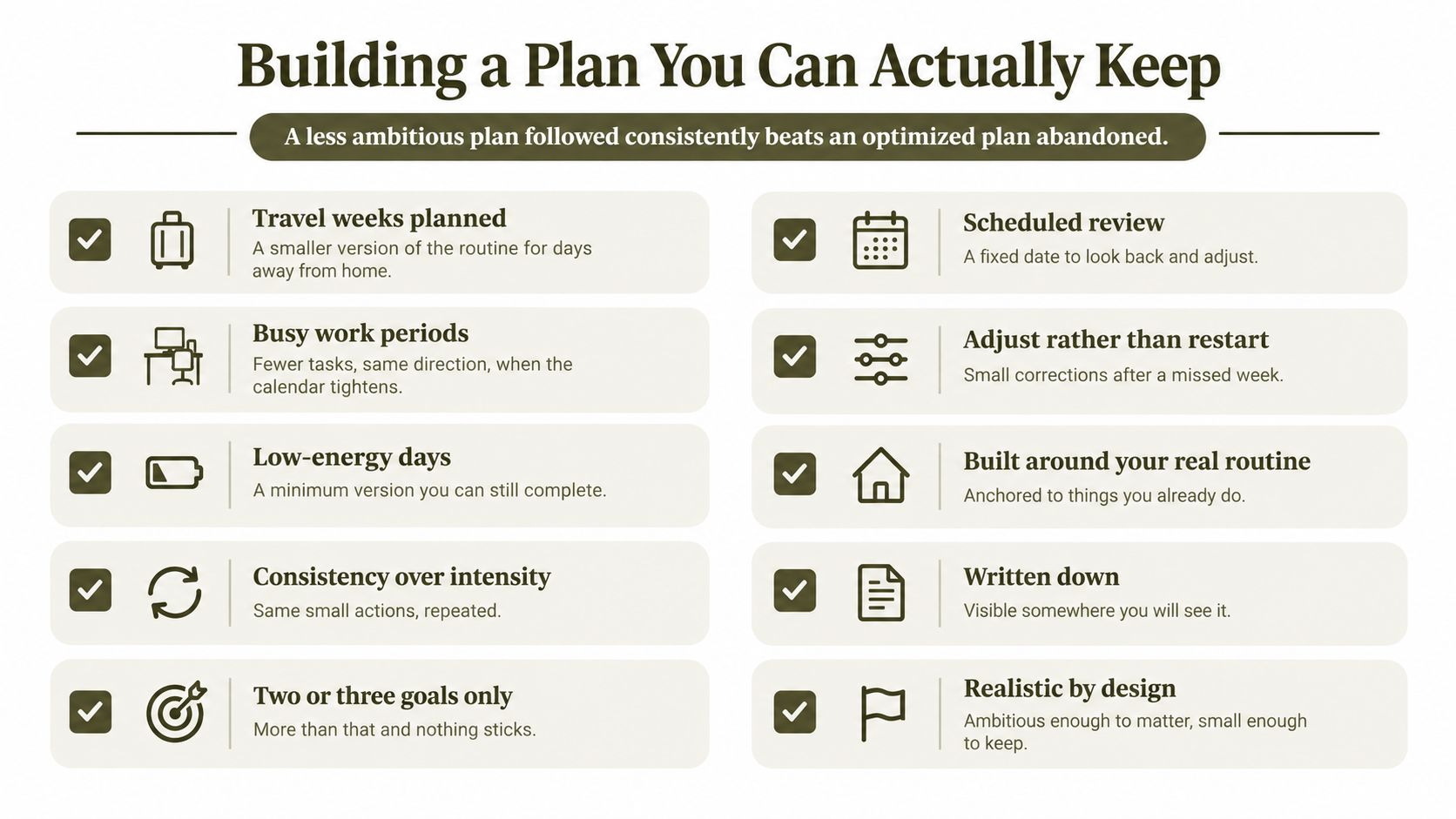
The most effective plan on paper is useless if travel, caregiving, work stress, or low energy makes it impossible to follow. A modest routine completed consistently can produce better information than an optimized protocol abandoned after a difficult week.
Adherence isn't a character trait. It's an outcome to measure and personalize. If you complete a routine only during calm weeks, the plan needs a disruption version, not a lecture about discipline. A walking plan might become a shorter indoor routine during travel. A carefully planned dinner might become a simpler repeatable meal during a deadline period.
Start this week with four decisions:
- Complete a brief assessment: Identify the priority that deserves attention first.
- Anchor one habit: Attach it to something already stable, such as waking, lunch, or closing your laptop.
- Choose one measurable marker: Track a relevant trend, such as sleep continuity, blood pressure, or completed routines.
- Schedule a reassessment: Pick the date when you'll review adherence and decide what changes.
Good habit formation depends less on perfect motivation than on a routine that still works when your circumstances change. Healthy aging is built through measurable steps, honest review, and small corrections over time.
Longwelle combines a brief longevity assessment with personalized wellness guidance, biomarker tracking, optional licensed nurse practitioner consultations, and tools for applying insights between reviews. Visit Longwelle to start with a structured baseline and build a wellness plan around your own goals, measurements, and real-world routine.