Learn
Formation of Good Habits That Actually Stick After 40
A research-backed guide to the formation of good habits for busy midlife adults, with practical steps for energy, sleep, and lasting daily routines.
The 21-day habit rule is wrong, and it has wasted years of effort for busy adults. You don't fail because you lack discipline when a new routine still feels awkward after three weeks. You fail when you choose a behavior that's too complex, attach it to an unreliable cue, and expect motivation to carry the load indefinitely.
The formation of good habits after 40 requires a different standard. Your work calendar changes, family responsibilities interrupt plans, sleep may become less predictable, and the routine that worked in your twenties may no longer fit your life. The practical question isn't, “How do I force myself through 21 days?” It's, “How do I design the cue and environment so the right action requires less thinking?”
Table of Contents
- Why the 21-Day Habit Rule Steers You Wrong
- What the Evidence Actually Says About Habit Timing
- Designing Cues and Habit Stacks That Trigger You
- Tracking Automaticity Instead of Just Streaks
- Engineering Your Environment to Do the Work
- Real Scenarios for Energy, Sleep, and Movement
- A 90-Day Plan and Knowing When to Adjust
Why the 21-Day Habit Rule Steers You Wrong
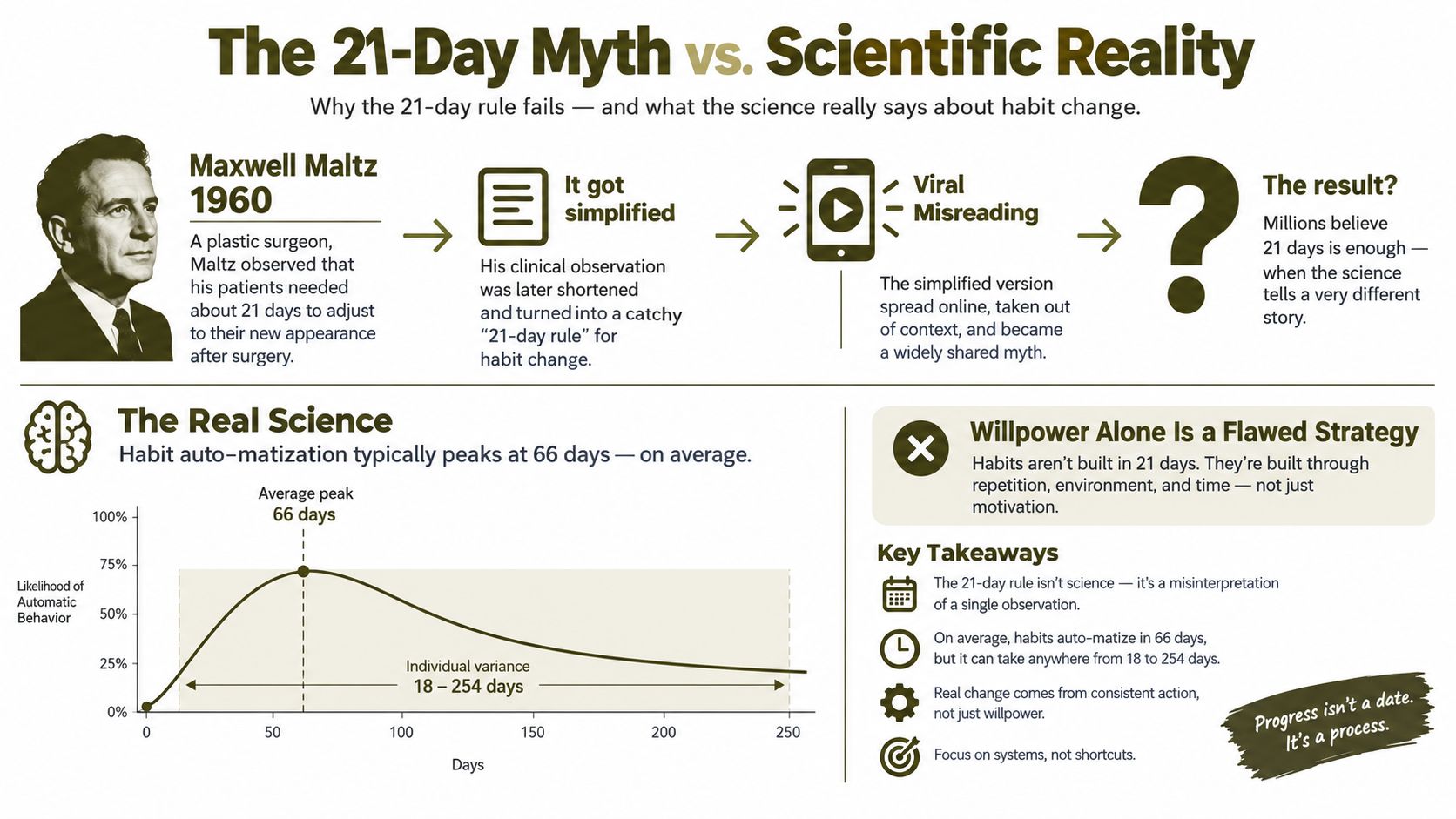
The familiar 21-day idea traces back to observations associated with plastic surgeon Maxwell Maltz, who noticed that patients often needed time to adjust to changes in their appearance or circumstances. That observation was later treated as a universal prescription for behavior. It wasn't a reliable timetable for building habits.
The problem gets worse when the myth joins the willpower narrative. Popular advice tells you to commit intensely, maintain a perfect streak, and prove your character through resistance. When the behavior still requires effort, you conclude that you're undisciplined. That diagnosis is usually wrong. The design is weak.
For a professional in midlife, the three-week finish line creates two predictable mistakes:
- You quit too early: The routine hasn't had enough repetition in a stable context, so you interpret normal effort as evidence that it isn't working.
- You blame motivation: You overlook the late meeting, the family interruption, the poor cue, or the excessive number of steps and label the problem a personal weakness.
Habit timing varies with the behavior, the context, and the person. Drinking water after an established meal cue is a simpler behavioral task than building a complete evening routine involving exercise, food preparation, screen limits, and sleep. A universal number can't account for that difference.
Practical rule: Stop asking whether you can survive 21 days. Ask whether your cue is obvious, your behavior is small enough to repeat, and your environment makes the action easier than avoidance.
The formation of good habits becomes more reliable when you remove daily negotiation. Put the walking shoes by the door. Attach mobility to brushing your teeth. Set the wind-down routine after skincare, not after an unpredictable work deadline. Less deliberation beats heroic effort.
What the Evidence Actually Says About Habit Timing
The evidence rejects the neat 21-day deadline. A landmark University College London study followed 96 adults repeating one daily behavior for 12 weeks. The median time to reach peak automaticity was 66 days, while estimated formation time ranged from 18 to 254 days, depending on the person and the behavior (University of Surrey summary of the study).
Use 66 days as a planning reference, not a finish line. Among participants whose data fit the model well, automaticity reached 95% of its asymptote after a median of 66 days. The practical message is clear: three weeks may start a routine, but it often does not make the behavior dependable (The Behavioral Scientist's explanation of the research).
The wider evidence supports a longer runway. A 2024 systematic review and meta-analysis of 20 studies involving 2,601 participants found that health-related habits typically took 2 to 5 months to develop. Individual formation times ranged from 4 to 335 days, and only 23% of participants reached the predefined habit-formation threshold (systematic review and meta-analysis.
Habit timing evidence at a glance
| Study / Behavior | Reported Range | Typical Timing | Practical Implication |
|---|---|---|---|
| Lally-style real-world health behaviors | 18 to 254 days | 66-day median | Plan beyond three weeks and expect variation |
| 2024 review of health-related habits | 4 to 335 days | Around 2 to 5 months | Reserve several months, especially for complex behaviors |
For adults over 40, behavior complexity matters more than an arbitrary countdown. A simple morning walk may become more automatic during a 6 to 8 week commitment window. A multi-step sleep routine can take substantially longer because it contains more actions and more opportunities for disruption. Treat these examples as planning horizons, not promises.
Set the review point after enough repetition to judge the system fairly. If the behavior still requires constant decisions, the problem may be its design, not your discipline.
Track automaticity alongside attendance. Do you remember the behavior without prompting? Does it require less effort? Can you resume quickly after a disrupted day? A streak records what happened. Automaticity shows whether the routine is taking hold.
Designing Cues and Habit Stacks That Trigger You
Motivation is a poor daily operating system. Cues are the more effective tool because they tell your brain when and where the behavior belongs. A useful habit loop connects a cue to a routine and gives you an immediate or meaningful reward.
Start by choosing one cue type:
- Time: “At 8 a.m.” works when your mornings are stable.
- Location: “When I enter the kitchen” can work better than a clock time for a flexible schedule.
- Preceding action: “After I pour coffee” links the new behavior to something already established.
- Emotional state: “When I notice work stress” can trigger a breathing routine, but it's less reliable because emotional cues are harder to predict.
For most adults with crowded calendars, a preceding action or location is the strongest starting point. Use the habit-stacking formula: “After I [existing habit], I will [new behavior].”
Example: After I pour my morning coffee, I will stand and do 10 air squats.
Keep the new behavior immediate and specific. “Improve my fitness” is not a cue-ready action. “Do 10 air squats beside the kitchen counter” is. You should know exactly what starts the routine, where you'll do it, and when it ends.
Make the stack difficult to skip
Place the new action directly after the anchor. If you pour coffee, check email, answer messages, and then hope to remember the air squats, you've built a gap wide enough for avoidance. Put the behavior before the next decision.
Write the commitment in advance:
After I pour my coffee, I will place the mug down, stand beside the counter, and complete 10 air squats before opening my phone.
Prepare the environment so the cue is visible. Leave a yoga mat where you can see it, keep the shoes at the door, or place the water bottle beside the coffee machine. If the anchor is unreliable, add a backup cue. A morning walk can attach to coffee on normal days and to putting on work shoes on rushed days.
For more practical routine ideas, review Longwelle's routines. The point isn't to copy someone else's schedule. It's to select one behavior that fits your existing life and give it a clear trigger.
This short video offers another visual explanation of how cue-driven routines work:
Tracking Automaticity Instead of Just Streaks
A streak can look impressive while hiding a fragile routine. You may complete a behavior only because you keep reminding yourself, negotiating with yourself, and forcing the action through resistance. That isn't failure, but it isn't automaticity either.
Use a simple weekly self-rating inspired by the Self-Reported Habit Strength Index. Once a week, score the behavior from 0 to 10 using three questions:
- How automatic did the behavior feel?
- How little effort did it require?
- How often did you find yourself doing it without consciously deciding?
Average your answers or use your overall impression. Keep the assessment weekly rather than turning every repetition into a judgment.
| Score Band (0-10) | What It Means | Action to Take |
|---|---|---|
| 0 to 3 | The behavior still feels effortful and depends on reminders | Shrink the action, strengthen the cue, or change the anchor |
| 4 to 6 | The routine is consolidating but remains vulnerable to disruption | Keep the same stack and remove friction |
| 7 to 10 | The behavior feels largely automatic in its established context | Maintain it and consider adding a carefully chosen next step |
A low score isn't a verdict. It's a design signal. If the routine stays below 3, don't add complexity. Move the cue, reduce the duration, or choose a behavior that fits the context better. If the score reaches the upper band, test the habit during a mildly disrupted day before expanding the stack.
A tool such as the Longwelle AI health coach can help you apply structured prompts between routine reviews. Use any tool as a feedback aid, not as a substitute for your own observation.
Automaticity matters more than a perfect calendar. A chaotic week tests whether the cue and context can carry the behavior when motivation drops. Your review should tell you what to repair before you add another target.
Engineering Your Environment to Do the Work
After 40, friction usually beats discipline. You might intend to walk, but the shoes are buried in a cupboard. You might plan a nutritious breakfast, but the blender is stored behind heavy cookware. You might want better sleep, but your phone stays beside the bed and invites one more check.
Redesign the physical environment before you demand more from yourself. Put the blender on the front counter. Place walking shoes beside the exit. Pre-portion supplements if that action is part of your established plan. Move the phone to another room after 9 p.m. Each change removes a decision from the moment when your energy is lowest.
Build a commitment window
Use a 6 to 8 week commitment window rather than a short challenge. In a large analysis of habit-building attempts, commitments lasting 6 to 8 weeks, weekly reporting to an external referee, and a monetary stake were among the most successful design features (ICWSM habit-building analysis).
You don't need an elaborate contract. Choose one accountability structure:
- A weekly referee: Send a brief Sunday message to a friend or coach.
- A visible record: Keep a shared log that makes missed cues easy to spot.
- A meaningful stake: Put money on the line with a person you trust and define the condition clearly.
The Sunday review should take only a few minutes. Ask, “Which cue worked?” and “Which cue got skipped?” Then change one environmental detail, not the entire plan.
Generic morning routines fail because they assume your mornings are predictable and your priorities match someone else's. Pure motivation fails because it treats every repetition as a fresh character test. A well-designed environment gives the behavior a physical advantage.
Start with one habit. Earn complexity through stability. If you attempt multiple habits, understand that simultaneous attempts can struggle early, even though those that survive the initial phase may become more successful according to the same analysis. Don't interpret an overloaded start as ambition. Interpret it as a cue-management problem.
Real Scenarios for Energy, Sleep, and Movement
A 44-year-old consultant wanted a dependable sleep routine, not another complicated evening protocol. She connected a 10-minute wind-down to her nightly skincare routine, placed the book and sleep mask beside the sink, and treated late calls as a predictable design problem rather than a personal failure.
During a week of late meetings, the original cue disappeared. She added a backup cue, changing into sleep clothes, and completed a shorter version of the wind-down before opening her laptop again. Her weekly review showed that the behavior wasn't the problem. The unstable transition was.
A 51-year-old father used a 7 a.m. walk after his coffee routine. A flu week interrupted the pattern, and he initially assumed he had lost all progress. He hadn't. He restored the stack by returning to the same coffee cue, shortening the first walks, and keeping his shoes beside the door.
The weekly automaticity review exposed the core issue: the cue had vanished during illness. He changed the trigger instead of restarting his identity as “someone who can't stay consistent.” Within 10 days, he had returned to his prior baseline, according to the scenario's tracking plan. That is the correct response to disruption. A failed week resets the clock, not the habit.
For adults trying to understand persistent fatigue, this guide to why you may be tired can help you consider sleep, recovery, and lifestyle factors alongside your routine design. Habit work shouldn't encourage you to ignore symptoms that need professional attention.
Two cues deserve more attention than they receive: light exposure and a consistent wake time. They can anchor the morning and make the rest of the day easier to organize. Start with the cue you can control most reliably, then build outward.
A 90-Day Plan and Knowing When to Adjust
Treat the first 90 days as a systems test, not a test of personal worth. You're collecting evidence about which behavior fits, which cue survives pressure, and which environmental changes reduce effort.
Days 1 through 14
Choose one cue-stacked behavior. Make it small enough to complete on a difficult day. Write the exact sequence, prepare the environment, and record whether the cue appeared and whether you acted.
Don't add a second target because the first week felt easy. Early ease may reflect novelty, favorable circumstances, or excess effort. Let the routine show you where it breaks.
Days 15 through 42
Keep the same behavior and add reinforcement. Use an immediate reward that doesn't undermine the goal, such as a favorite coffee after a walk or a satisfying checkmark after completing the wind-down. Rate automaticity once a week using the three-question scale.
At week 6, schedule a 30-minute review. Ask:
- Which cue produced the most reliable response?
- Where did the routine fail?
- Did the behavior remain appropriately small?
- What friction can you remove before changing the target?
Days 43 through 70
If the first behavior scores consistently in the upper range and survives ordinary disruptions, expand the stack carefully. Add duration, frequency, or one adjacent behavior, not all three. If the score remains low, redesign the cue instead of increasing pressure.
Days 71 through 90
Stress-test the system against travel, deadlines, family demands, or a disrupted sleep schedule. Define a minimum version that preserves the pattern when the full routine isn't possible. At week 12, conduct another 30-minute review and decide whether to consolidate, simplify, or restart the cycle with a better-designed behavior.
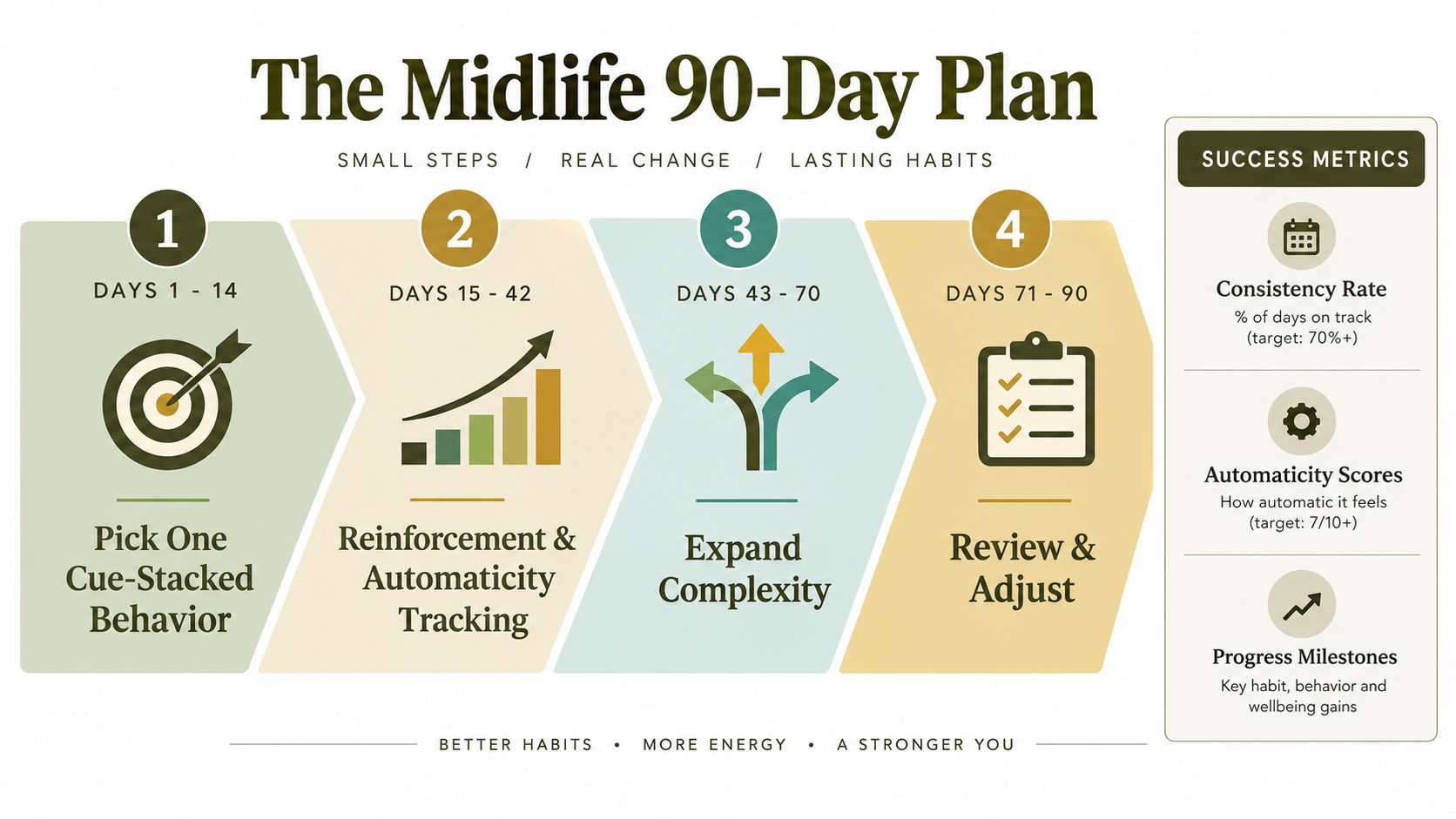
Pivot when the evidence tells you to pivot. Missing the cue three days in a row, remaining below an automaticity score of 3, or seeing sleep and energy trend worse means the plan needs adjustment. It doesn't mean you need harsher discipline.
The formation of good habits is a process of cue testing, environmental engineering, repetition, and review. Enter day 91 with a system you understand, not a streak you're afraid to defend.
Longwelle helps adults over 40 turn longevity goals into structured routines, with personalized guidance, biomarker tracking, and optional access to licensed nurse practitioners. Take the Longwelle assessment and use the results to choose one measurable habit worth building next.