Learn
What Is Longevity Medicine? a 2026 Guide
What is longevity medicine? Learn how it defines scope, evidence, biomarkers and tests, and how it complements wellness services like Longwelle.
Longevity medicine is a personalized, preventive approach that measures biological aging through repeated biomarker and functional testing to extend healthspan, not just lifespan, using a field where 14 biomarkers reached agreement in a 2025 consensus effort rather than relying on one gold-standard test. If your annual bloodwork looks normal but your energy, sleep, recovery, or concentration has shifted without notice, this distinction explains why a conventional checkup may not answer every question about your future health.
You may recognize the situation. You're in your 40s or 50s, your basic results come back within the expected range, and there's no obvious diagnosis to treat. Yet workouts take longer to recover from, sleep feels less restorative, and the same workload leaves you more depleted than it once did.
Longevity medicine responds by asking a different question: How is your health changing over time, and what can you do before a serious problem becomes obvious? It combines clinical prevention, biomarker monitoring, physical-function assessment, and targeted lifestyle changes. It isn't a promise of immortality, and it isn't a license to order every available test.
The important qualification is that the field isn't fully standardized. A practical longevity guide can help you understand the terminology, but decisions about symptoms, diagnoses, medication, or treatment belong with an appropriately qualified healthcare professional.
Table of Contents
- Why Longevity Medicine Is Suddenly Everywhere
- Biological Age Versus Chronological Age
- What the Evidence Base Actually Shows
- Common Tests and Interventions in Practice
- Why Longevity Clinics Vary So Widely
- How Longevity Wellness Services Complement Clinical Care
- What to Do With This Understanding
Why Longevity Medicine Is Suddenly Everywhere
The appeal is easy to understand. A normal annual panel can reassure you that nothing urgent has appeared, but it may not explain why your stamina has changed or whether several modest shifts are moving in an unfavorable direction. Longevity medicine tries to make those patterns visible earlier by combining measurements and repeating them over time.
The working definition: Longevity medicine is personalized preventive care that tracks biological aging and healthspan, not simply the number of years someone has lived.
A protocol may bring together blood chemistry, inflammation, metabolic health, physical function, and molecular markers. The aim is to identify risks, establish priorities, and see whether a practical intervention is associated with a better trend. That last part matters. A single result is a snapshot. A series of results can show direction.
The field has also adopted more advanced language, including deep biomarkers of aging, digital phenotyping, and AI-supported risk assessment. These tools may help clinicians detect patterns earlier, but they don't turn an uncertain measurement into a diagnosis. The evidence is strongest when testing supports a clear clinical question and a sensible action.

The honest answer to “what is longevity medicine” therefore has two parts. It's a serious attempt to move prevention earlier and make it more individualized, but it's also a developing field where providers may offer very different tests and interventions. The useful question isn't whether a program sounds futuristic. It's whether the measurement is meaningful, whether the response is appropriate, and whether progress will be checked over time.
Biological Age Versus Chronological Age
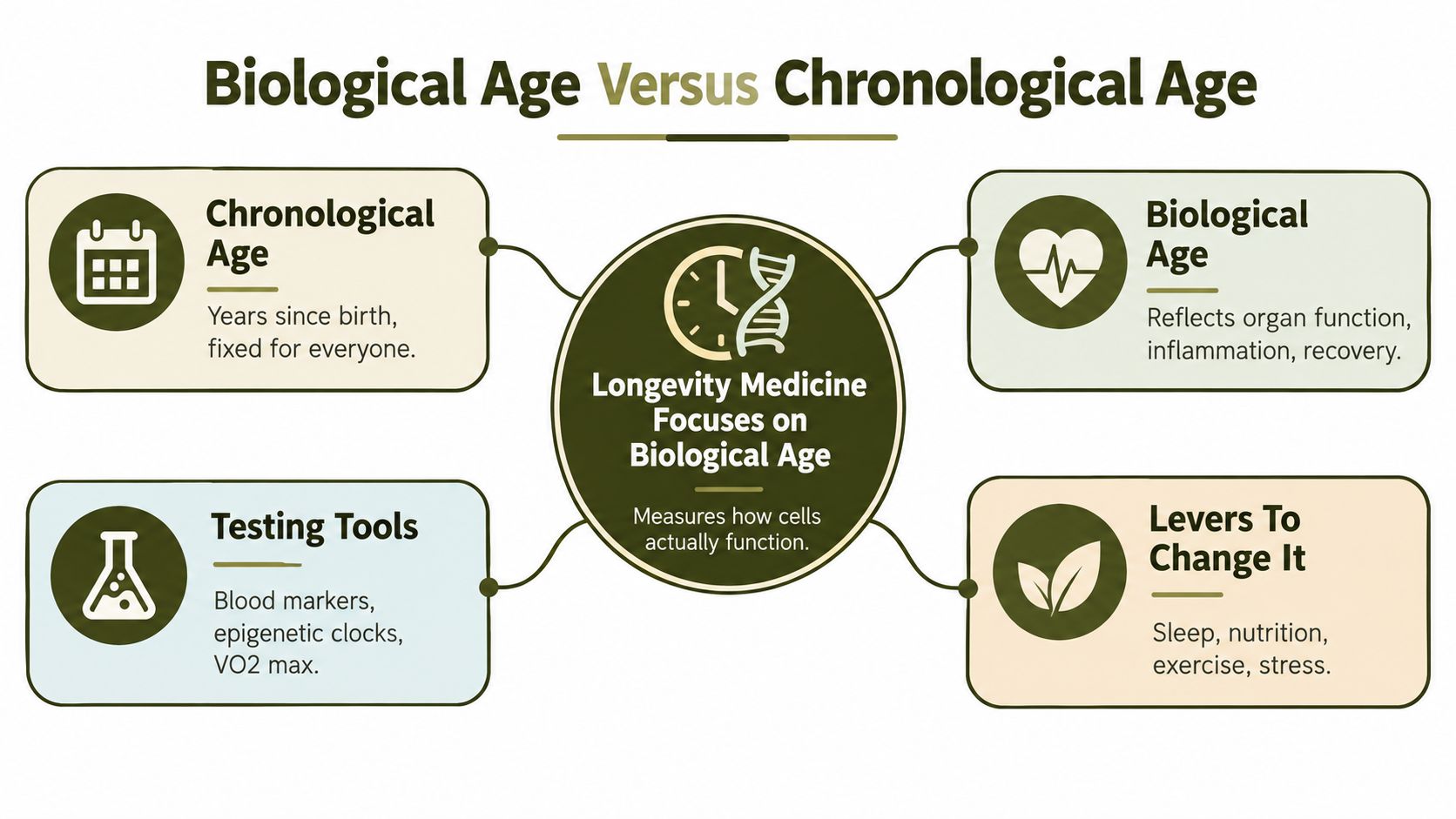
Chronological age is straightforward. It's the number of years since birth, and it advances at the same pace for everyone. Biological age is an estimate of how your body is functioning relative to expected aging patterns. It may draw on physiological, inflammatory, functional, or molecular information.
Consider two people who are both 50. One may have strong physical function, favorable metabolic results, good recovery, and stable cognitive performance. The other may have poorer fitness, increasing inflammation, declining strength, and a pattern of results that suggests higher future risk. Their calendars show the same age, but their health trajectories may not look alike.
That difference is why longevity medicine treats biological age as potentially more informative than chronological age. A recent review of personalized longevity medicine describes the field as using biomarkers, digital phenotyping, and AI-supported risk assessment to shift from disease management toward earlier detection and individualized prevention.
Why trends matter more than a score
A biological-age score can be useful as a communication tool, but it shouldn't become the entire clinical decision. Different tests measure different aspects of aging, and no score captures every relevant dimension of health.
Longevity medicine therefore favors longitudinal tracking. Repeated measurements can help answer practical questions:
- Direction: Is a marker stable, improving, or worsening?
- Context: Does the result fit your symptoms, medical history, and physical function?
- Action: Is there a reasonable intervention that follows from the finding?
- Review: Does the next measurement support the decision or call for a change?
A normal result today doesn't guarantee a favorable trajectory. Conversely, an isolated result outside a reference range doesn't automatically prove accelerated aging. The value comes from interpreting several domains together and connecting them to decisions that are safe and clinically appropriate.
A short visual explanation can make the distinction easier to grasp:
What the Evidence Base Actually Shows
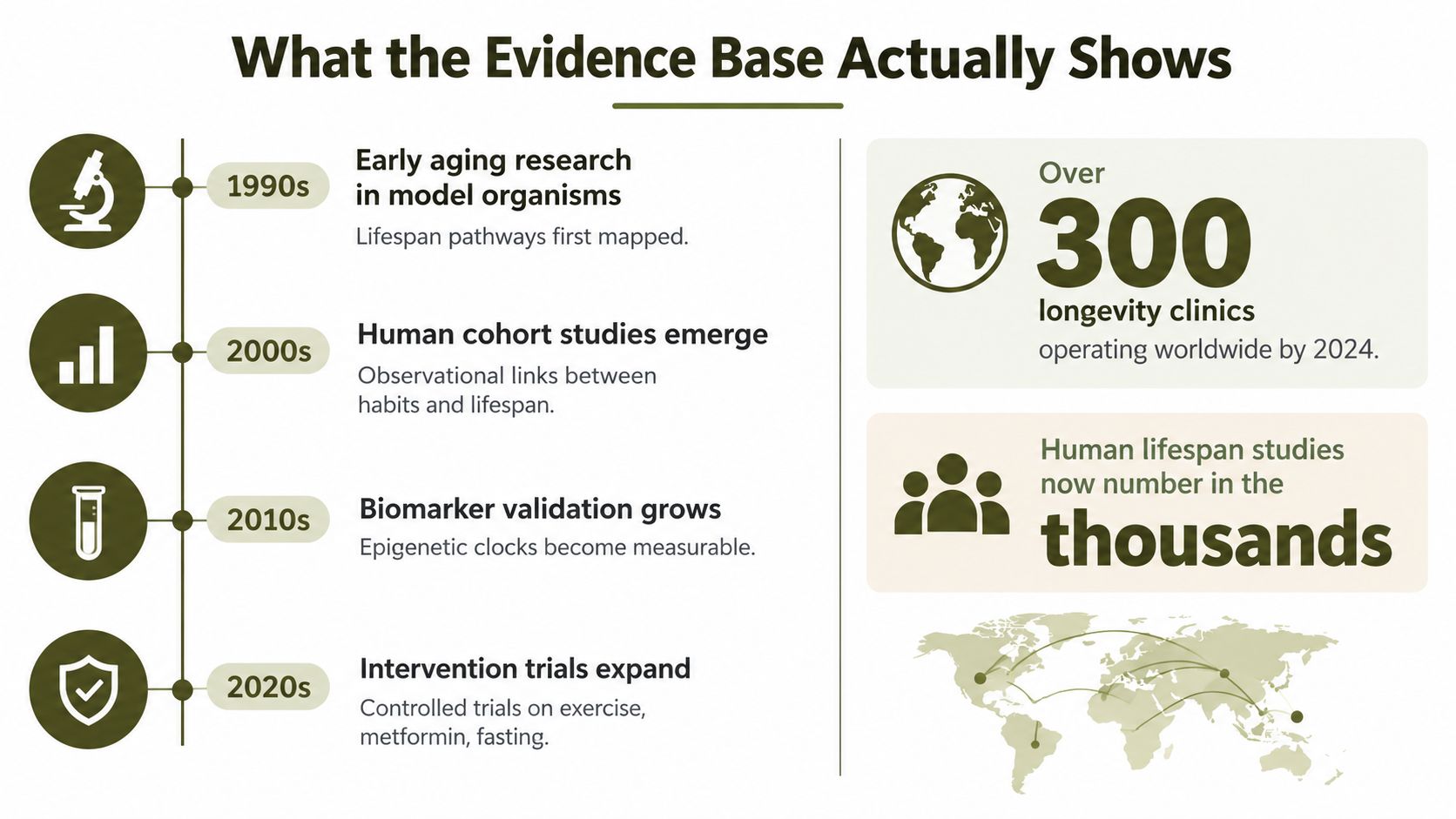
The research foundation developed alongside geroscience, the study of biological processes associated with aging, and the growing use of blood biomarkers. During the 2010s and 2020s, researchers increasingly used omics technologies to examine aging through several lenses, including epigenetic, proteomic, metabolomic, and lipidomic profiling.
A 2023 review of biomarkers and healthy aging described a shift away from a purely disease-centered model toward healthy-aging promotion. It also noted that DNA methylation clocks can predict disease outcomes and mortality. That doesn't mean a clock can tell an individual exactly how long they'll live. It means researchers are investigating whether molecular patterns can help estimate risk before conventional disease endpoints become visible.
From individual markers to combined signatures
The research increasingly reflects the complexity of aging. In the Long Life Family Study, researchers analyzed 19 blood biomarkers in 4,704 people aged 30 to 110 and identified 26 biomarker signatures, with 10 predicting different risks of morbidity and mortality. Those figures are important because they show the method behind modern longevity research: investigators combine multiple signals rather than treating one lab value as a complete measure of aging.
Another study examined 18 blood biomarkers in 4,961 adults aged 50 and older and combined them into signatures associated with long-term health outcomes, as described in the same review. These studies don't prove that every commercial biological-age panel improves health. They do explain why repeated, multi-marker monitoring has become central to the field.
The sensible interpretation is measured optimism. Biomarkers can support earlier risk assessment and better questions, but they still require clinical context. A test is not the same thing as a proven intervention, and an association between a marker and an outcome doesn't establish that changing the marker will necessarily change the outcome.
Common Tests and Interventions in Practice
A responsible longevity assessment usually looks across several domains because aging is too complex for one measurement to describe. The categories below aren't a universal checklist. They're a way to understand what a provider is attempting to measure and where the limits are.
| Domain | What it looks at | What it can and cannot tell you |
|---|---|---|
| Blood chemistry and metabolic markers | Patterns related to general physiology and metabolic risk | Can identify signals that deserve attention, but a result needs medical context and doesn't diagnose biological aging on its own |
| Inflammatory markers | Signals associated with inflammatory activity | May add context to broader risk assessment, but doesn't identify one universal cause or predict an individual outcome with certainty |
| Physical function | Strength, fitness, mobility, and recovery-related performance | Shows how the body is functioning now, but performance can be affected by training, injury, sleep, and other factors |
| Molecular and epigenetic markers | Molecular patterns associated with aging biology | Can contribute to research and risk assessment, but a biological-age estimate isn't a complete health evaluation |
| Digital and behavioral data | Sleep, activity, routines, and other longitudinal wellness signals | Helps reveal patterns between appointments, but consumer devices and self-reported data have limitations |
The strongest practical use of testing is usually prioritization. If results and reported habits point toward poor recovery, the next step may involve sleep routines, training load, or clinical evaluation rather than another exotic supplement. If metabolic risk appears important, a clinician may decide that established prevention and follow-up matter more than a branded age score.
What interventions usually mean
The intervention side commonly includes structured changes to movement, nutrition, sleep, stress management, and daily routines. A clinical program may also address diagnosed risk factors with standard medical care. The defining feature isn't novelty. It's the connection between a finding, a decision, and a follow-up measurement.
A 2016 review concluded that no single biomarker or tool can validly and specifically measure healthy aging, because aging involves multiple interacting processes. A 2025 expert consensus effort reached agreement on 14 biomarkers across physiological, inflammatory, functional, and epigenetic categories, which supports a multi-domain approach rather than one definitive test.
Practical rule: Ask what a test can change. If the answer is unclear, collecting the result may create more anxiety than useful information.
Why Longevity Clinics Vary So Widely
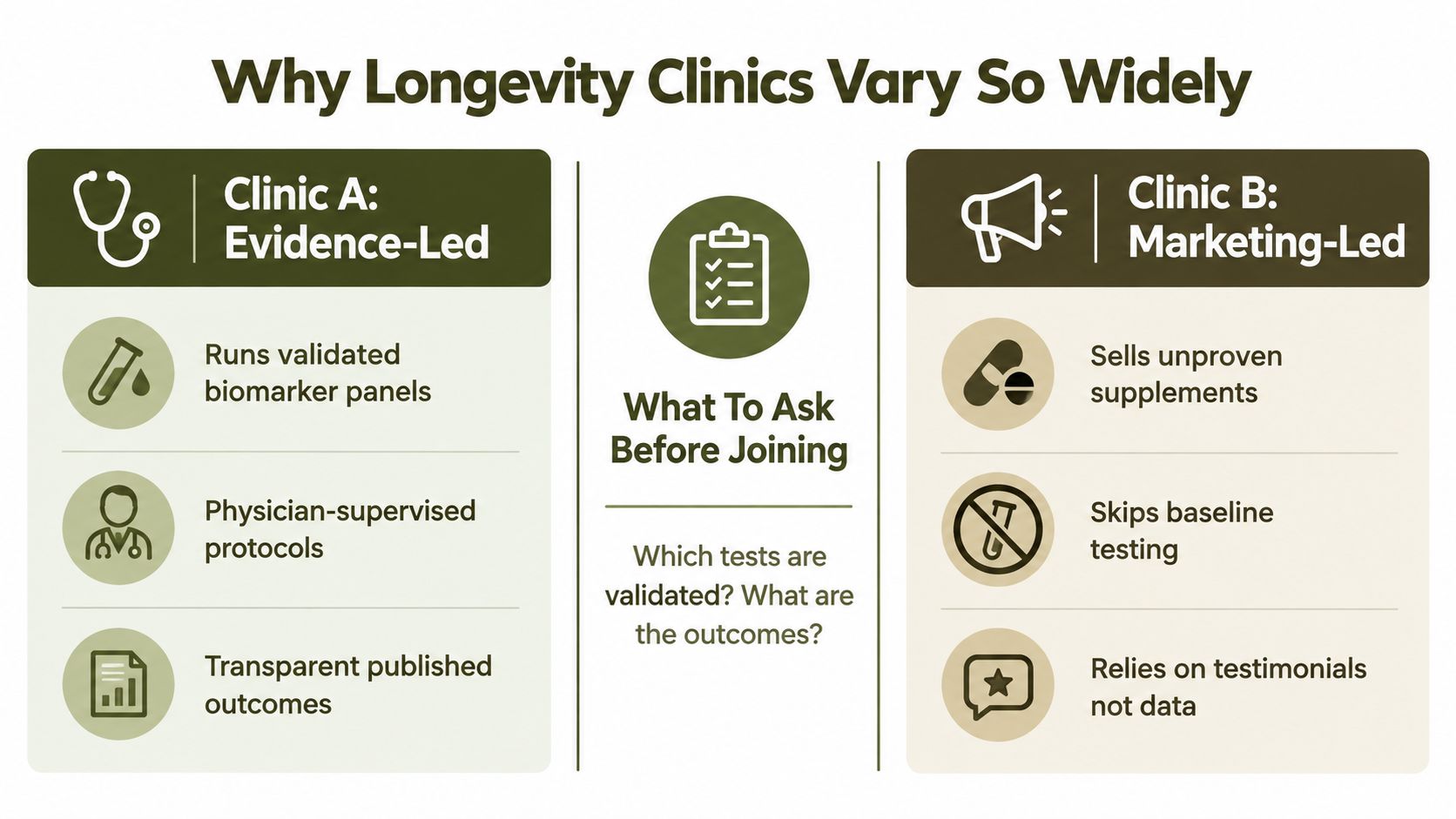
Longevity medicine can sound standardized when it's described through polished panels, dashboards, and biological-age scores. In practice, the experience may differ substantially from one clinic to another. The field includes conventional preventive monitoring, experimental approaches, and services that make claims stronger than the available evidence supports.
A 2025 global survey of longevity clinics examined 82 clinics and reported that more than a third offered stem cell treatments despite no clear clinical evidence of benefit. The survey also found that cognitive assessment appeared in fewer than 60% of clinics, even though the assessment was described as inexpensive and well-validated. It reported broad variation in diagnostic methods and intervention protocols, alongside inconsistent formal training in longevity medicine.
That doesn't make every longevity clinic unreliable. It does mean the label alone can't tell you whether a service is rigorous.
A useful way to sort the options
When you compare providers, classify each offering by the quality of its evidence and the role it plays in decision-making.
- Evidence-backed monitoring: Look for a clear medical history, appropriate baseline assessment, validated measurements, professional interpretation, and scheduled follow-up.
- Plausible but unproven add-ons: Treat novel biological-age scores, supplements, devices, and experimental protocols as uncertain unless the provider explains their limitations and the evidence behind them.
- Unsupported promises: Be cautious when a service guarantees reversal of aging, presents testimonials as proof, or recommends invasive treatment without a clear clinical rationale.
A trustworthy provider should be able to explain why each test is being ordered, what a result could mean, and what happens if the result is abnormal. You should also know who is qualified to interpret it and whether the service is diagnosing or treating a medical condition.
Questions to ask before joining
- Which tests are validated for the decision being made?
- Who reviews abnormal results or symptoms?
- Which recommendations are standard care, and which are experimental?
- How will progress be measured over time?
- What happens if you need a diagnosis or treatment outside the program?
The best answer may sometimes be that you need your primary clinician or a specialist rather than a longevity package. That kind of boundary is a strength, not a weakness.
How Longevity Wellness Services Complement Clinical Care
Clinical longevity medicine and non-clinical longevity wellness services can sit alongside each other, but they aren't interchangeable.
A clinical service may evaluate symptoms, diagnose disease, prescribe treatment, interpret medically significant results, and coordinate care under a licensed professional's responsibility. A wellness service generally focuses on education, structured routines, behavior change, and tracking selected wellness markers. It can help you organize information and follow through, but it shouldn't replace medical care when you have symptoms or abnormal findings.
That distinction is useful for busy professionals who want a practical starting point without assuming they need an intensive medical program. A brief assessment can identify lifestyle priorities, while educational material can translate technical research into decisions about sleep, exercise, nutrition, and recovery. If lab testing is included, you should understand who supervises it and who is responsible for interpreting clinically significant results.
One example is a service that combines a three-minute longevity quiz, personalized educational insights, coordination of initial lab work and ongoing biomarker monitoring under medical supervision, and optional consultations with licensed nurse practitioners. Its AI health coach and guided tools can help people apply routines between consultations, while progress tracking can organize changes in wellness markers over time. The service remains a wellness and education layer, not a substitute for diagnosis or treatment.
The AI health coach can be understood in that limited, practical role. It may help turn priorities into daily actions and make information easier to use, but it can't examine you, rule out serious disease, or independently authorize medical treatment.
Seek clinical care promptly for new, persistent, or worsening symptoms, and use a qualified healthcare professional for medication decisions, abnormal test results, and suspected disease. Wellness support works best when it improves preparation and consistency around care, rather than pretending to be care itself.
What to Do With This Understanding
Longevity medicine is personalized preventive care built around biological aging, repeated measurement, and healthspan, not a single score or miracle intervention. Two facts should guide your decisions: there's no universally accepted gold-standard test for healthy aging, and real-world clinics vary widely in what they measure and recommend.
Start with your goal. Do you want help understanding fatigue, sleep, fitness, or metabolic risk? Do you need diagnosis or treatment, or would education and routine support be a useful first layer? Then ask any provider which assessments are validated, who interprets them, and how the program distinguishes established care from experimental add-ons.
Structured longevity routines can make evidence-informed habits easier to apply, but the meaningful outcome is a trend over time, not a dramatic number on one report. Choose a program that helps you make sensible decisions, monitor what matters, and involve clinical care when the situation requires it.
Longwelle offers a brief longevity assessment, personalized educational guidance, structured routines, biomarker tracking, and optional access to licensed nurse practitioners under medical supervision. Visit Longwelle to identify practical healthspan priorities and decide whether a wellness and monitoring approach fits your next step.