Learn
Functional Health Testing: What It Covers and Why It Matters
Learn what functional health testing covers including panels and biomarkers, how results inform personalized wellness plans, and best practices

You wake up tired despite a full night in bed, lose focus halfway through the afternoon, and start wondering whether the problem is stress, sleep, diet, hormones, or just age. One source recommends more protein, another suggests cutting carbohydrates, and a third promotes an expansive panel of “optimal” biomarkers. Your routine checkup may not explain the symptoms, yet a consumer testing report can leave you with a list of abnormal-looking results and no clear next step.
Functional health testing can bring useful structure to that uncertainty. It uses measurable biological indicators, including laboratory values, physiological measures, and molecular signals, to describe health status, risks, or responses to an intervention. The important question isn't how many markers a panel includes. It's whether the measurements are reliable, clinically meaningful, and connected to an action that can help you.
Table of Contents
- Why Functional Health Testing Matters Now
- Understanding Functional Health Testing and Biomarkers
- What Types of Tests Are Available and When to Use Each
- How Test Results Inform Personalized Wellness Plans
- Common Misconceptions About Functional Testing
- Best Practices for Longitudinal Monitoring
Why Functional Health Testing Matters Now
Midlife often creates a confusing gap between how you feel and what a standard appointment appears to show. You may report declining energy, disrupted sleep, or brain fog, while the conversation ends with general advice to exercise more, reduce stress, or improve your diet. That advice might be sensible, but it doesn't explain which change deserves priority for your body and circumstances.
Functional health testing offers a measurement-based starting point. A result can help you ask whether a symptom deserves follow-up, whether a lifestyle change is affecting a relevant marker, or whether an apparent change is probably temporary. It doesn't replace diagnosis, and it can't turn every vague symptom into a single “root cause.” It can, however, make health decisions less dependent on guesswork.
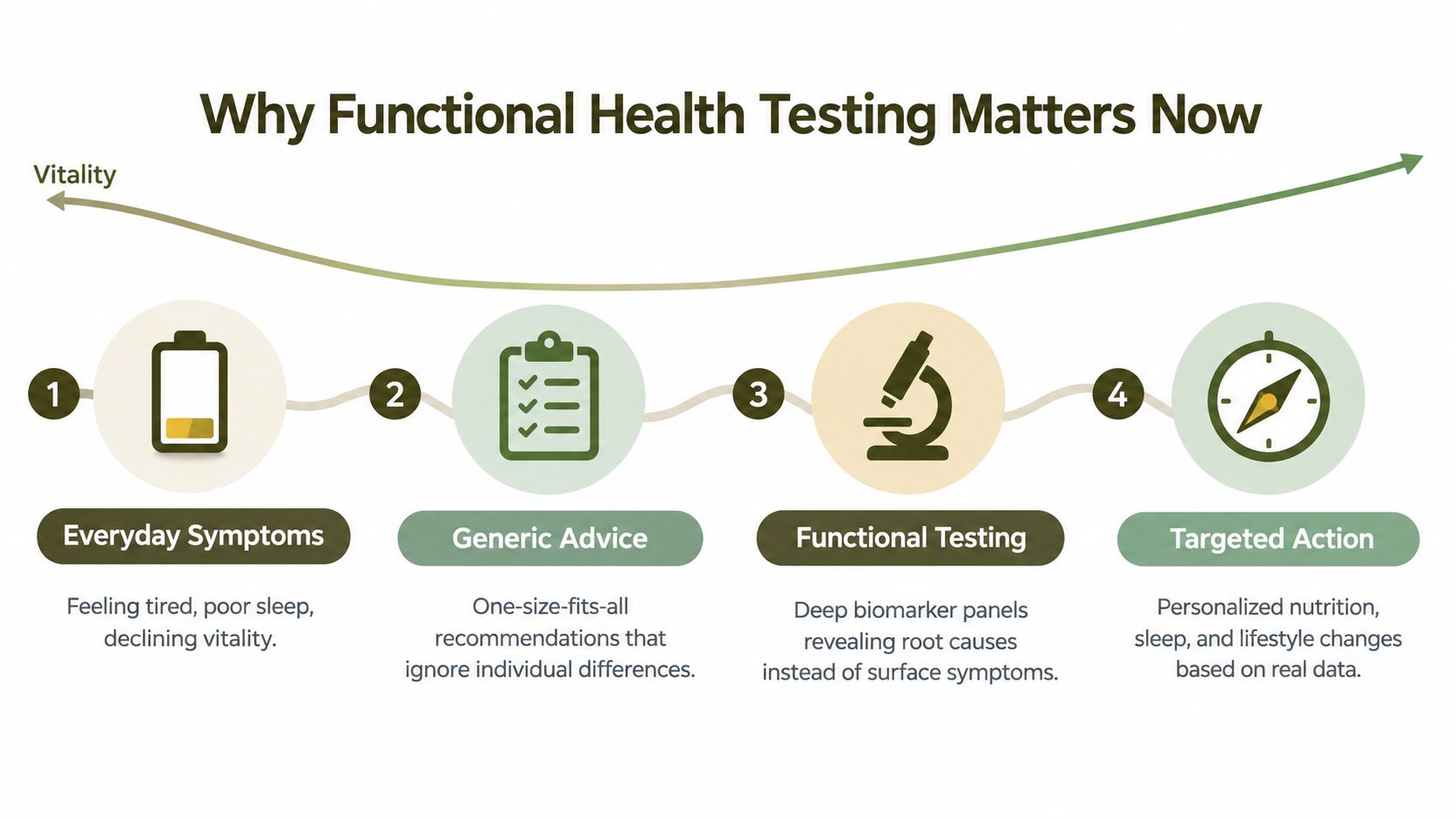
Consider two people who both describe low energy. One might have a glucose pattern that warrants a closer look at meals, movement, and routine clinical follow-up. Another might have symptoms linked to poor sleep, a recent illness, medication use, or an entirely different health concern. Treating both people with the same supplement stack would create the appearance of personalization without using personal information.
From symptoms to measurable questions
The value of testing begins with a well-formed question. “Which supplements should I take?” is usually too broad. “Could this symptom be associated with a result that changes my next clinical or lifestyle decision?” is more useful.
A practical testing question has three parts:
- The concern: What are you trying to understand, such as energy, recovery, metabolic health, or sleep?
- The measurement: Which marker can address that concern with a credible method?
- The response: What will you do if the result is high, low, borderline, or unchanged?
Testing becomes more useful when it supports a decision rather than merely satisfying curiosity. A measurement that produces no reasonable next step may add information without adding value.
Why objective data still needs judgment
Biomarkers can reveal patterns that symptoms alone can't show, but they don't speak for themselves. Preparation, timing, laboratory method, current illness, medications, and normal biological variation can all affect the result. A qualified professional may need to determine whether a finding calls for confirmation, monitoring, treatment, or no action.
The strongest approach combines measured data, personal context, and repeat observation. That combination can help adults over 40 make more deliberate choices about nutrition, exercise, sleep, and recovery while avoiding the promise that testing can forecast healthy aging with certainty.
Understanding Functional Health Testing and Biomarkers
Think of a biomarker as a gauge on a car dashboard. A temperature gauge can warn you that something needs attention, but it doesn't tell you whether the cause is the coolant, the thermostat, or a different mechanical problem. In the same way, a laboratory result can identify a signal without proving what caused it or what intervention will improve your health.
Functional health testing uses biological measurements to characterize a person's condition, risks, or response to an intervention. Depending on the question, testing may involve a single marker, a focused group of markers, or a broader panel covering areas such as metabolism, inflammation, hormones, kidney function, liver function, or nutritional status.
The field has developed over a long scientific timeline. Henry Bence Jones described a urinary protein associated with multiple myeloma in 1847, prostatic acid phosphatase was identified as a prostate-cancer biomarker in 1938, and rheumatoid factor testing emerged in 1940. Routine PSA testing entered practice in 1987, and PSA became the first biomarker approved by the U.S. Food and Drug Administration for early cancer detection in 1994. In 2000, high-sensitivity C-reactive protein was proposed for cardiovascular risk identification, while the National Institutes of Health launched its Pharmacogenetics Research Network to study genetic variation and drug response. These milestones are described in the history of biomarker development.
Measurement is not the same as usefulness
Two ideas often get blended together:
- Analytical validity: Can the test measure the marker accurately and reproducibly?
- Clinical validity: Does the marker meaningfully relate to a health condition or outcome?
- Clinical utility: Does using the test lead to a decision that benefits the person?
A biomarker can perform well in a laboratory and still have limited clinical utility. A result may be repeatable without showing that testing asymptomatic people improves outcomes. That distinction is the central safeguard against confusing advanced measurement with proven benefit.
Your baseline matters
A laboratory report usually compares your result with a population reference interval. Such intervals are commonly designed to contain about 95% of values from a reference population, as explained in research on individualized reference ranges. That comparison can help identify values that deserve attention, but it doesn't always show whether your current result represents a meaningful change for you.
Your own pattern may be more informative. A value within the population interval can still differ substantially from your established baseline, while an isolated out-of-range value may reflect temporary variation. Repeating the measurement under similar conditions allows you to separate a persistent trend from a one-off fluctuation.
That's why functional testing should be treated as a question-generating system, not a crystal ball. For a plain-language tour of common biological signals, see these examples of biomarkers.
What Types of Tests Are Available and When to Use Each
A larger panel isn't automatically a better panel. The right test depends on the question, the quality of the method, the person's symptoms and risk, and what happens after the result arrives.
Start with established clinical markers
Routine laboratory measures often provide the strongest foundation for a wellness assessment. Examples include glucose measures, lipid testing, kidney function, and liver tests. These markers can help identify patterns that deserve lifestyle attention, clinical follow-up, or confirmation.
They still have limits. A result doesn't diagnose every possible cause of fatigue or poor sleep, and a favorable value doesn't guarantee that all aspects of health are working well. The purpose is to begin with measurements that have understood uses and clear pathways for action.
A focused metabolic evaluation may be more helpful than an expansive panel chosen without a defined question. Longwelle's educational guide to metabolic health testing can help readers understand why these markers are often considered together rather than interpreted in isolation.
Use exploratory markers with restraint
Hormone panels, inflammatory markers, and vitamin measures may be relevant in particular contexts. Their interpretation can depend on age, sex, symptoms, medication, menstrual or menopausal status, training load, and the timing of collection.
A result from an exploratory test shouldn't automatically become a diagnosis or a supplement prescription. Ask whether the assay is reliable, whether the reference interval fits your situation, and whether an abnormal finding would lead to a documented next step.
The following decision test is more useful than a promise of “optimal” numbers:
| Question | Why it matters |
|---|---|
| What decision will this result change? | A measurement should have a practical purpose. |
| What could create a false result? | Preparation, timing, illness, and assay method can distort interpretation. |
| What happens after a borderline result? | You need a plan for confirmation or follow-up. |
| What happens if nothing is done? | The likely benefit of testing depends on the value of acting. |
Recognize tests with limited validation
Some popular consumer tests have limited reproducibility, unclear reference ranges, or insufficient evidence for routine decisions. Examples include food-specific IgG panels, many hair-mineral tests, live-blood analysis, and broad cytokine panels. The issue isn't that every measurement is meaningless in every circumstance. The issue is that a result may not support a dependable diagnosis or an effective intervention.
Screening evidence illustrates the difference between detection and benefit. The U.S. Preventive Services Task Force found that no biomarkers had been validated as pancreatic-cancer screening tests at the time of its review. For ovarian-cancer screening, CA-125 combined with transvaginal ultrasound didn't reduce deaths, while screening harms outweighed benefits, according to the USPSTF evidence summary.
More markers can create more noise
Every additional marker creates another opportunity for an incidental or borderline finding. When pretest probability is low, such findings can trigger anxiety, restrictive diets, unnecessary supplements, or repeated testing without improving health.
Decision rule: Choose a test only when you can explain what a meaningful result would change, who should interpret it, and what follow-up would confirm it.
How Test Results Inform Personalized Wellness Plans
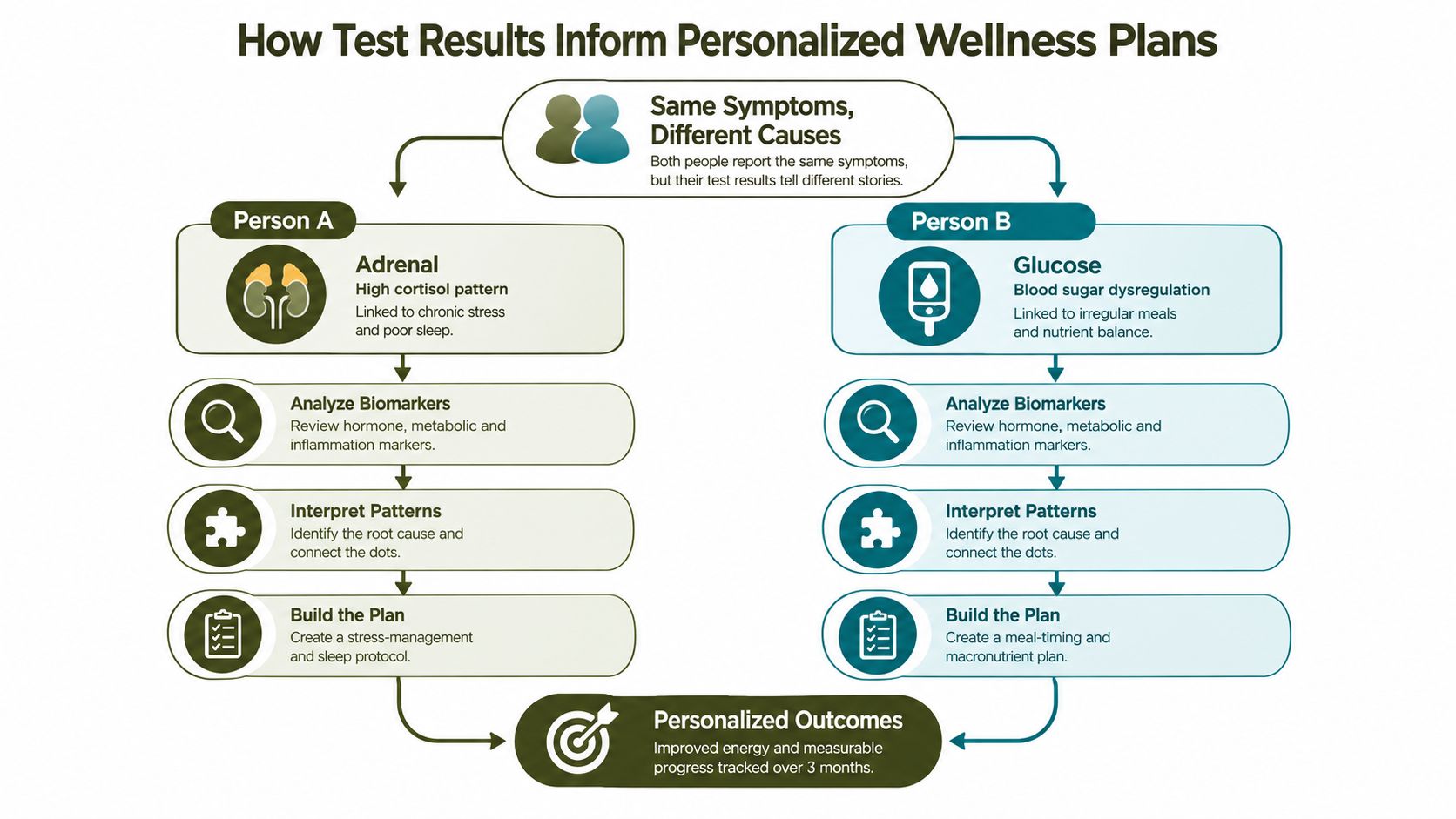
Two people can arrive with the same complaint and need different next steps. Suppose both report afternoon fatigue and restless sleep. One has a result that raises a question about glucose regulation, while the other has a finding that may require clinical confirmation before any intervention. Their plans shouldn't be identical just because their symptoms sound similar.
A result becomes useful when it changes the order of priorities. Someone with a relevant glucose pattern might discuss meal composition, carbohydrate timing, resistance training, daily movement, and appropriate medical follow-up. Someone whose results don't support that explanation might focus first on sleep regularity, medication review, recovery, or evaluation of another cause. These are examples of decision pathways, not universal prescriptions.
Build a feedback loop
The most practical workflow is simple:
- Define the question. Connect the test to a symptom, risk, goal, or intervention.
- Collect a baseline. Record relevant context, including sleep, illness, exercise, medications, and preparation.
- Choose a focused action. Start with changes that are reasonable, measurable, and safe.
- Track the response. Log symptoms and habits alongside the laboratory result.
- Review and adjust. Decide whether to continue, modify, confirm, or stop the approach.
Longitudinal monitoring matters because one result is a snapshot. Repeated results can show whether a pattern persists, changes with behavior, or disappears when collection conditions are controlled. Research on individualized reference ranges supports comparing results with your own history rather than relying only on a population interval.
Keep context beside the number
Recent strenuous exercise, illness, poor sleep, medication use, fasting status, and the timing of collection can influence results. For some people, menstrual-cycle phase also matters. If these details aren't recorded, you may attribute a temporary shift to a permanent change and make an unnecessary adjustment.
AI coaches and educational tools can help organize results, identify questions, and support habit tracking. They shouldn't replace a licensed professional when a result is clinically concerning, a treatment decision is being considered, or several findings interact. A nurse practitioner or physician can assess symptoms, history, examination findings, and test quality together.
The personalized wellness plan guide offers a useful way to think about turning measurements into structured actions.
Here's a short visual explanation of how data can fit into an ongoing wellness process:
The aim isn't to chase a perfect report. It's to create a repeatable cycle in which evidence informs a manageable behavior, the behavior is tracked, and the next measurement helps refine the plan.
Common Misconceptions About Functional Testing
Functional testing attracts people who want answers that standard advice hasn't provided. That interest is understandable, but several assumptions can make testing less useful.
Myth one says more is always better
A broad panel can look thorough while producing a long list of findings with no clear meaning. Each extra measurement may increase the chance of a borderline result, especially when the test is ordered without a specific reason to expect an abnormality.
That can lead to a familiar pattern. A person receives a result outside an advertised “optimal” range, removes several foods, buys multiple supplements, and remains unsure whether anything changed. The panel has generated activity, but not necessarily better health decisions.
A focused panel with a clear action threshold can be more informative than a large collection of poorly validated markers. Size is a feature of a test, not proof of its value.
Myth two says “normal” and “optimal” mean the same thing
A population reference interval describes how results are distributed in a selected reference group. It doesn't define a universal personal target, and it may not reflect the conditions under which your prior measurements were collected.
Your trend can therefore matter. A result inside the reference interval may still warrant a question if it shifts away from your established pattern. An isolated result outside the interval may deserve confirmation before you make a major change.
Myth three says testing solves the problem
Testing provides information. It doesn't create sleep, replace strength training, resolve a medication issue, or treat disease. Nor does a measurable biomarker automatically prove that changing it will improve how you feel or reduce future risk.
The evidence behind a test should match the decision you want to make. If the result can't reliably guide diagnosis, treatment, or a safe monitoring plan, testing may create noise rather than clarity.
Access matters, too. Expensive panels can favor people who can afford them while diverting attention from high-value prevention and standard primary-care evaluation. A balanced program starts with the most useful questions, not the longest menu.
A useful result earns its place by improving a decision, not by making the report look more advanced.
Best Practices for Longitudinal Monitoring
Repeated testing can reveal a meaningful pattern, but only when the process stays consistent. A change between two results may reflect biological variation, preparation differences, specimen handling, laboratory method, or a genuine change in health.
A U.S. national laboratory-medicine status report estimated that 32% to 75% of reported errors were associated with the preanalytic phase, 13% to 32% with the analytic phase, and 9% to 31% with the postanalytic phase, as reported in the CDC National Health Statistics report. Preanalytic issues include preparation, collection, labeling, transport, and handling. The lesson is direct: reliable tracking depends on the testing process, not only on the panel.
Make each collection comparable
Before each test, record the conditions that could affect interpretation:
- Timing: Use a consistent time of day when the marker is sensitive to daily variation.
- Preparation: Keep fasting status and other instructions consistent.
- Recent activity: Note strenuous exercise, unusual training, or disrupted recovery.
- Current health: Record recent illness, inflammation, or major sleep loss.
- Medications and supplements: Document what you're taking and follow professional instructions about whether anything should be paused.
Laboratory tests were ordered or provided at 27.3% of visits by U.S. adults aged 18 to 64 in the cited CDC analysis, showing how common testing is in routine care. That frequency makes process quality important for both conventional and wellness-oriented monitoring.
Use a review checklist
When a result looks surprising, don't react immediately. Check the collection conditions, compare the laboratory method and units, review the reference interval, and ask whether confirmation is appropriate. Two laboratories may not be directly comparable if they use different assays or reporting practices.
A health journal can make the numbers easier to interpret. Log symptoms, sleep, exercise, diet changes, stress, medications, and supplements near each result. The journal won't prove causation, but it can help you and your clinician spot patterns worth investigating.
Follow trends without becoming preoccupied
A sustainable monitoring plan focuses on direction and context rather than constant checking. Establish a baseline, choose a sensible follow-up interval with a qualified professional, and make incremental changes instead of responding to every fluctuation with a dramatic overhaul.
Seek licensed medical guidance for clinically concerning findings, persistent symptoms, or decisions involving treatment. The safest role for functional health testing is to support better questions, clearer follow-up, and disciplined behavior change. It isn't a substitute for medical care.
Longwelle combines a brief assessment, personalized educational guidance, biomarker tracking, and access to licensed nurse practitioners for people who want a structured approach to healthy aging. Take the Longwelle assessment to identify practical priorities and explore how supervised monitoring can support more informed wellness decisions over time.