Learn
Epigenetic Age Test: What It Measures and How to Use It
Learn what an epigenetic age test actually measures, how it differs from other biomarkers, and how to use results for longevity goals without overreacting.
An epigenetic age test estimates biological age from DNA methylation patterns at selected CpG sites, not from your calendar age. The original clock evaluated 353 CpG sites and showed an average prediction error of about 3.6 years across multiple tissues.
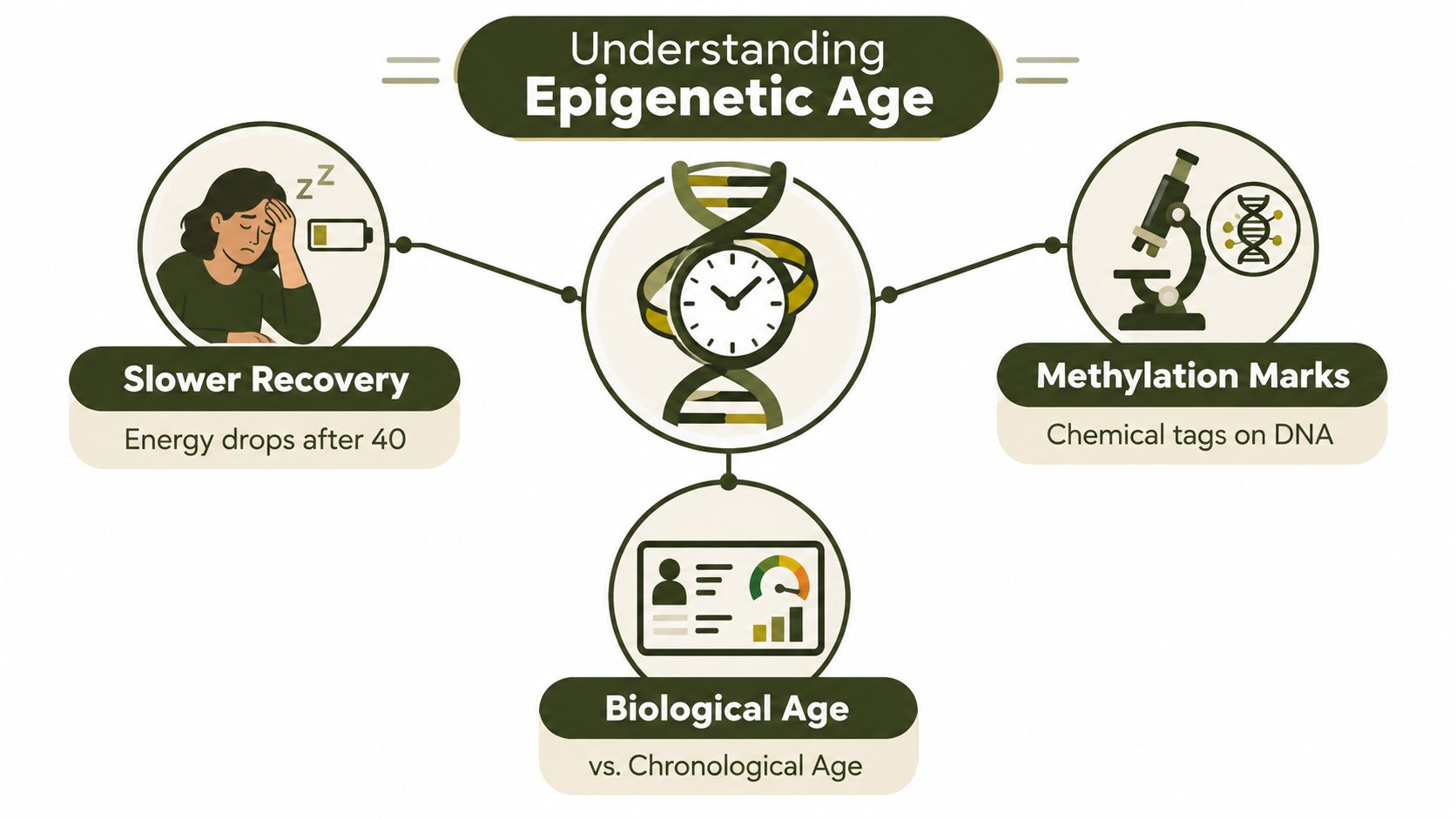
But what should you do when your report says you're biologically older than your chronological age? That's the question many high-achieving adults over 40 ask after the initial curiosity fades. A slower recovery from illness, less resilient energy, or poorer sleep can make a molecular measure feel like the objective answer.
It isn't a verdict. An epigenetic age test is a probabilistic research biomarker. Used carefully, it may add context to a broader health assessment. Used carelessly, it can turn one uncertain estimate into unnecessary anxiety, expensive experimentation, or false reassurance.
Table of Contents
- What Is an Epigenetic Age Test and Why It Matters
- How DNA Methylation Clocks Actually Work
- Why a Single Epigenetic Age Result Has Limited Meaning
- What Recent Research Says About Mortality and Risk Prediction
- The Ancestry Gap Most Consumers Never Hear About
- Can Improving Your Score Prove Health Gains
- How Epigenetic Testing Fits Into a Broader Longevity Strategy
- Building a Realistic Epigenetic Tracking Protocol
What Is an Epigenetic Age Test and Why It Matters
Can you measure biological aging objectively, especially when your calendar age doesn't seem to match how your body feels?
An epigenetic age test tries to answer that question by examining DNA methylation, a pattern of chemical marks attached to DNA. These marks can change how genetic instructions are read without changing the underlying DNA sequence. A test uses selected methylation patterns to estimate an age-related molecular profile, then compares that estimate with your chronological age.
The field's modern foundation came from Steve Horvath's 2013 DNA-methylation clock. Horvath assembled approximately 8,000 samples from 82 Illumina methylation-array datasets, representing 51 healthy human tissues and cell types. His elastic-net model evaluated methylation at 21,369 CpG sites and selected 353 CpG sites for a multi-tissue age-prediction algorithm. In validation analyses, the clock showed a correlation of approximately 0.96 with chronological age and an average prediction error of about 3.6 years across tissues including blood, saliva, buccal cells, liver, lung, adipose tissue, colon, brain, and cervical tissue. The Cognitive Vitality review of epigenetic clocks describes why this was a major milestone.
The number is not your diagnosis
The test doesn't calculate how many years you have left. It also doesn't directly measure your cardiovascular fitness, insulin sensitivity, muscle strength, cognitive function, or current disease status.
It estimates whether your methylation pattern resembles the patterns associated with a particular age in the test's reference data. That distinction matters. A result that appears older than your chronological age may identify a signal worth investigating, but it doesn't identify a single cause or prove that your habits have failed.
The most useful first question is therefore not, “How do I make this number younger?” It's, “What exactly did this test measure, in which tissue, using which clock, and with what uncertainty?” A clear explanation of biological age versus chronological age can help establish that distinction before you interpret the report.
How DNA Methylation Clocks Actually Work
DNA methylation is one way cells regulate gene activity. Think of your DNA as a large instruction library. Methylation adds chemical tags at particular locations, which can influence whether nearby instructions are more or less available for use. The tags don't rewrite the genetic code, but they can affect how cells read it.
A test focuses on CpG sites, locations where the DNA bases cytosine and guanine occur next to each other. The laboratory measures methylation levels at selected CpG positions, and an algorithm combines those readings into an estimated age or aging-related score.
Different clocks answer different questions
Horvath's original pan-tissue clock was trained primarily to estimate chronological age across several tissue types. Newer clocks may be trained against other outcomes, such as mortality, disease-related measures, or physiological biomarkers. That means “epigenetic age” isn't one universal measurement. Two tests can examine related biology while answering different questions.
Some clocks estimate an age-like value. Others estimate age acceleration, the difference between an estimated molecular age and chronological age. Tools such as DunedinPACE focus on the pace of aging, meaning the rate at which aging-related changes are occurring, rather than assigning you an age in years.
Many clocks show correlations above 0.90 with chronological age in validation cohorts, as described in this review of DNA-methylation aging measures. That performance is useful for population-level age prediction. It doesn't mean that an individual's result is an equally precise measure of personal health risk.
Why the sample matters
Methylation patterns vary by tissue. Blood and saliva don't provide interchangeable biological information, and a clock trained for one sample type may perform poorly when applied to another. Blood-based measurements can also be influenced by the composition of different white blood cell populations.
Laboratory processing introduces another layer. DNA extraction, normalization methods, assay technology, and platform differences can affect the score. Before testing, record:
- Specimen type: Confirm whether the test uses whole blood, a blood spot, saliva, or another sample.
- Clock identity: Find out whether the report estimates age, age acceleration, mortality-related risk, or pace of aging.
- Laboratory platform: Use the same laboratory and assay platform if you plan to repeat the test.
- Uncertainty: Look for confidence intervals, analytical error, or other information that shows how much precision the result has.
The practical interpretation is straightforward. An epigenetic age test can provide a molecular estimate, but the estimate only makes sense when you know what was measured and how the result was produced.
Why a Single Epigenetic Age Result Has Limited Meaning
A single number feels actionable because it appears objective. You can compare it with your chronological age, decide whether you're “ahead” or “behind,” and start searching for ways to change it. That instinct is understandable, but it gives a one-off result more authority than the measurement can support.
Epigenetic-clock scores can vary because of batch effects, DNA extraction procedures, slide position, assay technology, transient physiological states, and shifts in leukocyte composition. Applying a clock outside its intended tissue can produce errors on the order of 20 to 30 years, according to a review in Aging Cell. Technical reproducibility can still be high, with several clocks reporting intraclass correlation coefficients above 0.90 across replicate array measurements. That apparent contradiction is important: a laboratory may reproduce a measurement consistently while the measurement remains difficult to interpret biologically.

Build a trend, not a verdict
A more useful protocol treats the first result as a baseline. Repeat testing should use the same specimen type, laboratory, assay platform, and clock. You should also document acute illness, major medication changes, and meaningful shifts in diet, training, sleep, or body composition.
Practical rule: Don't interpret a small change as meaningful unless it exceeds the assay's analytical uncertainty and fits a prespecified retest plan.
The sample's context matters as much as the number. A test taken during an acute illness may not represent the same biological state as a sample taken during stable health. A change in laboratory or tissue can create an apparent trend that is really a change in measurement conditions.
This is why longitudinal tracking is stronger than snapshot interpretation. A repeated pattern under comparable conditions can provide more useful information than one surprising result. Even then, the trend remains one piece of evidence. Pair it with blood pressure, glucose regulation, sleep, strength, fitness, symptoms, and other relevant clinical measures.
The video below offers another visual explanation of why a biological-age number needs context rather than instant interpretation.
What Recent Research Says About Mortality and Risk Prediction
The strongest argument for epigenetic clocks isn't that they produce a dramatic personal number. It's that some clock measures contain information associated with health outcomes beyond chronological age alone.
A 2023 analysis followed 395 related individuals for a mean of 17.1 years. During follow-up, 187 participants, or 47.3%, died. DNA-methylation measures including GrimAge and DunedinPACE remained associated with all-cause mortality after analyses accounted for chronological age, family relatedness, physical activity, body-mass index, smoking, education, and chronic diseases. The findings are reported in the Journal of Gerontology.
That result suggests molecular-aging measures may capture information not fully explained by conventional demographic or lifestyle variables. It doesn't show that a person who lowers a clock score will live longer. The study observed an association between measurements and mortality outcomes. It did not establish that changing the score causes a change in lifespan.
Age and pace are not interchangeable
This distinction is easy to miss in consumer reports. A biological-age clock asks whether your methylation profile resembles an older or younger reference profile. A pace-of-aging measure such as DunedinPACE asks whether aging-related changes appear to be occurring faster or slower.
Those outputs can lead to different interpretations. Someone may have an older estimated age but a pace-of-aging score that doesn't indicate unusually rapid change. Another person may have a modest age difference while showing a pattern associated with faster aging processes. The report needs to identify which question the clock was built to answer.
What the research can and can't support
The mortality research supports cautious risk stratification, not personal prophecy. It doesn't tell you that a specific score guarantees disease, nor does it identify which intervention will change your outcome.
For a consumer, the responsible interpretation is:
- Use context: Consider chronological age, health history, family history, symptoms, medications, and standard clinical measures.
- Repeat thoughtfully: A single result can't distinguish a durable pattern from technical or biological fluctuation.
- Avoid causal claims: An association doesn't prove that lowering the score extends life.
- Seek interpretation: A qualified professional can help determine whether the result adds useful information or merely creates noise.
Epigenetic clocks are best treated as probabilistic research biomarkers. They may support a broader conversation about risk and aging, but they shouldn't replace diagnosis, screening, or established clinical care.
The Ancestry Gap Most Consumers Never Hear About
A biological-age report can look universal because it gives every customer a number in the same format. The underlying validation may not be universal.
Recent evidence indicates that many methylation clocks perform less accurately for African American and Hispanic populations, including reduced accuracy for chronological age and age acceleration. A 2025 meta-analysis also found associations between accelerated clock-measured aging, lower socioeconomic status, and marginalized race or ethnicity, as discussed in this Trends in Genetics analysis00131-3).
That finding changes how a result should be interpreted. A higher age-acceleration score may partly reflect unequal exposure to stressors, pollution, healthcare access, nutrition, or other social determinants. It may not represent an individual's modifiable lifestyle alone. Treating the score as a personal moral judgment would therefore be scientifically weak and ethically unacceptable.
Questions to ask before testing
Ask the provider for details before you pay for an interpretation.
- Was the assay validated in your population? Look for information about the reference groups used to train and validate the clock.
- What uncertainty does the report provide? A confidence interval or error estimate is more informative than a single unqualified number.
- What does the clock measure? Confirm whether it estimates chronological age, age acceleration, mortality-related risk, or the rate of aging.
- Which tissue was tested? A blood-based clock and a saliva-based clock shouldn't automatically be compared.
- Does ancestry affect performance? Ask whether the company has evaluated accuracy across relevant ancestry groups.
DunedinPACE offers an emerging counterexample. It excludes CpG sites influenced by ancestry-related methylation quantitative trait loci and has shown more consistent performance across ancestries. That doesn't make it universally perfect or eliminate the need for validation. It does show why clock design matters.
An unexpectedly “older” result should prompt questions about validation and context, not stigma or drastic action.
Prioritize conventional clinical markers and actionable habits over race-adjusted conclusions. Blood pressure, glucose regulation, lipid measures, physical function, sleep, and symptoms still provide essential information about your current health. An epigenetic age test may complement those measures, but it shouldn't define your health identity.
Can Improving Your Score Prove Health Gains
A lower epigenetic age score can be encouraging. It can't, by itself, prove that your health improved.
Marketing often treats a younger score as evidence of reversed aging. Clinical-translation reviews are more cautious. Epigenetic clocks still lack widely accepted biological interpretations, validated clinical thresholds, and sufficient evidence for routine healthcare decision-making, as discussed in this review of clinical translation for epigenetic clocks.
A score can change because of the clock selected, the tissue tested, the assay platform, the laboratory batch, or sample quality. A high-performing research clock may not remain directly comparable when moved from array-based testing to targeted sequencing. A short-term difference may therefore reflect technical or biological fluctuation rather than a durable reduction in disease risk.
What to track beside the score
Conventional measures answer different questions and often offer clearer action points. They shouldn't be treated as competitors to molecular testing.
| Measure | What it can show | Why it matters |
|---|---|---|
| Epigenetic age | An age-related DNA-methylation pattern | Provides molecular context, with uncertainty |
| Clinical biomarkers | Current physiological status and disease-related risk | Helps identify established areas for medical follow-up |
| Functional outcomes | Changes in strength, fitness, sleep, energy, and symptoms | Shows whether daily capability and wellbeing are changing |
| Lifestyle assessment | Behaviors such as activity, nutrition, alcohol use, smoking, and recovery habits | Identifies practical targets for intervention |
A stable epigenetic score doesn't necessarily mean an intervention failed. Blood pressure, glucose regulation, sleep quality, strength, fitness, and symptoms may improve independently of methylation age. Conversely, a younger score without better function or clinical markers shouldn't be called a health victory.
Use a measurement protocol
Repeat the test with the same laboratory, specimen type, and clock. Track standard biomarkers and functional outcomes in parallel. Define success prospectively using reproducible trends rather than declaring reversal from one before-and-after result.
That approach preserves the useful part of testing, structured feedback, without allowing an uncertain molecular score to dominate the entire health strategy.
How Epigenetic Testing Fits Into a Broader Longevity Strategy
An epigenetic age test works best as one data point in a larger system. It doesn't replace a conventional biomarker panel, a medical history, or an honest assessment of how you sleep, move, eat, recover, and function.
Each tool has a different job:
- Conventional biomarkers show current physiological status and may identify established disease-related risks.
- Lifestyle assessment reveals the behaviors and routines that influence energy, sleep, recovery, and long-term health.
- Epigenetic testing estimates a molecular aging pattern that may add context to other findings.
The value comes from combining these views. A high age-acceleration result alongside poor sleep, high blood pressure, and reduced fitness gives you a coherent reason to review recovery and clinical risk. A high result with otherwise stable markers demands more caution. It may reflect technical variation, tissue limitations, ancestry-related performance differences, or a signal that needs repeat testing.
A structured service can help keep the process grounded. Longwelle combines a brief assessment with personalized educational guidance, biomarker tracking, optional licensed nurse-practitioner interpretation, and progress monitoring. Its healthspan optimization guidance fits the principle that longevity planning should connect measurements with practical routines rather than chase one isolated score.
The aim isn't to make every number look younger. It's to build a coherent record of what changes, what stays stable, and what deserves professional attention.
Building a Realistic Epigenetic Tracking Protocol
Start with a baseline only when you know what the test measures. Record the specimen type, laboratory, assay platform, clock name, reported uncertainty, and any relevant context such as acute illness, medication changes, or major lifestyle disruption.
Then create a repeatable process:
- Establish the baseline: Save the complete report, not just the headline age.
- Repeat under comparable conditions: Use the same tissue, laboratory, platform, and clock at a prespecified interval.
- Track function in parallel: Record sleep quality, energy, strength, fitness, recovery, and symptoms.
- Review conventional data: Pair the result with appropriate clinical biomarkers and routine medical care.
- Interpret trends cautiously: Require a reproducible pattern before treating a shift as meaningful.
You can also use a longevity blood test framework to organize conventional biomarkers alongside lifestyle observations. The point isn't to collect endless data. It's to prevent one molecular estimate from operating without context.
An epigenetic age test is educational information, not a diagnosis or a substitute for medical advice. Meaningful progress usually comes from consistent habits, appropriate screening, and decisions that improve how you function, not from reacting to every isolated result.
Use the test to generate better questions, not fear. The most useful result is the one that helps you understand your broader health picture and choose a measured next step.
Longwelle offers a personalized longevity assessment, educational guidance, biomarker tracking, and optional nurse-practitioner support to help put molecular and clinical data into context. Visit Longwelle to start with a structured assessment and build a practical plan around measurable health and wellbeing markers.