Learn
Healthspan Optimization: A Practical Roadmap for Aging Well
Master healthspan optimization with actionable steps for biomarkers, lifestyle protocols, and tracking progress. Evidence-based guidance for adults 40+.
You're probably doing the same thing many busy professionals do in midlife. You notice the tired mornings, the lighter sleep, the slower recovery after workouts, and you start wondering whether this is just “getting older” or whether your body is asking for a better plan.
Healthspan optimization starts by treating those signals as data, not as a diagnosis. A rough week can come from workload, travel, alcohol, or stress, but a pattern that keeps repeating deserves a closer look. If fatigue is becoming normal, the first move is to map what changed, what's stable, and what's drifting, then use that as your baseline. For a simple starting point, you can pair that reflection with a structured self-check like why am I so tired.
Table of Contents
- Understanding Your Current Baseline
- Why Healthspan Optimization Matters Now
- Essential Assessments and Biomarkers
- The Pillars of Daily Protocol
- Structuring Habits for Real Life
- Navigating the Gap in Longevity Science
- Your 90-Day Healthspan Action Plan
Understanding Your Current Baseline
A lot of people in their 40s and 50s describe the same thing in different words. They're sleeping, technically, but waking unrefreshed. They're still exercising, technically, but it's taking longer to bounce back. That doesn't automatically mean something is wrong, but it does mean your current operating system may need adjustment.
Separate noise from pattern
One bad week is noise. A month of restless sleep, afternoon crashes, and declining training tolerance is a pattern. The useful move is to write down what you feel for two weeks, then compare it with what you're doing, because your body rarely changes in isolation.
Practical rule: Don't change ten things at once. Change one lever, track the response, and keep the rest stable long enough to see what's real.
The point of a baseline isn't perfection. It's clarity. If your sleep is short, your movement is inconsistent, and your energy is flat, you don't need a grand theory. You need a starting point that makes the next decision easier.
What to notice first
Begin with three questions. When do you feel your best. When does your energy dip. What habits repeat on the days you feel worse. That simple pattern review often reveals whether the problem is sleep timing, movement scarcity, overtraining, late eating, or just too much cognitive load.
You don't need to self-diagnose every symptom. You do need enough structure to know whether a change helped or didn't. That's the true value of a baseline: it turns vague concern into something you can act on without guessing.
Why Healthspan Optimization Matters Now
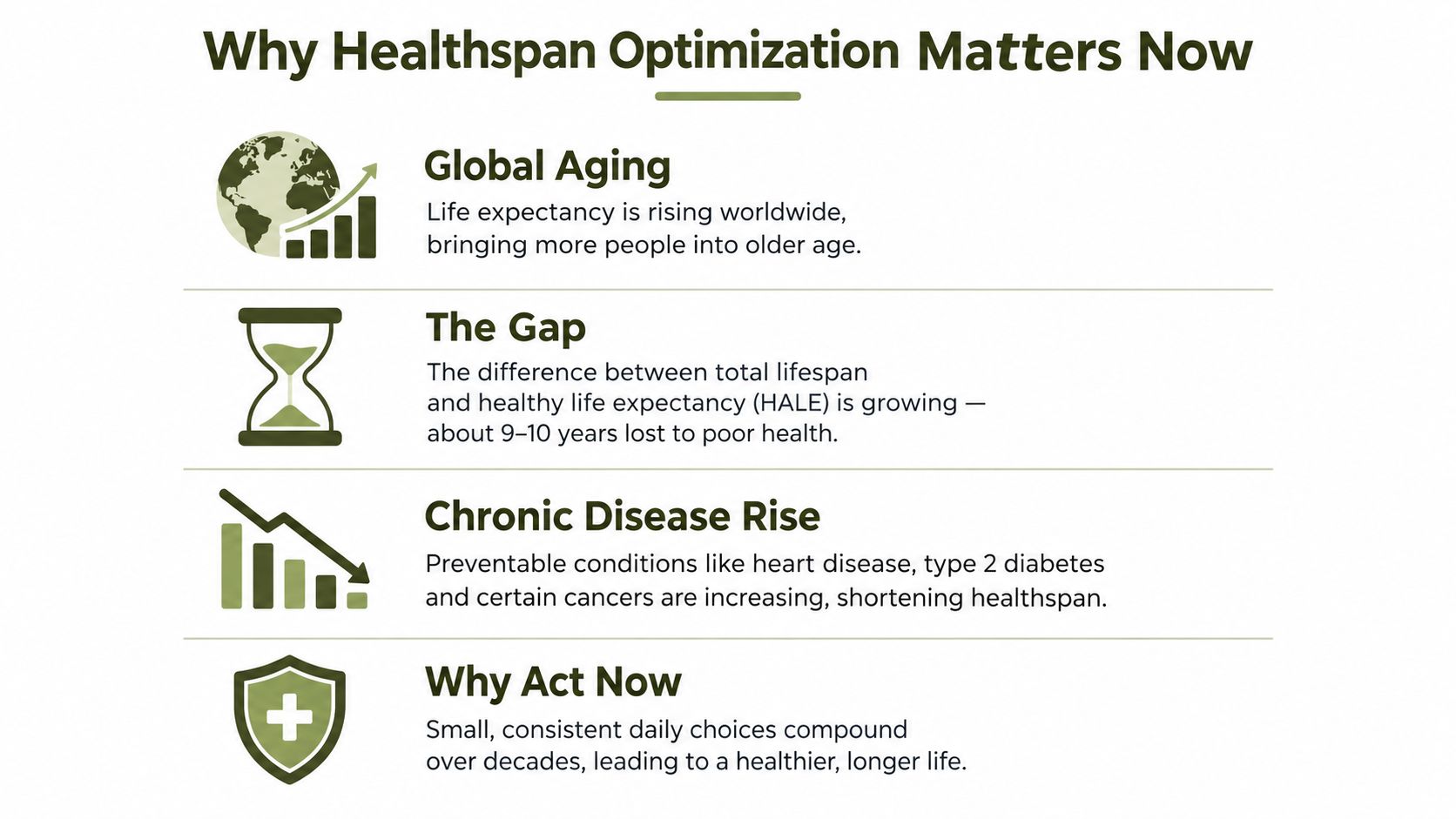
The global case for healthspan optimization is simple. People are living longer, but the extra years are not automatically years of good function. The World Health Organization reports that global life expectancy rose from 66.8 years in 2000 to 73.1 years in 2019, while HALE rose from 58.1 to 63.5 years over the same period, leaving a persistent gap of roughly 9.6 years between total lifespan and years lived in good health in 2019 (UN World Social Report chapter 2).
The gap is the point
That gap matters because longer life doesn't automatically mean more vitality, independence, or energy. The burden of chronic disease and disability still sits in the middle of many later years, even as mortality declines. If your goal is to stay useful, active, and mentally sharp, the relevant target isn't just surviving longer. It's compressing the years where health gets in the way of life.
The demographic shift makes this even more urgent. The World Health Organization projects that the number of people aged 60 or older will nearly double from 900 million in 2015 to 2 billion by 2050, rising from 12% to 22% of the world population, and by 2030, 1 in 6 people globally will be 60 or older, moving to 1 in 5 by 2050 (WHO projection).
Why this is now a practical issue
This isn't just a population trend. It changes what you should care about personally. Late-life disability is often driven by heart disease, stroke, chronic lung disease, sensory impairment, back and neck pain, falls, diabetes, dementia, and osteoarthritis, which means the best strategy is rarely one dramatic fix. It's a stack of modest choices that preserve function over time.
Bottom line: If more years are coming, the question is whether those years will feel capable or constrained.
Essential Assessments and Biomarkers
Busy professionals do not need more noise. They need a baseline that shows what is changing, what is stable, and what affects future risk. In a population-based cohort, seven of ten common serum biomarkers predicted future risk of chronic disease and death, with glycemic markers and HDL-related markers showing the strongest harmful and protective patterns, respectively (biomarker cohort study).
Start with what can be repeated
A useful starting point is sleep, movement, and basic labs. Sleep duration and quality show how recovery is holding up. Movement shows how much daily strain your body can absorb. Lab work adds an objective view of glucose control and lipid status, which is more reliable over time than a single reassuring result.
The value is in the trend. One fasting glucose reading may be informative, but a series of glucose and lipid checks tells you whether you are improving, stalling, or drifting the wrong way. Glucose regulation deserves attention because the link to healthspan appears to be partly explained by fasting blood glucose concentrations.
Use labs as a feedback loop
Treat biomarkers like a dashboard. Check, adjust, recheck. That is more useful than chasing novelty, because lifestyle changes only matter if you can see whether they are sticking.
A structured service can help when self-tracking is not enough. Longwelle offers a brief assessment, biomarker tracking, and optional licensed nurse practitioner input for people who want clearer feedback on sleep, energy, and routine decisions. Used well, that setup is less about medical theater and more about making the next adjustment visible.
Practical rule: If a marker does not change how you train, sleep, eat, or recover, it is probably not the right marker to obsess over.
The Pillars of Daily Protocol
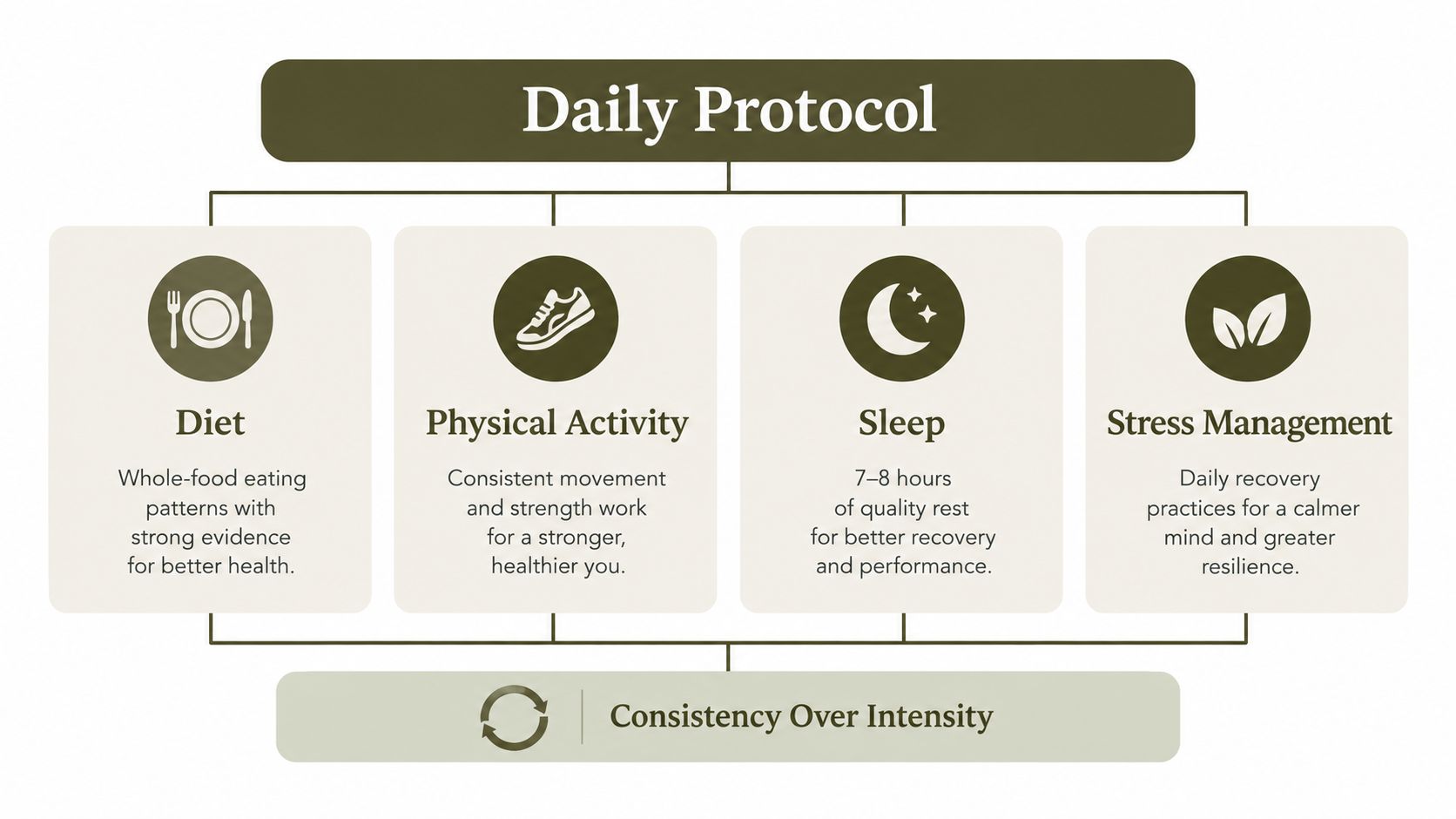
The strongest healthspan strategy still looks ordinary. Diet, physical activity, sleep, and stress recovery do more of the work than most supplement stacks, and the evidence for supplements extending human lifespan remains weak, with independent reporting noting that no supplement has shown that effect in large clinical trials (NYT coverage).
Why basics beat novelty
The contrast is straightforward. A pooled analysis of 85 studies found that consistent physical activity in adulthood is associated with a 30–40% lower risk of death from any cause, and even starting later in life was linked to a 20–25% lower risk. That is a behavior story, not a supplement story.
Exercise also affects sleep in ways that matter for busy professionals. A systematic review found 29 studies where exercise improved sleep quality or duration, 4 with no difference, and 1 with a negative effect, so timing and intensity still matter (exercise and sleep review).
What to prioritize first
Use this order in real life:
- Sleep first: Protect consistency before chasing sleep hacks, because recovery quality drives everything else.
- Movement second: Build moderate-intensity activity into the week and keep it repeatable.
- Food third: Anchor meals around simple, whole-food patterns instead of supplement dependence.
- Stress recovery fourth: Use brief daily recovery practices so the system can settle.
Moderate aerobic exercise has been associated with improvements in sleep latency, wake after sleep onset, and sleep efficiency after several weeks. That makes it a better starting point than random intensity spikes, especially if better sleep is the goal. For a practical routine reference, compare your current setup with this daily routine guide.
Structuring Habits for Real Life
The best protocol is the one that survives a normal week. Meetings, travel, family obligations, and decision fatigue will expose weak design fast. If every healthy choice feels like a fresh debate, the plan is too fragile to keep.
Build around existing anchors
Attach one habit to something you already do. Walk after your first coffee. Train after dropping the kids off. Breathe for two minutes after closing your laptop. The new behavior stops competing with your calendar, which is where most good intentions fail.
A tracking tool helps because memory is unreliable. A simple checklist, calendar block, or note app is enough if you use it. The point is not a vanity dashboard. It is a clear record of whether the plan still works when the week gets noisy.
Make adherence the metric
Real-world adherence is often only moderate, so a perfect plan that collapses in practice is a bad plan. A review of adherence studies found wide variation in diet and physical activity follow-through, and one community translation of a major elder fitness program reported moderate participation in both exercise and health education, with fewer people showing up for optional extra sessions. The lesson is plain. Consistency beats ambition.
Practical rule: Don't set a goal that only works on your best week. Set one that still works on your busiest one.
That is why simple monitoring matters. Track sleep, movement, and one or two lab markers over time. If the trend is stable or improving, keep going. If not, adjust the load, not just the motivation.
Navigating the Gap in Longevity Science
Longevity marketing often runs ahead of the evidence. People want a clean answer, a score, or a shortcut, but the current science is still catching up to the hype. A 2025 review notes that no longevity intervention has yet been proven effective or ready for widespread clinical adoption, and commonly discussed biomarkers such as epigenetic clocks and telomere length still lack reversibility data (2025 review).
Read aging markers carefully
That doesn't mean biomarkers are useless. It means you should know what they can and can't tell you. A number that moves on a report isn't the same as a validated improvement in healthspan. Correlation and action are not the same thing, and many consumer longevity tools blur that line.
The safest use of emerging markers is as context, not as a verdict. If a marker changes alongside better sleep, more movement, improved training tolerance, or cleaner metabolic labs, that's useful directional information. If a marker changes in isolation and nothing else improves, the result may be more noise than breakthrough.
Keep the question practical
The genuine question isn't “Which biomarker looks coolest?” It's “Which marker helps me change behavior in a way I can sustain?” That's especially important for adults over 40 who want measurable feedback without chasing speculative promises.
For a plain-language overview of the broader topic, longevity guide is a useful starting point if you want to compare your habits against a more grounded framework.
Your 90-Day Healthspan Action Plan
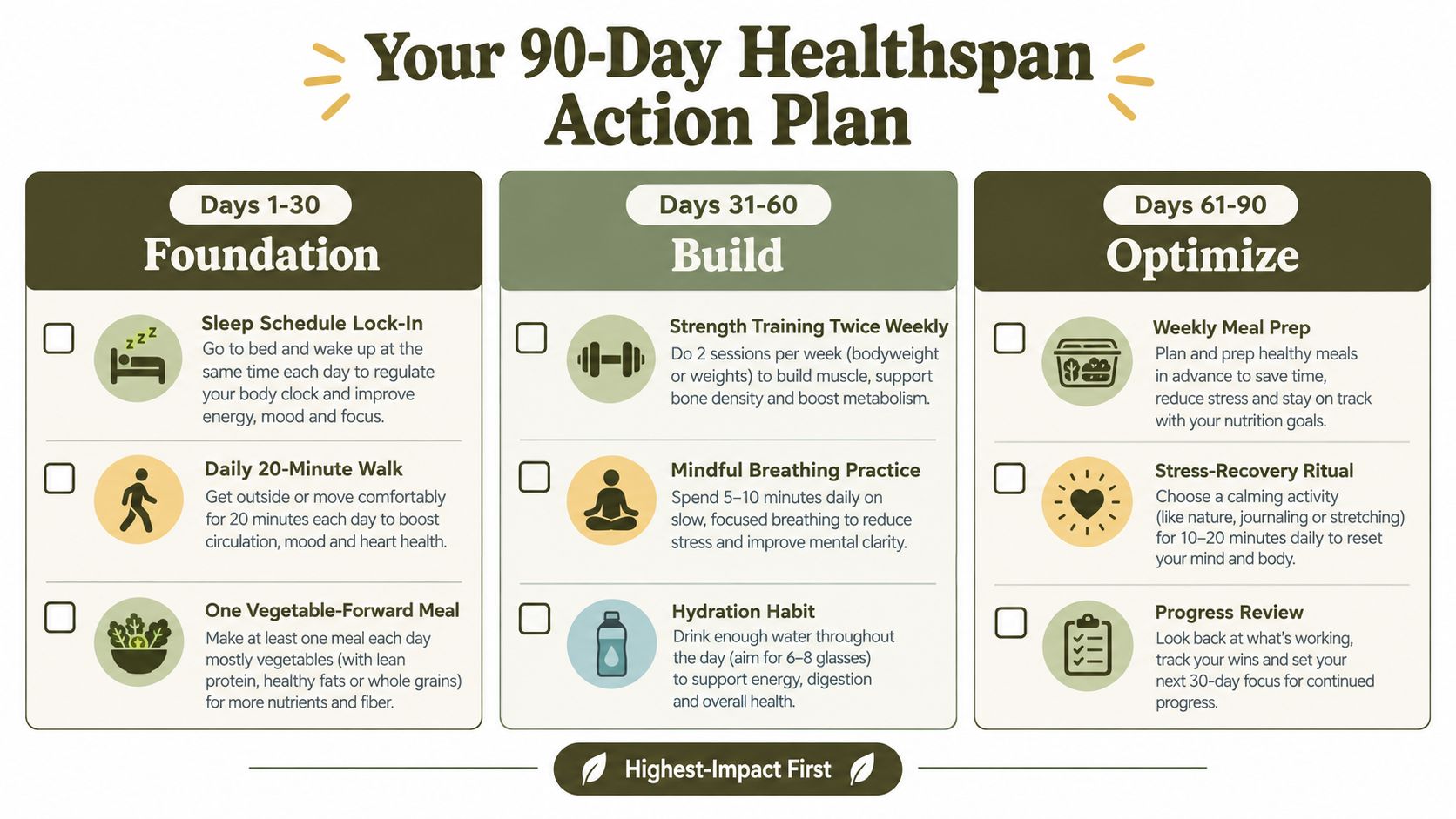
A strong 90-day plan doesn't try to fix everything. It starts with the highest-return habits, then layers on measurement once the routine is stable. That keeps the process calm, repeatable, and useful.
Days 1 to 30
Lock in a sleep window you can keep. Add a daily walk, even if it starts as a short one, and make one meal each day more vegetable-forward. These changes are small enough to stick and large enough to show you whether your baseline energy is moving.
Days 31 to 60
Add resistance training twice a week if your schedule allows it. Pair it with a short breathing or downshift practice so recovery isn't an afterthought. Tighten hydration and keep tracking sleep and energy so you can see whether the new load is helping or just adding strain.
Days 61 to 90
Use the third month to reduce friction. Batch a few meals, create a repeatable stress-recovery ritual, and review your progress markers against the baseline you set at the start. If the habits are working, keep them. If not, simplify them.
The footer rule is the one to remember: highest-impact first. Build the plan around what you'll still do when travel, deadlines, and family life get messy.
If you want a more structured way to track sleep, movement, and biomarker changes without guessing, visit Longwelle and start with a brief assessment. It's built for adults who want clearer feedback, practical routines, and measurable healthspan priorities, not more noise.