Learn
Biological Age vs Chronological Age: The Complete Guide
Understand biological age vs chronological age, how biomarker-based tests work, and what your results mean for personalized longevity plans after 40.

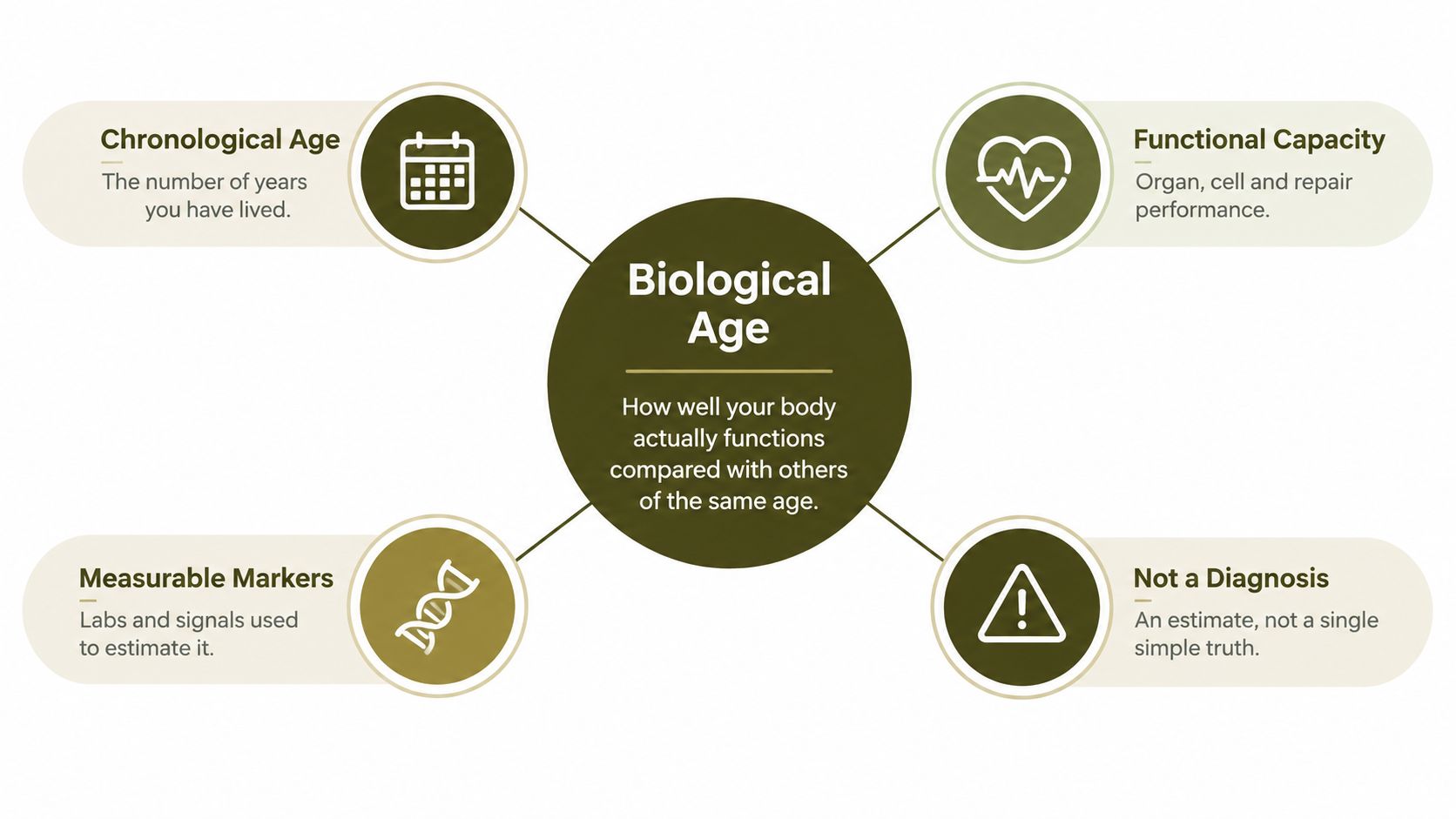
biological age measures how fast your body shows signs of aging through biomarkers, while chronological age is just the number of years you have lived. They are related but often different, and a higher biological age than chronological age is generally a signal to prioritize specific lifestyle interventions.
The popular advice is too simple: treat biological age like one universal score and assume any result tells you the truth about aging. In practice, biological age is a family of competing models, and the useful question is not just what number you got, but what it was built to measure and whether it changes what you do next.
| Measure | What it represents | What it's good for | Main limitation |
|---|---|---|---|
| Chronological age | Calendar time lived | Clear, fixed, easy to compare | Says nothing about function |
| Biological age | Estimated physiological state | Flags mismatch between age and body function | Depends on the model used |
| Age gap | Difference between biological and chronological age | Helps compare people of the same calendar age | Easy to over-interpret |
Table of Contents
- What Biological Age Actually Means
- The Three Classes of Biological Age Metrics
- Why There Is No Consensus Gold Standard
- The Real Drivers Behind Biological Age
- Interpreting Your Biological Age Result
- When Tracking Biological Age Makes Sense
- Building a Personalized Longevity Plan
- Frequently Asked Questions
What Biological Age Actually Means
A lot of people start with the assumption that biological age is one settled number, like a lab result with a universal meaning. It isn't. In the recent literature, biological age is increasingly operationalized as an estimated-age value derived from multi-marker models, and researchers use the age gap as the practical output, biological age minus chronological age, to distinguish people of the same calendar age who differ in physiological state (biomedgerontology review).
The useful distinction
Chronological age is fixed. It moves forward one year at a time and never asks how you slept, trained, recovered, or whether your labs look stable. Biological age tries to estimate how well your body is functioning relative to peers, using measurable signals from the body rather than the calendar.
That difference matters in real life. Two people can both be 52 on paper, yet one has better recovery, stronger labs, steadier glucose control, and better functional capacity. In that case, the number on the birthday cake tells you very little about day-to-day resilience.
Practical rule: treat biological age as a signal about physiology, not a verdict about identity.
Why the term gets misunderstood
Biological age sounds singular, but the field uses different biomarker families and different assumptions. Some approaches lean on routine clinical chemistry, which makes them practical at scale. Others are built from omics-heavy assays, which can be more complex to deploy even if they offer deeper molecular detail.
That's why a test can be meaningful without being definitive. The best way to read any result is to ask what kind of body signal it captures, what outcome it's supposed to predict, and whether the score changes decisions about training, sleep, nutrition, or medical follow-up.
The Three Classes of Biological Age Metrics
Biological age metrics fall into three technical classes, and they do not measure the same thing in the same way. A major recent evaluation compared Klemera and Doubal's method, phenotypic age, homeostatic dysregulation, and pace of aging, and placed them within broader classes that include blood chemistry-based metrics, epigenetic clocks, and telomere-based predictors (biomedgerontology review).
What each class is really doing
Blood chemistry-based metrics use routine lab values and related clinical markers. Their appeal is straightforward, they're often easier to deploy because they rely on standard panels already used in practice.
Epigenetic clocks look at DNA methylation patterns. They've become popular because they can track aging biology at a molecular level, but they often raise a different question, are they measuring intrinsic aging, or are they mainly excellent age-prediction tools?
Telomere-based predictors focus on telomere length or telomere dynamics. They're part of the aging conversation, but they're not the same as a broad functional estimate of how your body is aging across systems.
Different classes can disagree on the same person because they're answering different questions.
Comparison table
| Metric Class | Basis | Accessibility | Clinical Consensus |
|---|---|---|---|
| Blood chemistry-based metrics | Routine lab and clinical markers | Relatively accessible | Useful, but not a gold standard |
| Epigenetic clocks | DNA methylation patterns | More specialized | Widely discussed, still unsettled |
| Telomere-based predictors | Telomere length or dynamics | Specialized and narrower | Limited agreement on interpretation |
Why this taxonomy matters
The main lesson is simple. If two tests give you two different biological ages, that doesn't automatically mean one is broken. It often means the tests were built from different inputs and optimized for different outputs.
A clinically practical test should be judged by more than novelty. Ask whether it can be repeated, whether it tracks change over time, and whether it helps you prioritize a real intervention instead of just collecting another number.
Why There Is No Consensus Gold Standard
There is no agreed gold standard for biological age. Reviews identify two reasons: models use different biomarker sets, and some include chronological age as an input (PubMed review). Biological age is therefore not one settled measurement. It is a family of competing models with different assumptions and intended uses.
What that means for your result
A model that includes chronological age may estimate a person's age accurately while adding less information about health risk. The important question is not whether a score resembles your calendar age. Ask what it predicts: lifespan, chronic disease onset, functional decline, or response to an intervention.
Clinical utility remains unresolved. A 2025 evidence review found that the field has not established whether biological age improves on chronological age for outcomes that guide clinical decisions. See: PubMed review.
A result can be scientifically interesting without changing what you do next. That distinction matters when a test is expensive, difficult to repeat, or disconnected from a specific health decision.
How to compare tests without getting lost
| Practical question | Better tests do this | Weak tests tend to do this |
|---|---|---|
| What does it measure? | Name the inputs clearly | Hide the biomarker basis |
| Can it be repeated? | Track change over time | Treat one result as final |
| Does it change decisions? | Point to an action | Stop at the number |
| Is it clinically useful? | Connect to meaningful outcomes | Rely on marketing language |
A useful tool should explain itself. The provider should identify the biomarkers behind the result, what the score is intended to predict, and how to interpret a change. Without that information, the number may be more impressive than useful.

The practical trade-off
Blood chemistry metrics often use routine clinical panels, making them easier to deploy at scale than omics-heavy assays (biomedgerontology review). Epigenetic clocks may provide a more specialized view, yet technical sophistication does not automatically improve decision-making.
The choice involves accessibility, repeatability, biological scope, and clinical relevance. Until researchers agree which outcome biological age should predict, treat any single score as one piece of evidence, not a diagnosis or final verdict. For a first assessment, choose a test whose inputs you can understand, repeat under similar conditions, and connect to an action.
The Real Drivers Behind Biological Age
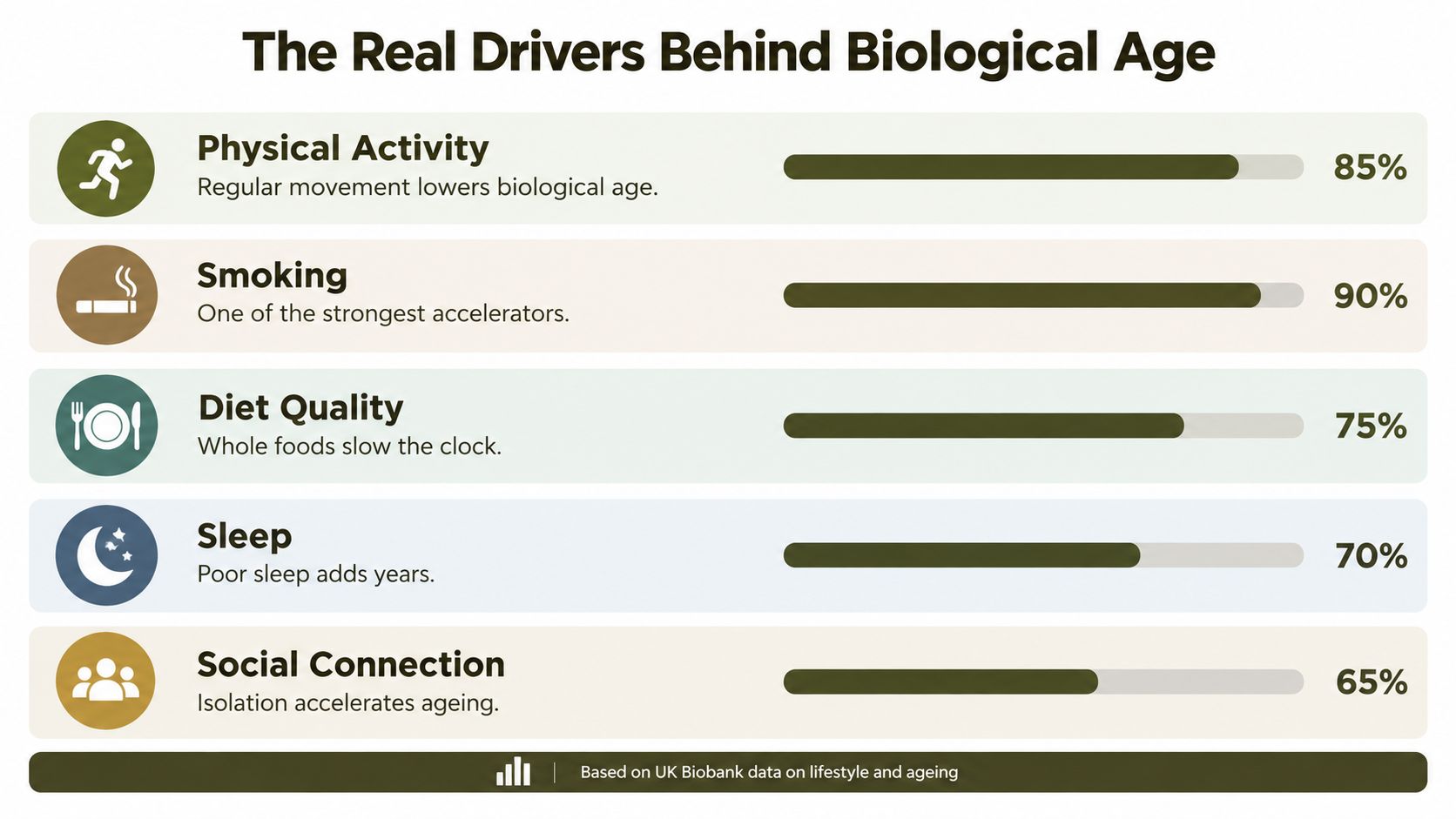
A biological age score is only useful if you know what moves it. In a large UK Biobank analysis of 59,316 healthy participants, researchers built an integrative biological-age model from physical measures, biochemical assays, cognitive functions, and genomic data, then identified 35 modifiable factors associated with the age gap (AAN press release).
What actually shifts the needle
The strongest associations were tied to pulmonary function, body mass, hand grip strength, basal metabolic rate, estimated glomerular filtration rate, and C-reactive protein (AAN press release). That mix tells you something important. The most actionable levers are not just “age” in the abstract, they're cardiometabolic, renal, inflammatory, and functional-performance markers.
If you only chase the score, you miss the levers that move it.
What to track instead of obsessing over a number
A practical program should watch the markers and functions that biological age tends to reflect.
- Pulmonary and cardiovascular fitness: Your breathing capacity and exercise tolerance often reveal more about resilience than a single score.
- Strength and body composition: Hand grip strength and body mass are not vanity metrics, they're functional signals.
- Kidney and inflammatory markers: Estimated glomerular filtration rate and C-reactive protein tell you whether the body is under strain.
- Energy and recovery: Sleep quality, daily vitality, and training recovery help explain why the same score feels different from one month to the next.
The point is not to make biological age into a lifestyle superstition. The point is to use it as a summary signal, then look underneath it for the markers you can improve.
For a simple overview of biomarker categories, this examples of biomarkers guide is a useful reference.
Interpreting Your Biological Age Result
A biological age result is best read as a gap, not as a verdict. If the number comes back higher than your chronological age, the immediate question isn't panic, it's context. If it comes back lower, that still doesn't mean you can relax and ignore sleep, strength, or cardiometabolic health.
A simple reading framework
Start with the direction of the gap.
- Higher than chronological age: Treat it as a prompt to review recovery, inflammation, metabolic health, and functional capacity.
- Lower than chronological age: Treat it as encouraging, but still verify whether the result matches how you feel and perform.
- Flat over time: Look for maintenance, because stability can be a good outcome when life is stressful or training load is high.
A single result also shouldn't be over-read. Hydration, recent illness, sleep disruption, acute stress, and even timing around training can distort what a test appears to say. The safest move is to compare like with like, under similar conditions, and focus on trend rather than drama.
Why the function question still matters
A 2025 scoping review notes that methylation-based clocks can correlate strongly with chronological age, but that correlation doesn't fully answer how well they reflect intrinsic aging versus a model built mainly to predict age itself (Frontiers review). The same review also highlights that biological age spans molecular, cellular, tissue, organ, and functional levels, which is why one score can miss energy, sleep, and resilience.
If your result doesn't match how you function, trust the mismatch enough to investigate it. A good test starts a conversation about lab work, training load, sleep debt, and recovery habits. It doesn't end one.
For deeper lab context, see the longevity blood test guide.
When Tracking Biological Age Makes Sense
Biological age tracking is useful when you want feedback, not certainty. It works especially well for high-performing adults over 40 who already care about sleep, energy, training, and recovery, because it gives them a way to see whether their effort is reflected in their biomarkers and function.
Good reasons to track it
- You're already changing habits: If you've started strength training, improved sleep, or tightened nutrition, a longitudinal test can help you see whether the plan is moving the right markers.
- You want objective feedback: Some people don't trust vibes alone. They want a data point that sits alongside how they feel and perform.
- You're managing midlife drag: Restless sleep, lower energy, and slower recovery are common reasons to look beyond chronological age.

When it's mostly noise
Biological age is less useful if you're hoping for a clean diagnostic answer, a replacement for routine medical screening, or a single number that settles every question about your health. It's also a poor fit if you know you'll react emotionally to one unfavorable result and make drastic changes without context.
A better rule is simple. Use it when you're prepared to act on trends, not when you're hunting for reassurance.
For people who want structured guidance around these markers, Longwelle offers a short assessment, biomarker monitoring, and optional access to licensed nurse practitioners, which can help put the result in context without pretending the score is the whole story.
Building a Personalized Longevity Plan
A useful longevity plan starts with baselines, not hype. If you want biological age to mean anything, you need a way to connect it to daily behavior, repeat measurements, and the few markers that matter most to you.
A practical framework
- Get a baseline: Record your current biomarkers, sleep, energy, training load, and any existing clinical context.
- Pick a small set of priorities: Focus on one or two areas that are already limiting you, such as poor sleep, low strength, or rising inflammatory burden.
- Match interventions to the signal: Improve the habits that influence those markers, rather than trying to “fix aging” in general.
- Retest on a schedule that makes sense for change: The goal is trend visibility, not constant checking.
- Review results with context: If a change looks off, look at stress, illness, travel, training, and recovery before declaring success or failure.
What tends to work better than extremes
Consistent routines usually beat dramatic resets. Daily movement, better sleep, improved nutrition quality, and targeted lab follow-up are more useful than chasing one-off interventions that look exciting but don't hold up over time.
If you want a structured way to connect assessments to habits and follow-up, the healthspan optimization guide is a practical place to start.
Small changes become meaningful when you can repeat them and verify the effect.
Frequently Asked Questions
Can biological age be reversed?
It can move in a better direction when the underlying markers improve, but that doesn't mean you've rewound time. Think of it as a modifiable estimate of physiological state, not a time machine.
How often should I test?
Test often enough to see a trend, not so often that you confuse normal fluctuation with progress. Repeated measurements are more valuable than one dramatic reading.
What if my biological age is higher than my chronological age?
Treat it as a cue to review recovery, strength, metabolic markers, inflammation, and sleep. One result shouldn't trigger panic, but it shouldn't be ignored either.
Are epigenetic tests reliable enough to guide decisions?
They can be informative, but they're not a universal gold standard and they don't settle every question about function or risk. Use them as one input among several, especially when the score doesn't match how you feel or perform.
What matters more, the score or the trend?
The trend. A single number can mislead, while repeated results under similar conditions are far more useful for making decisions.
If you want a clearer way to turn biomarker results into action, Longwelle combines a brief assessment, biomarker monitoring, and optional nurse practitioner support in one longevity-focused workflow. It's a practical fit if you want to understand your healthspan signals without reducing your body to a single number.