Learn
Online Health Coaching for Midlife Longevity
Explore online health coaching for midlife longevity. Learn how modern programs support behavior change, biomarker tracking, and lasting healthy aging outcomes.

A 48-year-old professional can leave an annual physical with “normal” results and still know something has changed. Sleep is less restorative, the waistline has gradually expanded, and a familiar workout now requires more recovery. The lab report may not show an urgent problem, but daily experience is sending a different message.
That gap creates a difficult decision. Wellness influencers recommend supplements, longevity headlines contradict one another, and health apps produce more notifications than priorities. Online health coaching can help by turning broad health advice into a structured process: identify the most useful starting point, connect habits with measurable feedback, and adjust the plan without confusing coaching with medical care.
Table of Contents
- The Midlife Moment Driving Online Health Coaching
- What Online Health Coaching Actually Is
- The Three Coaching Models You Will Encounter
- How Behavior Change and Biomarkers Connect to Longevity
- How to Evaluate Any Online Health Coaching Program
- Why Biomarker Tracking and Medical Oversight Matter
- Do You Need a Human Coach or Is AI Enough
- A Practical First 90 Days and Key Questions Answered
The Midlife Moment Driving Online Health Coaching
Midlife rarely presents one isolated problem. Sleep may deteriorate while exercise becomes less consistent. Work demands, caregiving, travel, and changing responsibilities can make a previously reliable routine difficult to maintain. At the same time, many adults begin paying closer attention to cardiometabolic health, strength, recovery, and the prospect of staying active later in life.
The challenge isn't a lack of information. It's deciding what deserves attention first.
A normal annual physical can provide reassurance, but it may not explain why you feel tired after a poor night's sleep, why training feels harder, or why your usual eating pattern no longer produces the same results. A coach can help translate those experiences into practical questions for a physician, useful behavior targets, and a review process that distinguishes a temporary disruption from a persistent trend.
Practical rule: In midlife, prioritization usually creates more value than adding another optimization project.
The commercial scale of digital coaching reflects this demand. One industry report valued the global digital health coaching market at USD 10.22 billion in 2023 and projected it to reach USD 29.46 billion by 2031, with a projected compound annual growth rate of 14.39%. The same report estimated that North America represented 40.50% of the market in 2023, with a regional value of USD 4.14 billion. These figures come from the Grand View Research digital health coaching market report, and they show that digital coaching has moved well beyond a small wellness niche.
Why a structured plan matters
Longevity advice often fails at the point of application. “Sleep better” doesn't tell you whether to change your bedtime, evening light exposure, alcohol routine, training schedule, or room environment. “Improve metabolic health” doesn't identify whether your first step should involve meal composition, daily movement, resistance training, sleep regularity, or a conversation with your clinician.
Online health coaching acts as a translation layer between health research and ordinary decisions. The right program won't promise that one habit will solve every concern. It will help you choose a manageable target, observe what happens, and decide what to change next.
This guide focuses on that evaluation process. It covers what online coaching includes, how human and AI models differ, why biomarker feedback matters, and how to keep coaching aligned with medical oversight.
What Online Health Coaching Actually Is
Online health coaching combines three layers that work together.
The first is digital delivery. A program may use secure messaging, video consultations, app-based check-ins, wearable integrations, questionnaires, and progress dashboards. This format removes geography as a barrier and allows support to continue between appointments. A member can record sleep, activity, meals, or symptoms during the week, then use that information in a scheduled review.
The second layer is behavior change support. A coach helps turn a broad ambition into a specific action, such as preparing a protein-rich breakfast before work, scheduling strength training around travel, or creating a wind-down routine that can survive a busy evening. The coach also helps identify obstacles, review adherence, and modify the plan when the original strategy doesn't fit real life.
The third layer is clinical integration. In a more serious longevity program, wearable patterns, continuous glucose monitor trends, and blood biomarker results shouldn't sit in separate silos. A coach may help you understand what a trend means for your next behavior, while a qualified medical professional determines whether a result requires clinical evaluation or treatment.
What it isn't
Online health coaching isn't just a course, a library of meal plans, or an automated stream of motivational messages. It also isn't a substitute for diagnosis, prescription treatment, or urgent medical care.
A chatbot may answer a question. An app may count steps. A meal plan may provide convenient recipes. Coaching adds an iterative relationship, where information leads to a decision, the decision leads to an action, and the result informs the next decision.
That distinction matters because midlife goals rarely remain stable. A plan designed for an energetic month may fail during a work deadline, a family illness, or a change in medication. Good coaching makes room for those conditions instead of treating them as personal failure.
Research supports the broader idea that technology-enabled coaching can produce measurable changes. In a 2025 real-world evidence study of adults using a digital coaching platform, participants who completed baseline and three-month assessments improved in distress tolerance, perceived stress, self-compassion, and mindfulness, with all reported changes statistically significant at p < 0.01. The study is available in BMC Health Services Research through Springer. The result doesn't mean every program will produce the same outcome. It does show why structured digital support should be judged as an intervention process, not merely as content delivery.
The Three Coaching Models You Will Encounter
Most buyers will encounter three broad structures. The important question isn't which model has the most fashionable technology. It's which model has enough judgment, responsiveness, and accountability for your starting point.
Human-led coaching
A human coach provides context that an automated system may miss. You can explain that a missed workout happened because of a sick child, a difficult work trip, or a new symptom rather than lack of commitment. The coach can help you preserve the goal while changing the method.
This model is often most useful when several issues overlap. Someone managing sleep disruption, low energy, changing medication, and a complicated training history may need a person who can ask follow-up questions and recognize when the issue belongs with a physician. Human coaching can also help when emotional resistance, shame, grief, or burnout affects adherence.
The limitations are practical. Availability varies, communication may be slower, and the quality depends heavily on the coach's training and scope of practice. Ask whether the coach can review lab information, how referrals work, and what happens when a concern falls outside coaching.
AI-driven coaching
AI coaching is strongest at continuous pattern recognition and fast feedback. It can identify that your sleep schedule has shifted, notice a repeated gap in movement, summarize food logs, or suggest a small adjustment based on your stated preferences. It can also provide reminders without requiring a scheduled appointment.
The trade-off is limited judgment. An AI system may detect that recovery markers look unusual, but it shouldn't independently explain a medication effect, diagnose a condition, or decide whether you should train through unexplained fatigue. It may also struggle when the best choice depends on values, emotional readiness, or competing responsibilities.
Hybrid coaching
A hybrid model combines automated monitoring with periodic human review. AI handles routine prompts, trend summaries, and daily reinforcement. A coach handles strategy, ambiguity, accountability, and escalation.
A 2026 systematic review of coach-facilitated digital health interventions identified 35 studies and found that human, AI, and hybrid approaches were feasible and acceptable. The review appears in Supportive Care in Cancer. The evidence also indicates that engagement and protocols varied, so “hybrid” alone doesn't guarantee quality.
| Dimension | Human-led coaching | AI-driven coaching | Hybrid coaching |
|---|---|---|---|
| Responsiveness | Depends on appointment and messaging availability | Fast responses and frequent prompts | Fast routine feedback with scheduled human review |
| Personalization | Deep contextual personalization | Strong pattern-based personalization | Combines data patterns with personal context |
| Complexity | Better for setbacks, conflicting goals, and unusual circumstances | Best for repeatable daily behaviors | Useful when daily consistency and periodic judgment are both needed |
| Clinical integration | Can coordinate with medical professionals if the program has a defined pathway | Requires clear safety boundaries and escalation rules | Offers the strongest structure when AI monitoring connects to qualified human oversight |
| Best starting point | Complex goals or low confidence | Clear goals and comfort with self-directed tools | Busy adults who want automation without losing human accountability |
How Behavior Change and Biomarkers Connect to Longevity
A biomarker becomes useful only when it changes a decision.
Suppose your sleep becomes irregular and your training recovery worsens. A coaching process might first examine bedtime consistency, evening stimulation, alcohol, workload, and exercise timing. It can then help you choose one or two changes rather than imposing a complete lifestyle overhaul. Over time, blood markers, body composition, fitness measures, or wearable trends may provide additional context.
The coach's role is to connect behavior, measurement, and adjustment. That connection prevents two common mistakes: assuming that effort automatically produced the intended physiological result, or abandoning a useful habit because one short-term measurement looked disappointing.
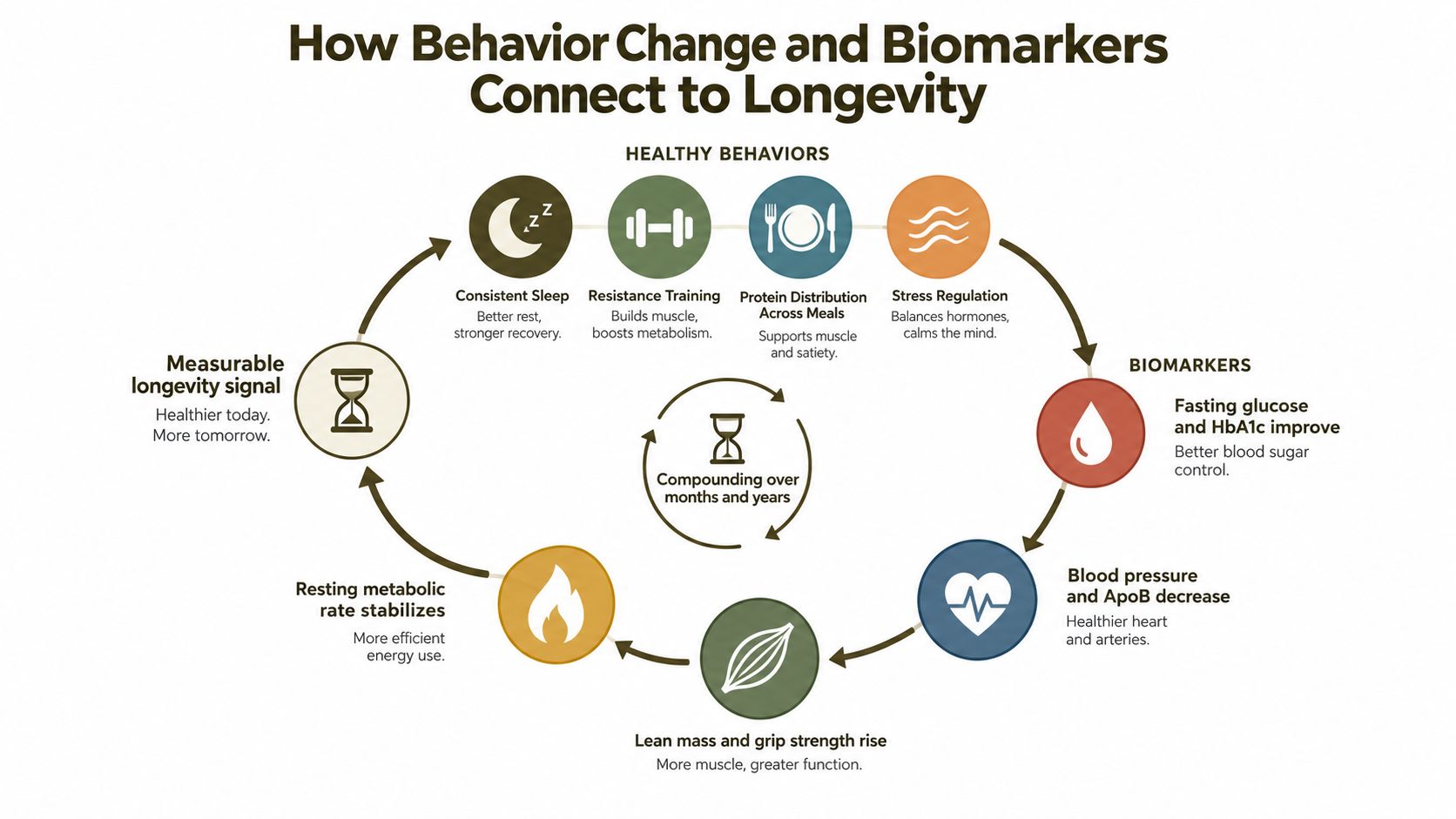
What the feedback loop looks like
Healthy aging behaviors can include consistent sleep, resistance training, protein distribution across meals, stress regulation, aerobic activity, and regular recovery. These behaviors influence different aspects of physiology, but the relationship isn't always immediate or linear.
A coach can help you ask better questions:
- Is the behavior specific enough? “Exercise more” is less useful than a defined training pattern that fits your schedule.
- Is the measurement appropriate? A single weight reading won't describe body composition, while a step count won't describe strength or recovery.
- Is the review interval sensible? Some changes need time before they can be interpreted responsibly.
- Is the result clinically meaningful? A coach should not turn a laboratory result into a diagnosis or treatment recommendation outside their scope.
The evidence base supports the value of tracking and feedback rather than advice alone. A 2024 umbrella review and meta-meta-analysis covering 44 randomized controlled trials and 15,100 participants reported pooled changes including 1,329 additional steps per day, 55 more minutes of moderate-to-vigorous physical activity per week, 103 fewer kilocalories per day, and 1.9 kilograms lower body weight, alongside improvements in sleep quality and insomnia severity. The findings are reported in the PubMed record for the review.
Those results shouldn't be treated as a personal forecast. They support a more modest conclusion: digital systems can help shift behavior when tracking, feedback, and repeated prompts are implemented consistently. Longevity coaching should therefore focus on a closed loop, not a collection of disconnected recommendations.
How to Evaluate Any Online Health Coaching Program
A polished app isn't evidence of a well-designed program. Before signing up, ask how the service works when your motivation is high, when it drops, and when your data raises a concern.
Start with accountability
Find out how often someone or something checks in, who responds when you stop logging, and what happens if a goal repeatedly fails. “Support whenever you need it” is less informative than a defined messaging response, review cadence, and escalation process.
Examine the intake
A useful intake should go beyond a personality quiz. Ask whether the program considers medical history, medications, sleep, activity, nutrition, goals, constraints, and relevant laboratory information. A templated plan may be convenient, but it should still show how recommendations change based on your answers.
Demand data transparency
You should know what information the platform collects, how it is displayed, and whether you can retain copies of reports. If the program uses biomarkers, ask which results matter for your goals, who interprets them, and when repeat testing is considered appropriate.
Confirm professional boundaries
A responsible service explains what coaches can do and when they refer to a physician, registered dietitian, nurse practitioner, or other qualified professional. It should also provide a clear process for symptoms, abnormal results, medication questions, and urgent concerns.
Before paying, ask: Who reviews my data, what happens when the plan stalls, and where does coaching stop?
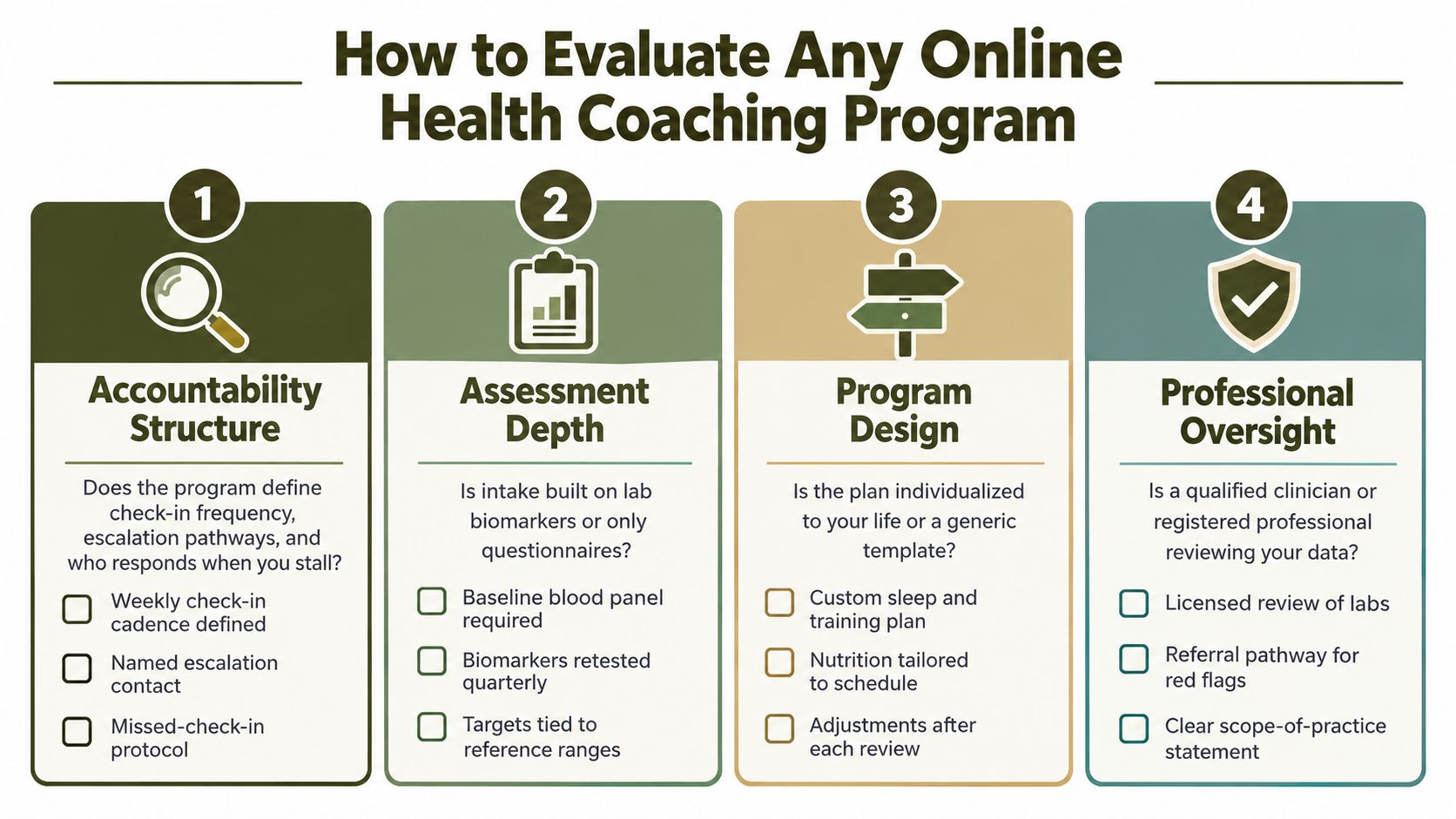
Use this short checklist to compare providers:
- Accountability: Is the check-in cadence clear? Is there a named contact or escalation route?
- Personalization: Does the plan adapt to your schedule, preferences, results, and barriers?
- Data: Can you see the trends, understand the inputs, and access your reports?
- Oversight: Are qualified professionals involved when interpretation or referral is needed?
- Safety: Does the program avoid diagnosis, unmonitored supplement stacking, and aggressive changes without appropriate context?
For further background on choosing priorities rather than collecting endless interventions, review this guide to healthspan optimization. Treat vague outcome language, one-size-fits-all protocols, pressure to buy unnecessary products, and missing safety boundaries as reasons to pause.
Why Biomarker Tracking and Medical Oversight Matter
Self-reported habits are useful, but they aren't complete evidence of physiological change. Step counts tell you about movement. Body weight reflects more than fat mass and can shift with hydration. A food log depends on accurate recording and can't reveal every factor affecting metabolism or recovery.
Biomarkers add another layer. Results such as fasting glucose, HbA1c, lipid measures, inflammatory markers, and other clinically relevant tests can help you and a qualified professional evaluate whether a lifestyle strategy deserves continuation or revision. They don't replace symptoms, examination, medical history, or clinical judgment.
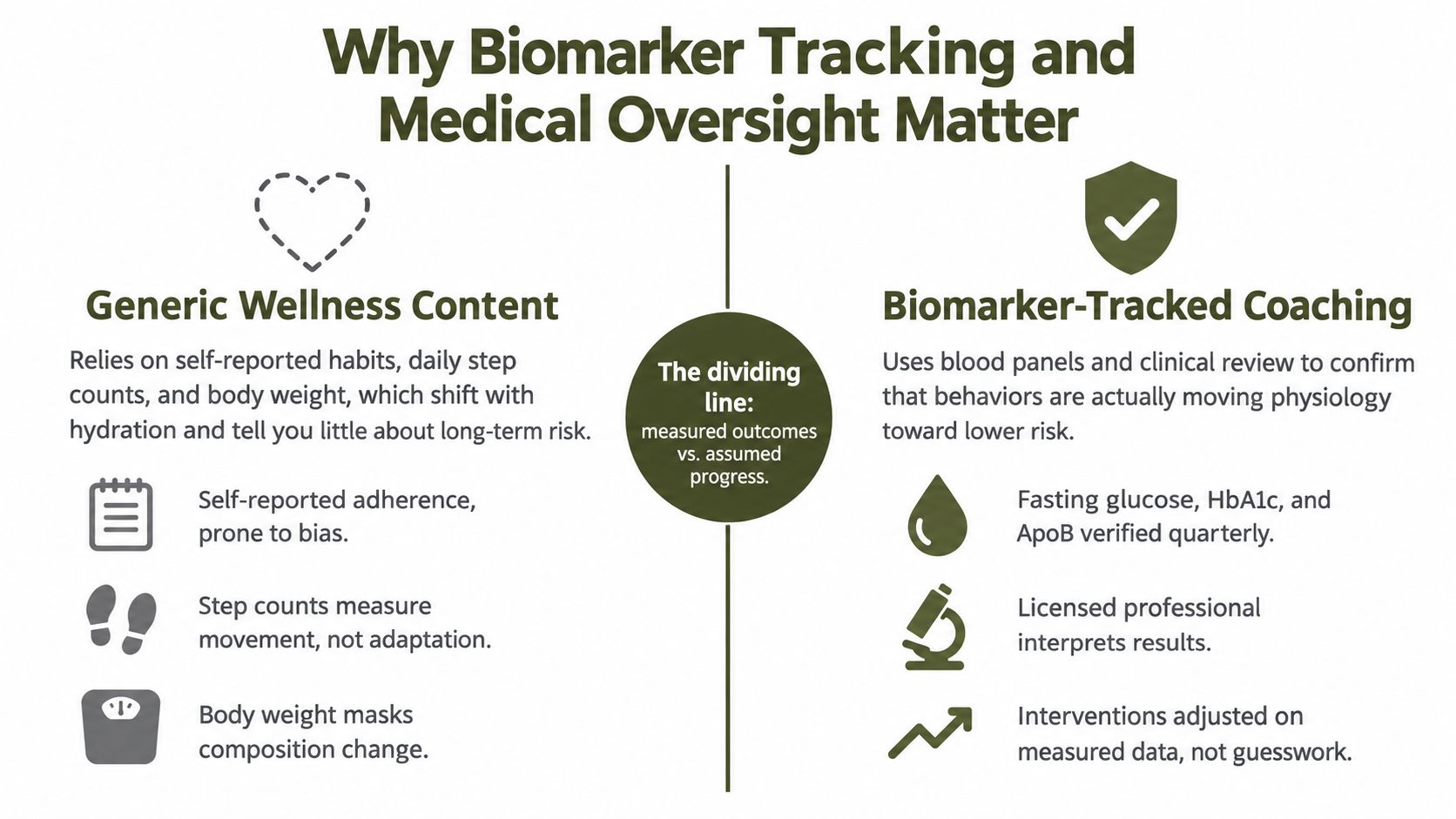
The value is interpretation
A result outside a reference range doesn't automatically identify a cause. A change may relate to medication, illness, training load, sleep, diet, laboratory variation, or a condition that requires medical evaluation. A coach can help organize the information and prepare questions, but qualified clinicians should handle diagnosis and treatment decisions.
That boundary protects the member. It reduces the risk of responding to one result with an extreme diet, unnecessary supplements, or a training plan that ignores fatigue. It also makes the coaching relationship more useful because the program can support medical care rather than compete with it.
A service that coordinates with a primary care physician or specialist should explain how that coordination works. Can you share reports? Who contacts the clinician? Does the service tell you to seek care when a result or symptom falls outside its scope? These operational details matter more than a dashboard full of colorful charts.
For a practical introduction to testing and interpretation, see this resource on longevity blood testing. The aim isn't to turn every wellness decision into a medical procedure. It's to make sure that measurable data is interpreted responsibly and connected to an appropriate next step.
Do You Need a Human Coach or Is AI Enough
The human-versus-AI debate is too narrow. The useful question is which tasks require automation and which require judgment.
AI can manage repetitive work effectively. It can detect a gradual change in sleep timing, summarize activity patterns, identify missed habits, organize a food log, and generate reminders based on your routine. If your goal is to build a consistent evening walk or remember a planned breakfast, fast feedback may be more valuable than another appointment.
AI can also help create a shared record for a human review. Instead of trying to remember every difficult night or skipped workout, you can bring a summarized pattern to the coach. That makes the conversation more specific.
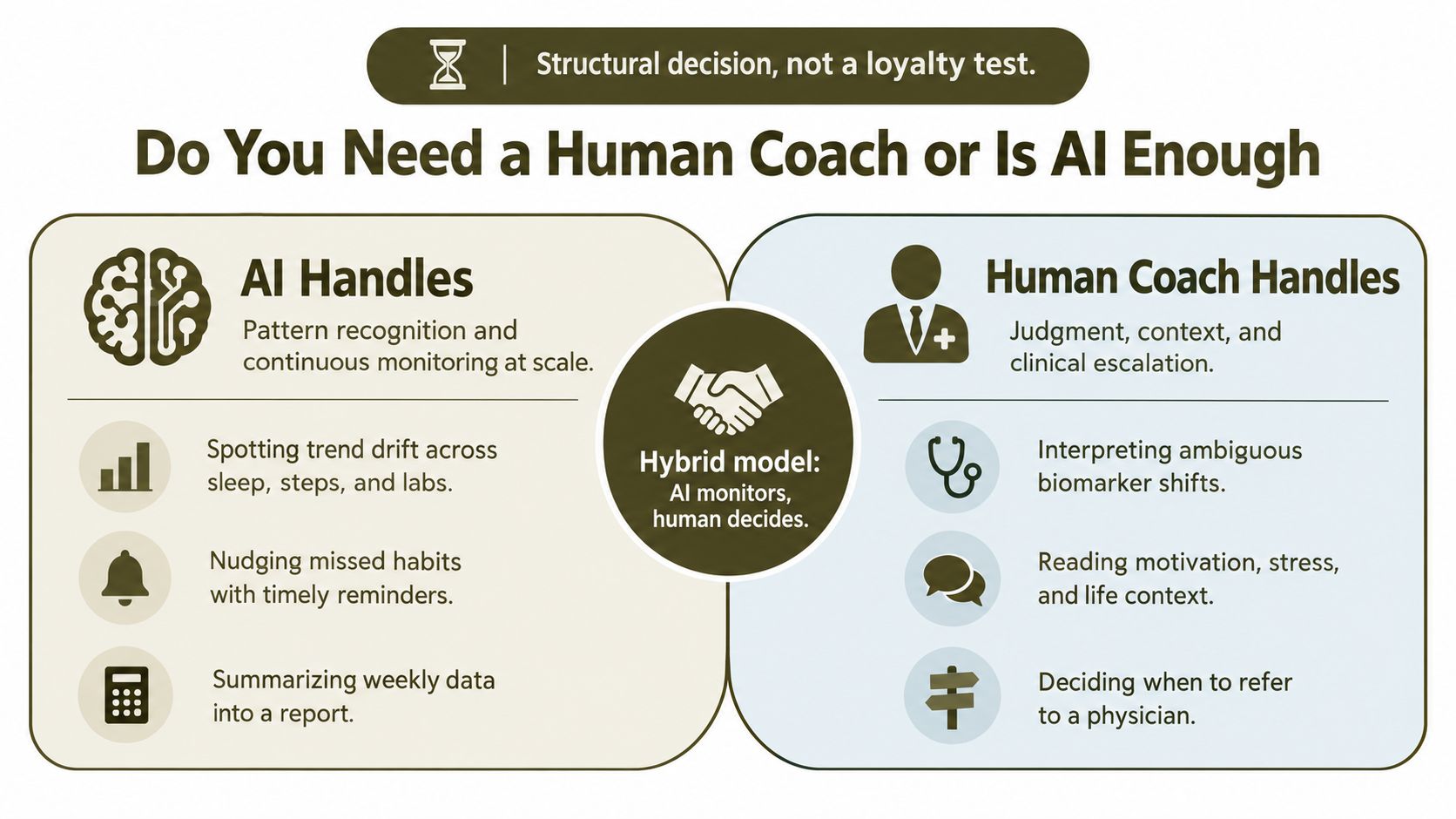
Where human judgment changes the decision
Consider a person whose hs-CRP trend rises after a medication change. An automated system may flag the movement. A human coach can help place it in context, identify the relevant timeline, and direct the member to the prescribing clinician rather than suggesting an improvised supplement stack.
Or consider a poor HRV reading after several nights of disrupted sleep. An AI tool may recommend recovery. A human coach can ask whether the person has symptoms, whether training is important for mental health that day, and whether the pattern is isolated or persistent. The coach still shouldn't diagnose the cause, but can help turn uncertainty into a safer decision and a clear referral if necessary.
A 2025 systematic review found that human, AI, and hybrid coaching were all feasible and acceptable, while differences in engagement and protocols made direct comparisons difficult. A related discussion of the evidence appears in Frontiers in Digital Health. The practical implication is not that AI is inadequate or that human coaching is always superior. It's that the service should match the task.
This AI health coach model can be useful for between-session guidance, but readers should still ask how the system handles uncertainty, sensitive data, and escalation. For many adults over 40, the most sensible structure is hybrid: AI monitors and prompts, while a human provides context, accountability, and referral judgment.
A Practical First 90 Days and Key Questions Answered
You don't need to redesign your entire life before starting. Use the first 90 days to establish a baseline, test a focused plan, and decide what deserves continued attention.
Days 1 to 30
Begin by gathering relevant medical information and discussing appropriate bloodwork with your healthcare professional. Choose one coaching model based on your complexity, availability, and need for accountability. Select two behavior targets, such as a consistent sleep schedule and resistance training, or aerobic activity and more deliberate protein distribution across meals.
Keep the targets narrow enough to observe. Record the behavior, the obstacle, and how you feel. Avoid changing ten variables at once, because you won't know which adjustment helped or created a problem.
Days 31 to 60
Add the feedback loop. Review wearable patterns, adherence, symptoms, and any available biomarker information with the appropriate professional. If the plan isn't working, change the design rather than just demanding more willpower.
This is also the right time to test the check-in structure. Does an AI prompt help you act? Does a human conversation help you solve barriers? Do you know who to contact when a result or symptom falls outside the program's scope?
Days 61 to 90
Compare the information you have collected and keep only the practices that fit your life and show a useful signal. Discuss repeat testing with your clinician rather than assuming every marker needs frequent measurement. Formalize a sustainable routine for the next season, including what you'll track, when you'll review it, and which changes require professional input.
Common questions
Is online health coaching covered by insurance or an HSA? Coverage varies by plan, provider, service type, and location. Ask the program for current billing information and confirm eligibility directly with your insurer or HSA administrator before enrolling.
How should a program handle biometric and lab privacy? Look for a clear privacy policy, secure data practices, an explanation of third-party sharing, and a way to request or export your records. You should understand what data the service stores and why.
How do I coordinate coaching with my doctor? Tell your primary care physician or specialist which habits, devices, tests, and supplements the program recommends. Keep one current list of medications and interventions, ask which professional owns each decision, and don't delay medical care while waiting for a coaching response.
The best online health coaching program won't remove every uncertainty. It will help you identify the next responsible action, measure what matters, and stay consistent long enough to learn from the result.
Longwelle offers a brief longevity assessment, personalized wellness guidance, biomarker tracking, AI-supported habit tools, and optional consultations with licensed nurse practitioners. Visit Longwelle to explore a structured, evidence-informed approach to midlife health and healthy aging.