Learn
Microbiome and Aging: What Research Reveals About Longevity
Microbiome and Aging. Discover how the gut microbiome influences aging. Learn what research reveals about diet, probiotics, and actionable steps

You wake up tired despite a full night in bed. Your digestion feels less predictable than it used to, your weight responds differently to familiar meals, and recovery from stress or exercise takes longer. These changes often get filed under “normal aging,” but that explanation can hide useful information.
The gut microbiome, the community of microorganisms living in the digestive tract, may offer part of the picture. It doesn't provide a simple biological age score, and it can't explain every symptom. But microbiome patterns can add context to conventional health measures, especially when you track them alongside diet, medication, metabolic markers, inflammation, sleep, and daily function.
Table of Contents
- Why Your Gut Matters More as You Age
- What the Research Shows About Microbiome Changes
- Connecting Microbiome Insights to Longevity Biomarkers
- Diet and Probiotics, What Actually Supports Microbiome Health
- Building a Microbiome-Supportive Daily Routine
- Common Myths About Microbiome Testing and Aging
Why Your Gut Matters More as You Age
A midlife professional might respond to new fatigue by adding coffee, to digestive discomfort by removing more foods, and to restless sleep by buying another supplement. That sequence is understandable, but it treats each symptom as a separate problem. The gut is one place where digestion, immune activity, metabolism, and daily habits intersect, so changes there may provide useful clues about the broader aging process.
The microbiome isn't a single organ or a fixed list of “good” and “bad” bacteria. It's an ecosystem whose members interact with one another and with the food, medications, and other conditions around them. Two people can have different microbial communities and both be healthy. The more practical question isn't whether your results match somebody else's ideal profile. It's whether your microbial pattern appears stable, adaptable, and consistent with the rest of your health picture.

Why midlife deserves attention
Midlife often brings several changes at once. People may alter their eating patterns, move less during demanding work periods, sleep irregularly, take new prescriptions, or experience hormonal transitions. Each factor can influence digestion and microbial ecology, which makes it difficult to label a change as “age-related” without considering the surrounding context.
That distinction matters for longevity. A microbial result can reflect a current diet, a recent illness, medication exposure, or a chronic condition. It may also reflect a resilient aging pattern. Without those details, a test can create anxiety rather than insight.
Practical rule: Treat a microbiome result as context, not a verdict. Interpret it beside symptoms, habits, medications, and clinically relevant biomarkers.
The most useful role for microbiome data is therefore comparative. A single sample gives you a snapshot. Repeated observations, combined with changes in energy, bowel regularity, sleep, and laboratory measures, may help you and a qualified professional identify whether a pattern is persistent or temporary.
From gut health to healthy aging
Researchers increasingly study the microbiome alongside established measures of health rather than in isolation. This approach avoids the common mistake of assuming that every difference between younger and older adults represents decline. Some microbial changes may accompany healthy adaptation, while others may occur with frailty, inflammation, illness, or treatment burden.
The practical implication is straightforward. You don't need to chase a mythical “young” microbiome. You need a structured way to support your gut and assess whether your overall trajectory is moving in a healthier direction.
What the Research Shows About Microbiome Changes
The research on microbiome and aging doesn't support a simple story in which microbial diversity always falls as people grow older. A 2022 cross-cohort analysis pooled 21,000 fecal microbiomes from seven data repositories across five continents, including participants aged 18 to 107 years. The study found that diversity and uniqueness correlated with aging, but not in a straightforward linear pattern associated with healthy aging. It also examined Kendall uniqueness, a measure related to movement away from a shared core microbiome structure. The full Nature Aging study is important because it shows why “older equals less diverse” is an inadequate interpretation.
Diversity describes how many different microbial taxa or functions are present and how evenly they are represented. It can be useful, but it isn't a universal health score. A person can have a diverse community that functions poorly in a particular context, while another person can have a less varied community that remains stable and compatible with good health.
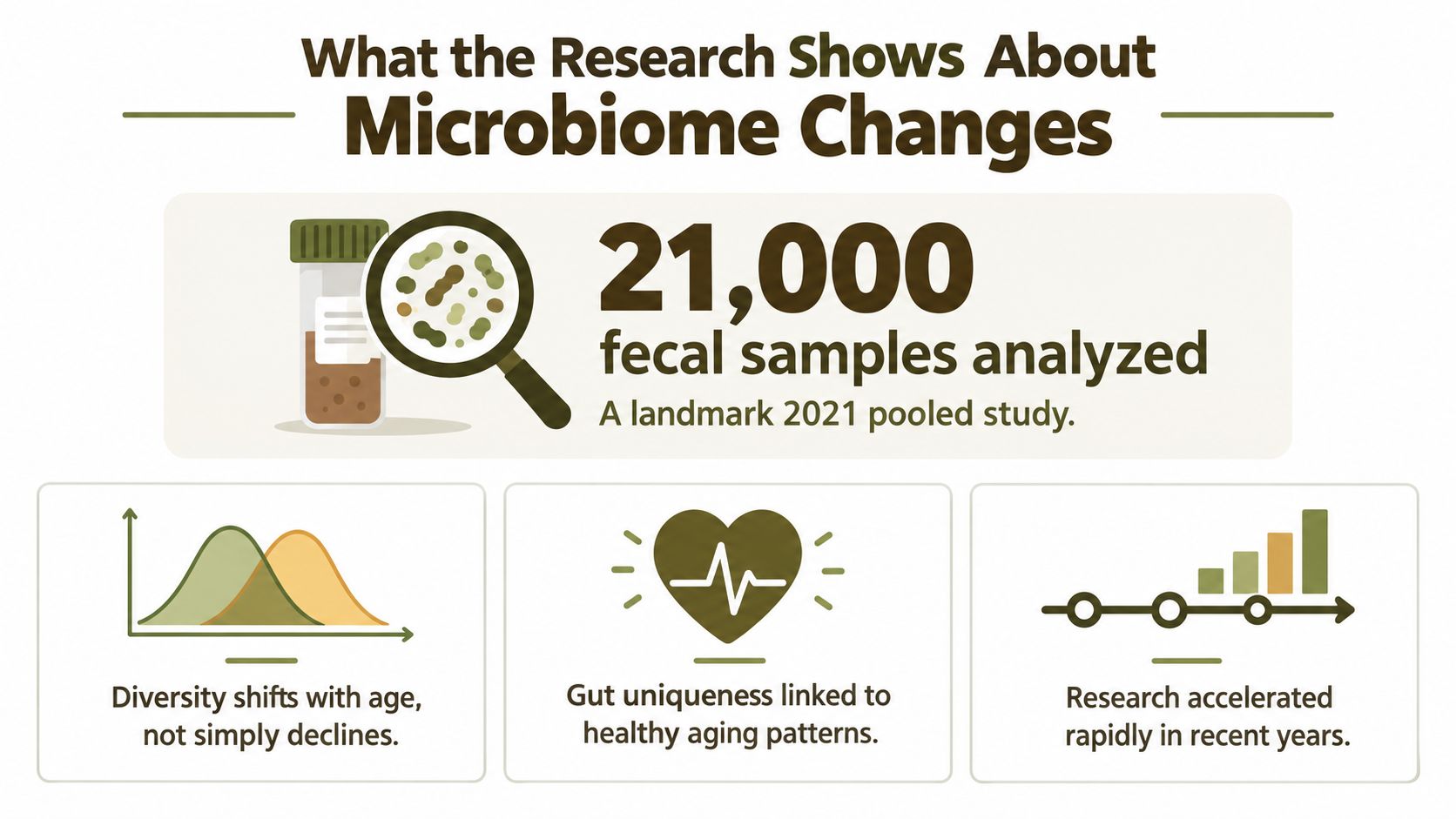
Diversity is not the same as resilience
A major 2020 systematic review identified 27 empirical human studies of normal and successful aging. Across those studies, older adults generally showed higher alpha diversity in microbial taxa, functional pathways, and metabolites than younger people, especially among the oldest-old. The systematic review in PMC helped bring scattered findings into a common framework and emphasized that the strongest signals were connected with healthy aging, not chronological age alone.
That finding changes the practical question. Instead of asking, “How do I make my microbiome look young?” ask, “Does my microbial community fit a pattern of healthy function and resilience?” The answer requires more than a diversity number. It may involve the composition of the community, its functional signals, the stability of results over time, and how those findings align with your health status.
Why one sample has limits
Microbiome research often compares groups rather than predicting outcomes for one person. A group-level association can identify a promising biological pattern, but it doesn't prove that changing one organism will improve an individual's longevity. Sampling method, recent food intake, medication, bowel patterns, and underlying illness can all affect interpretation.
The elderly cohort data described in the 2022 research also showed that a substantial share of participants had communities dominated by Bacteroides, with Firmicutes representing another large average share across samples. Those observations establish that aging can involve measurable compositional shifts, but they don't create a universal target profile for every adult.
This is why the strongest interpretation combines composition, function, trajectory, and clinical context. A result that looks unusual in isolation may be unimportant. A modest shift that persists alongside worsening metabolic or inflammatory markers may deserve closer attention.
The research is valuable, but it doesn't justify a simplistic “microbiome age” label. Aging biology is heterogeneous, and microbial change can represent adaptation, medication effects, disease-driven dysbiosis, or some combination of these processes.
Connecting Microbiome Insights to Longevity Biomarkers
A microbiome test becomes more useful when it answers a decision-relevant question. For example, are digestive symptoms appearing alongside broader metabolic changes? Did a microbial pattern change after a medication or major dietary shift? Are subjective improvements in energy and sleep accompanied by objective changes in relevant health markers?
That is the difference between collecting data and practicing personalized longevity care. The microbiome can add biological context, while conventional testing can help assess the systems most relevant to a person's symptoms and goals. Neither category replaces the other.
Build a connected picture
A practical review may include:
| Biomarker Category | What It Indicates | Why It Matters for Aging |
|---|---|---|
| Microbiome composition | Which organisms and community patterns are detected | Adds ecological context to diet, digestion, medication, and health changes |
| Microbial functional signals | Potential activities associated with the detected community | Helps move beyond counting organisms alone |
| Metabolic indicators | How the body is handling glucose, lipids, and related processes | Provides context for healthspan and long-term risk management |
| Inflammatory markers | Signals associated with immune activation | Helps distinguish a local digestive concern from a broader pattern requiring clinical attention |
| Reported symptoms and habits | Daily function, sleep, diet, bowel patterns, and recovery | Shows whether laboratory patterns correspond with lived experience |
The table isn't a diagnostic algorithm. It's a reminder that no single microbial feature can summarize aging quality. A person with a stable microbiome result and worsening symptoms needs a different conversation from someone with an unusual result but good function and stable clinical markers.
Track change rather than chase a target
Longitudinal tracking is especially useful for lifestyle experiments. If you increase fiber, change meal composition, improve sleep regularity, or review a supplement with a professional, record the intervention and observe what changes afterward. Don't attribute every improvement to the microbiome, because several habits often change at the same time.
A sensible monitoring plan defines the question first, chooses relevant measures, and sets a review point. The review should ask whether the intervention is tolerable, whether symptoms changed, and whether the broader health picture supports continuing it.
For a plain-language overview of biomarker categories and how they can fit into a structured wellness plan, see these examples of biomarkers. The important principle is not the brand of test. It's the discipline of interpreting results in context and avoiding conclusions that the evidence can't support.
Diet and Probiotics, What Actually Supports Microbiome Health
The most reliable microbiome strategy is usually less dramatic than the supplement aisle suggests. A varied, fiber-rich eating pattern gives the gut community a steady supply of different substrates. Fermented foods can add live cultures and familiar foods to meals. Probiotic supplements may have a role in specific situations, but they aren't interchangeable, and a capsule isn't automatically more effective than a consistent food pattern.
The evidence also challenges the idea that lower diversity is always harmful. The systematic review of 27 human aging studies found that older adults generally had higher alpha diversity than younger adults, particularly among the oldest-old. That doesn't mean every older person should maximize diversity. It means diet and supplement decisions shouldn't be based on a single simplistic score.
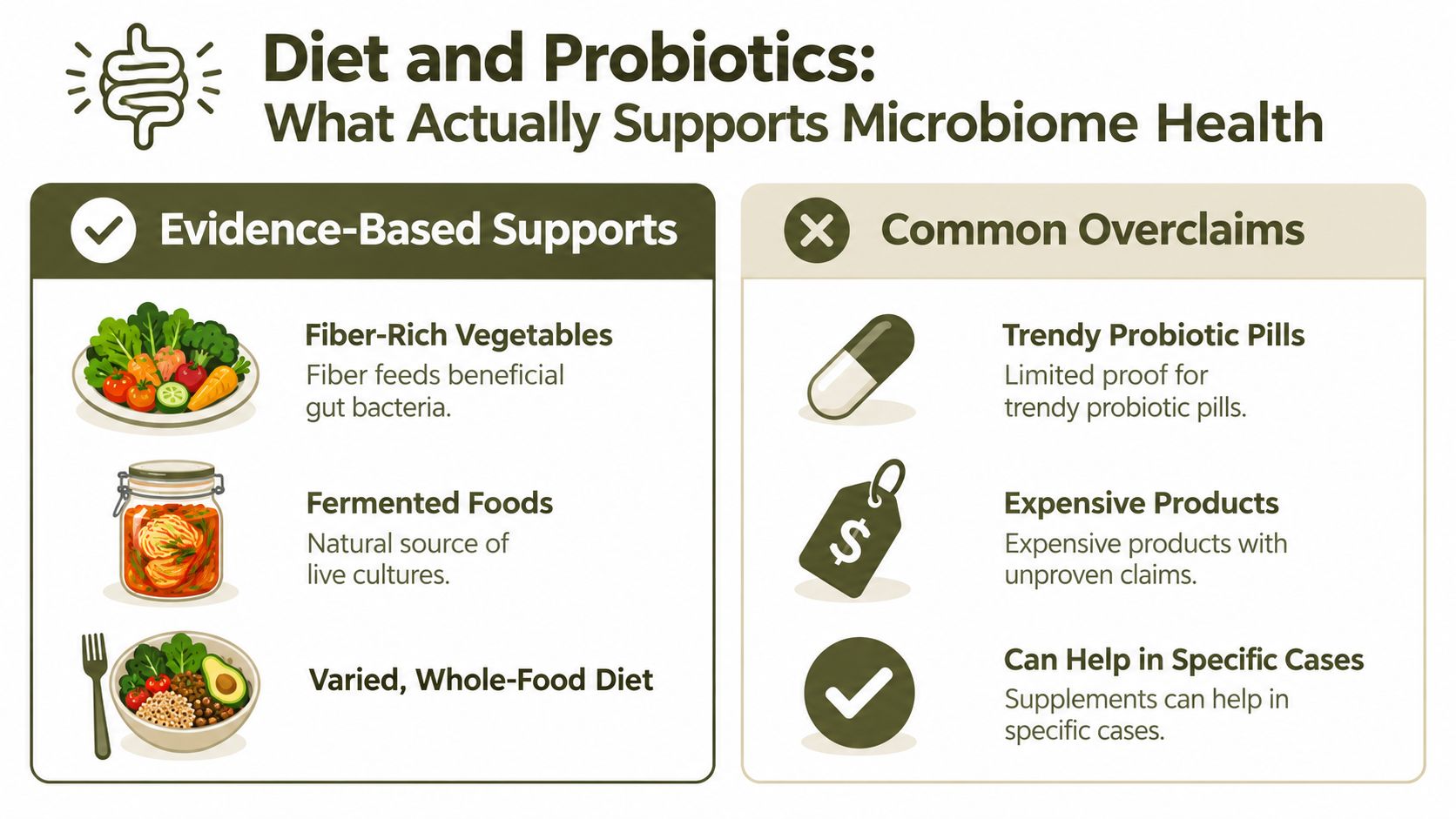
Compare the foundations
Fiber-rich plants are the first place to look. Vegetables, fruit, legumes, whole grains, nuts, and seeds can support a more varied food environment for gut microbes. Increase them gradually if your current diet is low in fiber, particularly if you already experience bloating or irregular bowel movements.
Fermented foods offer another practical option. Yogurt with live cultures, kefir, fermented vegetables, and other traditionally prepared foods can fit into meals without turning your routine into a laboratory protocol. Tolerance varies, so choose foods you can eat consistently.
Whole-food variety matters more than a single “superfood.” Rotating plant foods, using herbs and spices, and building meals around minimally processed ingredients creates a sustainable pattern. A food you can eat regularly is more useful than an expensive ingredient you abandon after a week.
Where probiotics fit
Probiotic supplements should be judged by the specific strain, dose, product quality, intended outcome, and the person's medical context. Evidence for one product or strain can't automatically be transferred to another. Marketing language such as “rebalances your microbiome” or “reverses aging” goes far beyond what an individual test can establish.
A probiotic may be reasonable to discuss with a qualified clinician when there is a defined digestive concern or a specific reason for use. It deserves more caution in people who are immunocompromised, managing complex illness, pregnant, or taking multiple medications.
A useful filter: If a product promises a universal microbiome transformation, ask what outcome was measured, in whom, for how long, and whether the result applies to the exact product being sold.
Prebiotic fibers deserve equal attention. They are food components that microbes can use, but they can also worsen discomfort when introduced too aggressively. Start with a tolerable serving, observe your response, and adjust rather than forcing a rigid target.
A practical longevity diet doesn't require perfection. It requires repeatable meals, enough plant variety to support the ecosystem, and a willingness to change one variable at a time. For broader guidance on turning research into a personalized healthspan plan, explore healthspan optimization.
Building a Microbiome-Supportive Daily Routine
A good routine makes microbiome support ordinary. You don't need to redesign every meal or measure every digestive sensation. Start by attaching a small number of actions to habits you already perform, then record the outcomes that matter to you.
| Habit Category | Specific Action | Impact Level |
|---|---|---|
| Food variety | Add a different plant food to a familiar meal and rotate choices across the week | High practical value |
| Fiber progression | Increase fiber gradually and pair the change with adequate fluids | High practical value |
| Meal consistency | Keep meals broadly predictable while testing one meaningful change at a time | Moderate practical value |
| Movement | Include regular walking or other activity that you can sustain | Moderate practical value |
| Sleep routine | Protect a consistent wind-down period and observe its relationship with digestion and recovery | High practical value |
| Medication review | Ask a qualified clinician whether prescriptions or supplements may affect symptoms | Clinically dependent |
| Tracking | Record symptoms, bowel patterns, energy, sleep, and relevant test results | High interpretive value |
Use a simple daily sequence
In the morning, note sleep quality and digestive symptoms before changing your routine. If coffee affects urgency or discomfort, record the pattern instead of assuming the coffee is the only cause. A short walk after a meal may be easier to maintain than an ambitious exercise plan added without regard for your schedule.
At meals, build around a recognizable source of plants and fiber. If your usual breakfast is refined and low in fiber, add berries, oats, nuts, seeds, or a tolerated alternative. If lunch is repetitive, vary the vegetable, legume, or whole-grain component rather than buying a new supplement.
In the evening, protect sleep as part of the same health system. Poor sleep can alter appetite, food choices, stress tolerance, and recovery, which then makes it harder to interpret any dietary intervention. The goal isn't to claim that one sleep change will produce a particular microbial result. The goal is to remove a major source of noise from your health tracking.
Make the experiment measurable
Choose one change and keep the rest of your routine reasonably stable. Track:
- Digestive response: Note bloating, discomfort, stool consistency, and regularity.
- Daily function: Record energy, concentration, exercise recovery, and perceived vitality.
- Recovery signals: Include sleep quality and how refreshed you feel.
- Context: Mark illness, travel, antibiotics, major stress, medication changes, and unusual meals.
Review the pattern with a professional if symptoms persist, worsen, or appear with other health changes. A qualified clinician can decide whether additional testing is appropriate and can help separate a dietary tolerance issue from a condition that requires medical assessment.
A structured routine such as this daily routine guide can help turn intentions into repeatable actions. The value comes from consistency and review, not from following a rigid protocol that ignores your preferences or medical history.
Common Myths About Microbiome Testing and Aging
The first myth is that lower diversity is always bad. The aging literature doesn't support that conclusion. The major review discussed earlier found that older adults generally had higher alpha diversity across microbial taxa, functional pathways, and metabolites than younger adults, especially among the oldest-old. Diversity is one dimension of an ecosystem, not a standalone grade for health.
The better question is whether the community is appropriate to the person's context and whether it changes alongside symptoms or clinical markers. A result can be unusual without being dangerous. Conversely, a result that looks reassuring may not explain persistent symptoms.

Myth one, diversity tells the whole story
A single diversity score can't identify resilience, disease, or biological age by itself. Composition, function, stability, medications, diet, and health status all influence interpretation. The useful output isn't “high is good” or “low is bad.” It's a reason to ask a more precise question.
Myth two, a microbiome age test is definitive
Microbiome age estimates may summarize associations observed in research populations, but they don't provide a complete prediction of an individual's future health. Recent reviews emphasize that much of the evidence remains associative and cross-sectional, with results confounded by diet, medications, and comorbidities rather than aging alone. The current review record on PubMed also highlights that candidate biomarkers aren't yet validated for individual decision-making.
This is the underserved issue in microbiome and aging. Adults want to know whether a result reflects healthy aging or disease-driven dysbiosis, but current testing often can't separate those explanations with certainty. A responsible interpretation therefore uses the test as one input among several, not as a diagnosis or an instruction to buy a particular supplement.
Myth three, probiotics reverse age-related decline
Probiotics don't replace diet, sleep, movement, medication review, or clinical care. Their effects depend on the product and the situation, and a short-term change in symptoms doesn't prove that a supplement has corrected the underlying aging process.
The same caution applies to prebiotic powders, “detox” plans, and products built around one fashionable organism. Some people may benefit from a targeted intervention, while others may experience no meaningful change or may feel worse. Personal tolerance and medical context should guide the decision.
A more credible framework asks four questions:
- What problem are you addressing? A symptom, a laboratory pattern, or a general wellness goal?
- What else could explain it? Consider diet, prescriptions, illness, stress, sleep, and recent changes.
- What will you measure? Choose outcomes that matter in daily life and, when appropriate, clinically relevant biomarkers.
- When will you reassess? Set a review point instead of adding products indefinitely.
The promise of microbiome testing lies in better context, not in replacing judgment. Use it to generate focused questions, test reasonable changes, and recognize when professional evaluation matters.
Longwelle offers a structured longevity assessment, personalized lifestyle guidance, biomarker tracking, and access to licensed nurse practitioners for adults who want help interpreting health patterns over time. If you want to connect microbiome questions with a broader healthy-aging plan, visit Longwelle and start with its longevity assessment.