Learn
Creatine for Women: A Midlife Longevity Guide
Discover the science-backed benefits of creatine for women over 40. Learn how it supports muscle, bone, and brain health, plus safe dosing protocols.

The most popular advice about creatine still frames it as a shortcut for getting bigger muscles. That advice misses the more useful question for women in midlife: how do you preserve strength, physical independence, and mental energy as the body changes? Creatine isn't a replacement for resistance training, sufficient protein, sleep, or medical care. It may, however, be a practical way to support the systems that make those habits more productive.
For women over 40, the value of creatine has less to do with bodybuilding aesthetics and more to do with healthspan. The strongest evidence relates to muscle and strength, while research into cognitive function and menopause remains promising but incomplete. Used with realistic expectations, creatine monohydrate can fit into a broader longevity routine focused on staying capable, resilient, and engaged in daily life.
Table of Contents
- Rethinking Creatine for Women Over 40
- How Creatine Fuels Cellular Energy
- Longevity Benefits for the Midlife Body and Brain
- Evidence-Based Dosing and Timing Protocols
- Safety Profiles and Biomarker Monitoring
- Integrating Creatine into Your Daily Longevity Routine
- Tracking Your Progress and Next Steps
Rethinking Creatine for Women Over 40
Creatine has spent decades surrounded by an image of young men lifting heavy weights in pursuit of maximum size. That image is incomplete. Women produce creatine naturally, obtain some through food, and use the same cellular energy system during strength training, brisk movement, and other demanding activities.
The more relevant midlife concern isn't whether creatine will make a woman look like a bodybuilder. It's whether she can maintain the muscle and strength needed to climb stairs, lift luggage, carry groceries, get up from the floor, and continue participating in the activities she enjoys. Those outcomes depend primarily on training and nutrition, but creatine may help support the work required to achieve them.
Healthspan matters more than appearance
Muscle is functional tissue. It helps a person remain mobile, recover from physical demands, and handle disruptions such as illness or periods of inactivity. During perimenopause and menopause, many women become more aware of changes in recovery, body composition, energy, and strength. A longevity strategy should respond to those changes with structured movement rather than treating them as an unavoidable decline.
That perspective fits the broader principles of longevity medicine for healthy aging, where the aim is to preserve function and quality of life, not merely to chase a smaller number on the scale. Creatine belongs in that conversation because it can support the energy demands of the training that protects function.
Practical rule: Treat creatine as a training support, not as a substitute for training.
The supplement also deserves a more measured discussion around the brain. Creatine participates in energy metabolism beyond skeletal muscle, and researchers are exploring whether it may help with mental fatigue, memory, and cognitive resilience during demanding periods. Those possibilities are interesting, particularly for women dealing with high workloads, poor sleep, or menopausal changes, but they shouldn't be presented as guaranteed cognitive enhancement.
The case for creatine is therefore straightforward. It isn't a miracle compound, a fat-loss product, or a reason to abandon foundational habits. It is a well-established nutritional tool that may help women train consistently and preserve the physical capacity that supports independent living.
How Creatine Fuels Cellular Energy
Every cell needs energy, but not every task demands energy at the same speed. Walking at an easy pace and performing a challenging set of squats both require energy, yet the second activity creates a much sharper and more immediate demand.
The body uses adenosine triphosphate, or ATP, as a directly usable energy currency. You can think of ATP as a rechargeable battery that powers a muscle contraction or another cellular task. The battery discharges quickly, so the body needs systems that can restore it before the next demanding effort.
Creatine contributes through a storage and recycling system. Inside muscle, creatine can exist alongside phosphocreatine. When an intense effort uses ATP, phosphocreatine helps rapidly rebuild ATP, allowing the muscle to continue producing force during repeated high-intensity work. This doesn't create limitless energy, and it doesn't eliminate fatigue. It helps the body manage short periods when energy demand rises faster than slower production systems can respond.
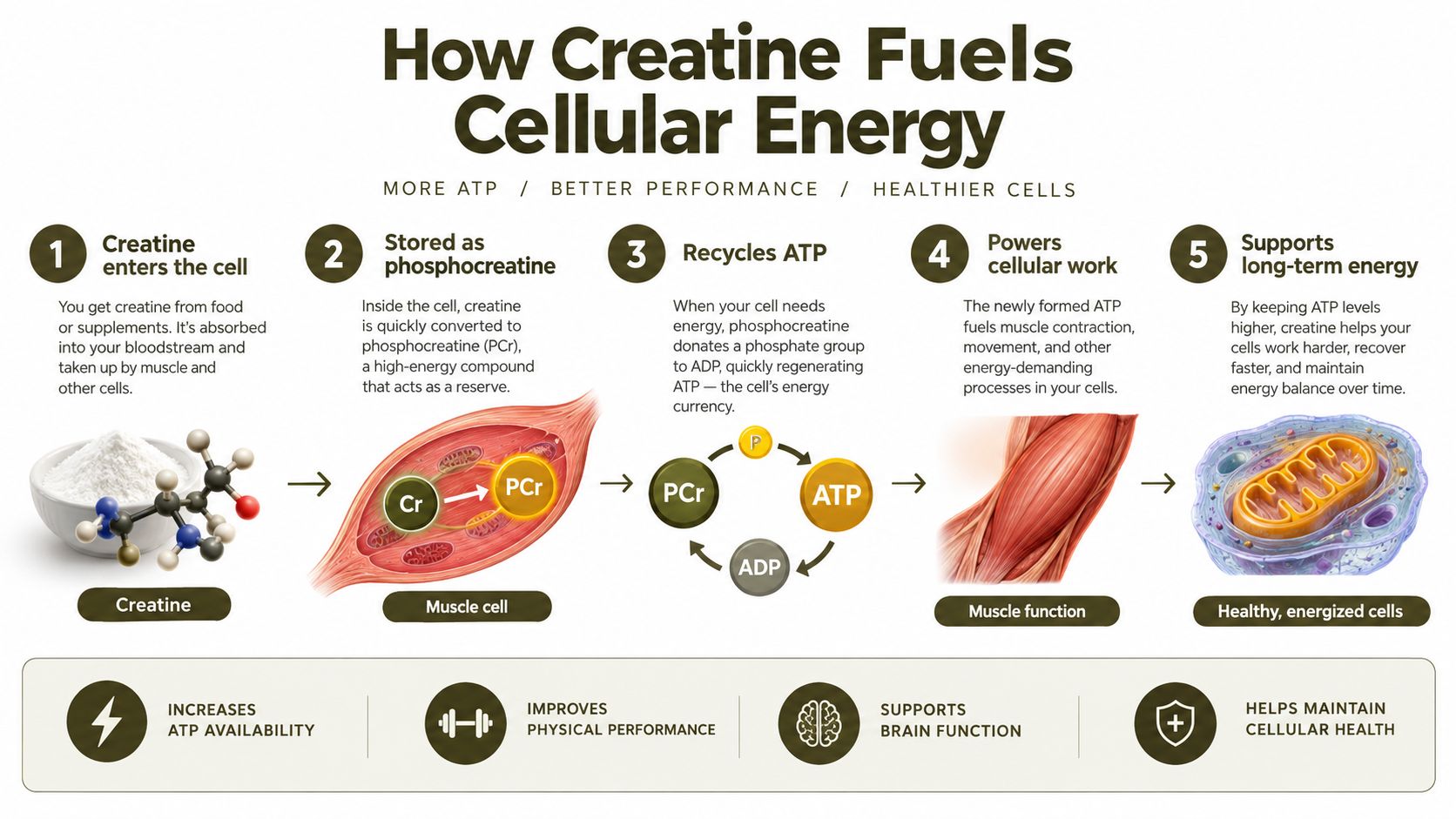
The rechargeable battery analogy
The process is easier to understand in five practical steps:
- A demanding action begins. A loaded carry, a set of resistance exercises, or a quick climb increases the immediate energy requirement.
- ATP supplies the first burst. The muscle uses available ATP to produce force.
- Phosphocreatine helps restore ATP. Stored phosphocreatine donates the components needed to rebuild ATP rapidly.
- Repeated efforts become more manageable. The muscle has more support for high-intensity work that occurs in intervals, sets, or short bursts.
- Training provides the adaptation. The meaningful long-term outcome comes from repeatedly giving the body a reason to become stronger, not from taking creatine while remaining inactive.
This explains why creatine works best alongside resistance training. The supplement supports the energy system, while training supplies the stimulus that encourages muscle and strength adaptation. Taking creatine in isolation isn't equivalent to building a program that challenges the major movement patterns.
What this means outside the gym
The same energy logic helps explain why creatine is relevant to daily vitality, even though the most reliable practical benefits are tied to exercise. A stronger training session may make it easier to develop the leg, hip, back, and upper-body strength needed for daily tasks. Over time, those capabilities can matter more than an isolated performance metric.
The brain also relies on ATP, which is why creatine has attracted interest in cognitive health. Still, mental clarity depends on many factors, including sleep, stress, nutrition, medications, and health conditions. Creatine should be viewed as a possible support for energy availability, not as a treatment for brain fog or a replacement for medical evaluation.
Longevity Benefits for the Midlife Body and Brain
Creatine is often filed under bodybuilding, but its more useful role for women over 40 may be much broader. It can support the training that preserves muscle, strength, and independence, while offering a possible source of additional cellular energy for the brain. That makes it a foundational longevity tool, not a shortcut to a larger physique.
Muscle and strength
Sarcopenia becomes more consequential when declining muscle reduces everyday capacity. The first signs may appear as slower recovery after a demanding day, difficulty lifting a suitcase into an overhead compartment, or needing to stop while carrying groceries. A structured resistance program addresses those challenges directly by training strength and preserving the physical abilities that support independent living.
Creatine works best as part of that program. It does not replace the training stimulus, but it may help a woman complete productive sessions more consistently and gain more from the work over time.
Female-specific research supports combining creatine with resistance training rather than treating the supplement as a standalone intervention. In a trial involving postmenopausal women, a loading phase of approximately 0.3 grams per kilogram per day, about 20 grams per day, was associated with 0.52 kilograms of additional fat-free mass, a 5.2 kilogram increase in leg-press strength, and a 1.7 kilogram increase in bench-press strength. These findings are reported in a female-specific review of creatine and women's health. The practical value is clear: more lean tissue and greater force production can translate into stronger performance in ordinary life.
Those results are not a promise for every woman. Training history, nutrition, health status, age, menopausal stage, and adherence all shape the response. The useful takeaway is that postmenopausal women can respond to creatine when they pair it with a well-designed resistance program.
Bone and physical resilience
Muscle and bone health develop together through movement and loading. Resistance exercise gives the skeleton a reason to adapt, while stronger muscles and better balance can help a woman move with greater confidence. Creatine may support the training process, but it should not be presented as a standalone solution for bone density.
A practical midlife routine includes progressive resistance work, walking or another regular form of movement, adequate nutrition, and professional assessment when fracture risk or bone health raises concern. Creatine belongs inside that plan, alongside the habits that address the wider causes of physical decline.

Cognitive energy and mental fatigue
The brain has substantial energy needs, so researchers have examined creatine for possible effects on cognition, memory, and mental fatigue. The most responsible interpretation remains cautious. Some women may consider it during high mental demand, disrupted sleep, or menopausal transition, but evidence for broad cognitive enhancement in healthy, well-rested adults is not definitive.
That distinction avoids two mistakes. Creatine should not be dismissed because of its bodybuilding reputation, and it should not be expected to resolve concentration problems caused by sleep disorders, anemia, thyroid dysfunction, depression, medication effects, or other medical issues.
Creatine may support the capacity to train and function, but it cannot compensate for an unresolved health problem.
For a longevity-focused plan, protect muscle first, treat cognitive claims modestly, and monitor real-world function. Notice whether recovery improves, training becomes more consistent, and strength remains sufficient for ordinary life.
Evidence-Based Dosing and Timing Protocols
Women do not need a separate creatine system solely because they are women. The established options are a loading phase of about 20 grams per day for 5 to 7 days, followed by 3 to 5 grams per day, or a steady 3 to 5 grams per day without loading. The practical reasoning behind both approaches is outlined in this peer-reviewed review of creatine for women.
Loading raises muscle creatine stores more quickly. A steady dose reaches a similar level more gradually, while keeping the routine simpler and potentially easier on digestion. Neither protocol is more appropriate for women. The better choice depends on the desired pace, tolerance, and ability to follow the plan consistently.
Comparing the two approaches
| Protocol | Daily Dosage | Time to Saturation | Best For |
|---|---|---|---|
| Loading followed by maintenance | About 20 g/day for 5 to 7 days, then 3 to 5 g/day | Faster | Someone who wants to increase muscle creatine availability promptly and tolerates divided doses |
| Steady maintenance | 3 to 5 g/day | More gradual | Someone who prefers simplicity, wants to minimize the chance of digestive discomfort, or has no reason to load |
A loading dose can be divided across the day instead of taken all at once. Smaller servings with meals may improve comfort. The exact clock time matters less than taking the supplement consistently. Once the loading period ends, continue with the maintenance dose each day.
Pair the supplement with a stimulus
Creatine has its clearest practical value alongside resistance training. Greater intramuscular creatine and phosphocreatine availability supports rapid ATP resynthesis during repeated high-intensity work, which can help a woman perform and recover from strength-focused efforts. The training plan therefore matters more than optimizing the minute of ingestion.
Start with movements that train the legs, hips, upper body, and trunk. Adjust the program to current ability and increase demands gradually. Beginners do not need bodybuilding-style volume. Anyone with pain, recent surgery, or a significant medical condition should obtain individualized guidance before increasing training demands.
Creatine monohydrate is the form supported by the relevant evidence. Select a product that clearly lists creatine monohydrate as its ingredient, then follow the serving instructions. Workout timing is optional. Taking it with a meal or another established daily habit can make adherence easier, which matters more than a precise timing strategy.
Loading is optional. A steady approach can support the same long-term goal with less planning. Women who experience bloating or loose stools can skip loading, reduce the amount taken per serving, or discuss another approach with a qualified clinician.
Safety Profiles and Biomarker Monitoring
Creatine monohydrate has a long history of use, but “widely used” doesn't mean “appropriate for everyone.” Safety decisions should account for kidney health, current medications, pregnancy or breastfeeding, medical history, and the quality of the product. A woman with known kidney disease or an unexplained abnormal kidney result should speak with a licensed healthcare professional before starting supplementation.
Water-related changes are one of the most common concerns. Creatine draws water into muscle cells, so some people may notice a change in scale weight or how their muscles feel. That isn't the same as gaining body fat, but it can be uncomfortable for someone who is highly focused on scale fluctuations. Digestive upset can also occur, particularly when a person takes a large amount at once.
Interpreting kidney markers carefully
Serum creatinine and estimated glomerular filtration rate, or eGFR, are common kidney-related markers. Supplementation can make serum creatinine more difficult to interpret because creatinine is connected to creatine metabolism. A change in the lab value doesn't automatically establish kidney damage, and a normal-looking result doesn't eliminate the need for context.
Here, the longevity blood test guide can help readers understand why biomarkers need interpretation rather than isolated reactions. A clinician can review the baseline result, follow-up result, hydration status, medications, medical history, and the broader pattern of kidney function.
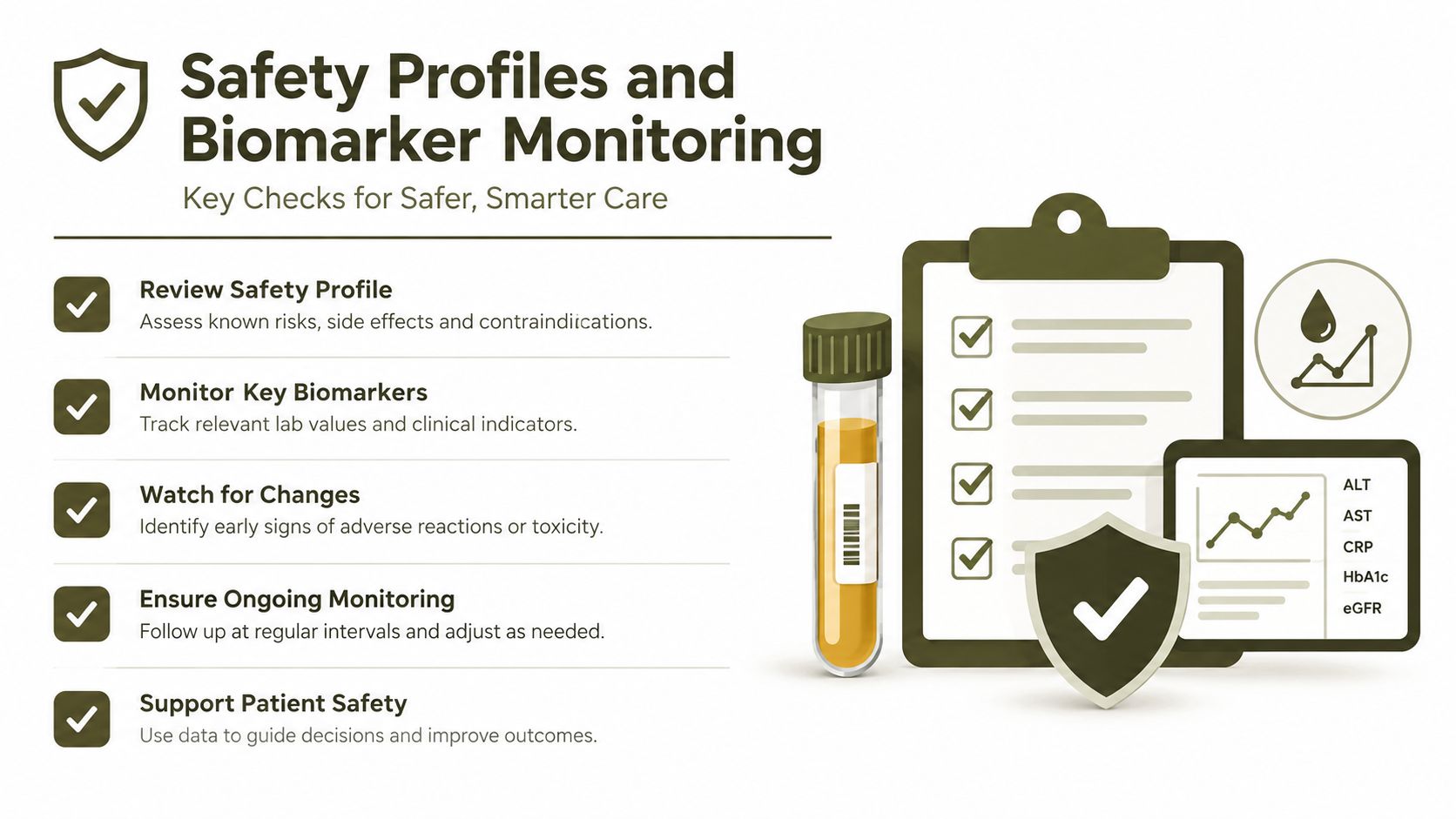
When professional input matters
Discuss creatine with a healthcare professional before starting if you have:
- Known kidney disease: Ask for individualized advice rather than relying on general supplement guidance.
- Abnormal kidney-related labs: Establish whether the result needs evaluation before supplementation.
- Multiple medications: A clinician can consider potential interactions and the broader treatment plan.
- A complex health history: Conditions affecting fluid balance, blood pressure, or metabolism deserve personalized review.
- Persistent symptoms: Ongoing swelling, unusual fatigue, digestive problems, or other changes need assessment instead of being attributed automatically to creatine.
Hair-loss concerns also require restraint. Online discussions often present a clear cause-and-effect story, but the information provided here doesn't establish that creatine causes hair loss in women. If shedding changes, track the timing and discuss it with a clinician who can consider thyroid status, iron stores, hormonal changes, stress, nutrition, and other common contributors.
Clinical perspective: A biomarker is a piece of evidence, not a diagnosis.
Use a reputable manufacturer, avoid proprietary blends that hide ingredient amounts, and introduce one meaningful change at a time when possible. That approach makes it easier to identify what helps, what causes discomfort, and what deserves further investigation.
Integrating Creatine into Your Daily Longevity Routine
The most sustainable creatine routine usually feels unremarkable. A woman might place the container beside the coffee grinder, mix it into a smoothie after breakfast, or take it with lunch. The goal isn't to create a complicated supplement ritual. It's to attach the dose to a habit that already happens reliably.
A practical day could begin with breakfast, hydration, and a protein-rich meal. A woman who strength trains later might take creatine in the morning rather than waiting for the workout, because daily consistency matters more than a narrow timing window. On training days, she can focus on completing the session with good technique. On rest days, she can keep the same supplement habit and prioritize walking, mobility, or recovery.
Build the routine around fundamentals
Creatine works best as one part of a wider system:
- Protein supports tissue repair: Distribute adequate protein across meals according to individual needs and medical guidance.
- Resistance training supplies the signal: Use a progressive plan that challenges major muscle groups without exceeding current recovery capacity.
- Hydration supports comfort: Drink regularly throughout the day and respond to thirst, climate, exercise, and medical advice.
- Sleep protects recovery: Address inconsistent sleep rather than expecting a supplement to overcome chronic sleep disruption.
- Movement keeps the benefit practical: Include walking, balance work, stairs, carries, or other activities that resemble real life.
Mixability is mostly a convenience issue. Stir creatine monohydrate into a beverage, shake it in a bottle, or blend it into yogurt or a smoothie. If clumping bothers you, use a warmer liquid or mix it thoroughly. You don't need a branded stack, a pre-workout formula, or a complex cycling schedule to begin.
A structured daily longevity routine can make these behaviors easier to repeat by giving them a consistent place in the day. The right routine should reduce decision fatigue, not add another performance project.
Tracking Your Progress and Next Steps
Creatine is worth evaluating through function, not hype. Start by recording a simple baseline. Note the movements you currently perform, how you feel during and after training, the daily tasks that feel difficult, and the quality of your sleep and energy. You don't need to measure everything. A few consistent observations are more useful than a constantly changing set of metrics.
Track outcomes that matter
Use a mix of objective and subjective feedback:
- Training performance: Record exercise selection, repetitions, resistance, and perceived effort in a notebook or app.
- Functional capacity: Notice whether carrying groceries, climbing stairs, rising from a chair, or lifting luggage feels more manageable.
- Recovery: Track muscle soreness, readiness for the next session, and whether your routine remains consistent.
- Cognitive stamina: Observe concentration during demanding work, while remembering that many factors influence attention.
- Body composition: If you choose to monitor it, use the same method and conditions rather than reacting to isolated readings.
- Health markers: Repeat relevant lab work only when clinically appropriate and interpret it with a qualified professional.
The review evidence discussed earlier shows why context matters. A measured change in lean mass or strength can be meaningful, but it belongs to a training program and a broader health picture. If nothing improves, check the fundamentals before increasing the dose. The issue may be inconsistent training, inadequate recovery, insufficient nutrition, pain, or an unrelated medical concern.
The core argument for creatine for women is practical rather than sensational. Creatine can support the rapid energy demands of resistance training, and resistance training is one of the most direct ways to protect strength and physical independence through midlife. Cognitive benefits remain less certain, so use them as a possibility rather than a promise.
Start with a clear goal, select an appropriate dosing approach, and discuss biomarker monitoring with a healthcare professional when your history calls for it. Longwelle offers a brief longevity assessment, personalized science-informed guidance, biomarker tracking, structured routines, and optional access to licensed nurse practitioners, which can help you place creatine within a broader healthspan plan rather than treating it as an isolated supplement.
Take the Longwelle assessment to identify the healthspan priorities that matter most to you, then use your results to build a practical plan for strength, recovery, energy, and biomarker tracking. If you're considering creatine, bring your questions and relevant lab results to a licensed healthcare professional so your routine reflects your individual health needs.