Learn
Sleep and Longevity: The Science of Restorative Sleep
Sleep and Longevity. Discover the proven science linking sleep quality to longevity. Learn evidence-based strategies to optimize your sleep duration

Approximately 7 to 8 hours of consistent sleep per night is the strongest evidence-based sweet spot for longevity, while sleeping substantially less or more is associated with higher mortality risk. Just as important, how regular that sleep is may matter as much as the number of hours.
That conclusion challenges the way sleep is usually discussed after 40. Most advice gives you a target, then treats every night as an isolated event. Longevity research takes a broader view. It looks at your habitual pattern, including duration, timing, regularity, daytime function, and the symptoms that may explain why your sleep has changed.
A stable schedule can be more useful than chasing an ideal number on an occasional night. At the same time, unusually long or unrefreshing sleep shouldn't be dismissed as evidence of excellent recovery. It may be a sign that something else needs attention.
Table of Contents
- The Science Linking Sleep to a Longer Life
- Why Sleep Regularity Matters More Than Just Hours
- How to Track Your Sleep for Longevity
- Long Sleep and Napping, Warning Signs or Habits?
- Practical Steps to Optimize Sleep Quality
- Building a Sleep Foundation for Healthy Aging
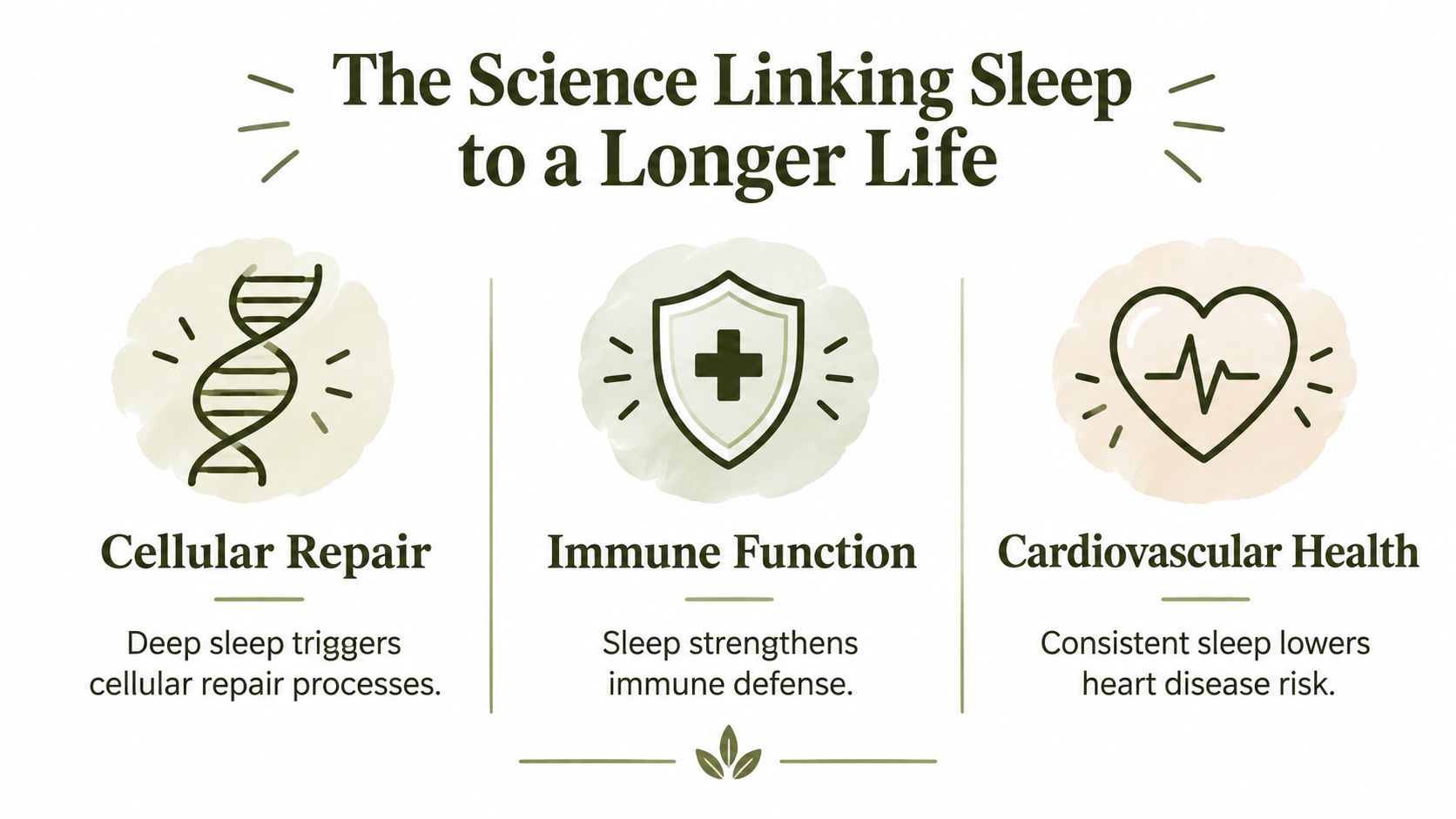
The Science Linking Sleep to a Longer Life
The strongest foundation for understanding sleep and longevity comes from prospective studies. Researchers record participants' sleep patterns, then follow them over time to examine subsequent health outcomes and deaths. This design is more informative than asking people about sleep after illness has already developed, although it still can't prove that sleep duration itself causes mortality.
Across large prospective studies and systematic reviews, the relationship is consistently U-shaped. Mortality risk tends to be lowest among adults who report approximately 7 to 8 hours per night, while both shorter and longer sleep durations are associated with higher all-cause mortality. A 2010 systematic review found that short sleepers, commonly defined as sleeping fewer than 7 hours, had a 12% higher risk of death than people sleeping 7 to 8 hours. Long sleepers, often defined as sleeping more than 8 or 9 hours, had approximately 30% higher mortality risk in the same analysis (systematic review and meta-analysis).
What the curve does and doesn't prove
The U-shaped pattern is useful for setting priorities, but it isn't a prescription that every adult must follow to the minute. Sleep needs vary with age, health, activity, medications, work demands, and recovery from illness. A person who occasionally sleeps longer after a demanding period isn't equivalent to someone who routinely spends extended time in bed and remains exhausted.
| Sleep Duration | Relative Risk |
|---|---|
| Approximately 7 to 8 hours | Lowest observed risk range |
| Fewer than 7 hours | 12% higher risk than 7 to 8 hours in a 2010 analysis |
| More than 8 or 9 hours | Approximately 30% higher mortality risk in the same analysis |
The more important coaching question is whether your pattern is persistent and unplanned. Regularly sleeping below roughly 7 hours can indicate that your schedule, stress load, environment, or a sleep disorder needs attention. Regularly sleeping much longer than your previous baseline, especially with fatigue, can point toward illness, depression, fragmented sleep, medication effects, or accumulated sleep debt.
The 2017 dose-response analysis adds another layer. It found the lowest observed mortality risk at approximately 7 hours, with each hour below that level associated with a pooled relative risk of 1.06, and each additional hour above it associated with a pooled relative risk of 1.13 (Journal of the American Heart Association analysis). These figures describe associations, not a guarantee that adding or removing exactly one hour will change an individual's lifespan.
For a practical longevity plan, use duration as a baseline signal, not a score to optimize obsessively. The broader principles of healthspan optimization also require context, including symptoms, movement, nutrition, stress, and clinical history (healthspan optimization guidance).
Why Sleep Regularity Matters More Than Just Hours
A person can average 7 to 8 hours and still have a poorly aligned sleep pattern. Consider a schedule that shifts substantially between workdays and weekends. The weekly average may look acceptable, but the body's sleep and wake signals keep moving. That mismatch can affect circadian timing, hormone secretion, glucose regulation, blood pressure rhythms, and autonomic recovery.
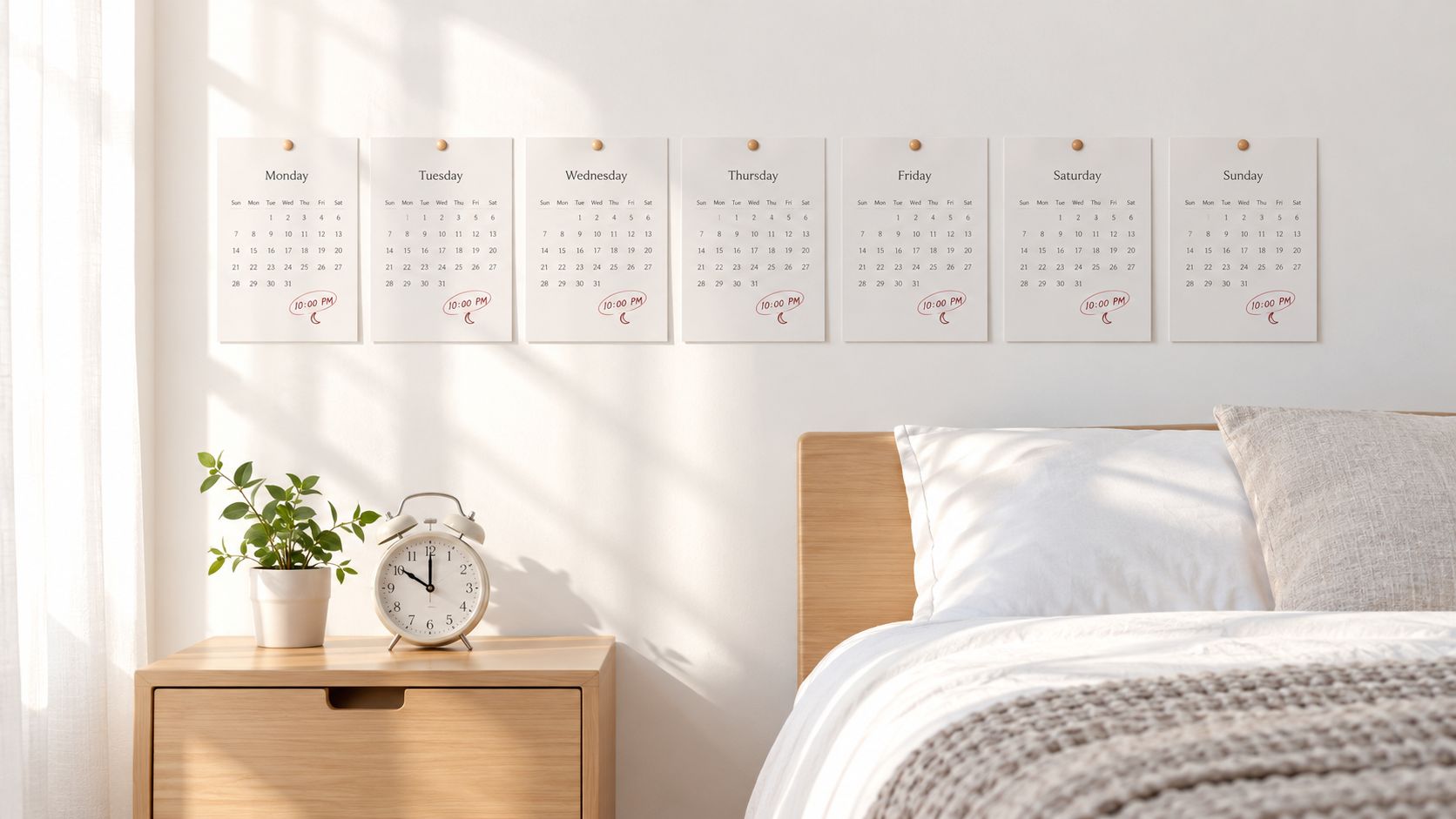
This is why sleep regularity deserves equal billing with sleep duration. Regularity means that bedtime and wake time remain relatively stable across days, rather than swinging between very different schedules. It doesn't require a rigid lifestyle. It does require recognizing that large, repeated shifts create a biological cost that an average-hours calculation can hide.
The overlooked survival signal
In a prospective cohort study, irregular sleep was associated with a 30% higher risk of all-cause mortality than regular sleep after adjustment for relevant factors, with a hazard ratio of 1.30 (prospective cohort findings). A separate cohort analysis found that people in the more-regular sleep groups had approximately 20% to 48% lower all-cause mortality risk than those in the least-regular group, and regularity predicted mortality more strongly than duration in comparative models.
That doesn't prove that regularity directly causes longer life. People with regular schedules may also differ in work conditions, health status, stress, activity, and access to care. Still, the finding changes the practical order of operations. If your sleep duration is already close to your personal need, improving timing consistency may offer more value than forcing yourself to stay in bed longer.
Start with the wake time, not bedtime. A dependable morning anchor helps your body anticipate sleep later, while an artificially early bedtime can create frustration if you aren't sleepy. Limit large weekend shifts where possible, seek outdoor light in the morning, and adjust gradually when work or caregiving makes perfect consistency unrealistic.
Your evening routine should support that anchor rather than compete with it. A repeatable wind-down can include dimmer light, a short walk, reading, preparation for the next day, or a screen-free transition. Practical ideas for building that pattern are outlined in this structured night routine.
Practical rule: Protect your wake time first, then let bedtime become more predictable as your sleep pressure and circadian rhythm align.
How to Track Your Sleep for Longevity
Sleep tracking works best when it answers a specific question. Are you sleeping too little, or are you spending enough time in bed but sleeping poorly? Is your schedule stable? Are naps compensating for short nights? Without a question, a wearable can turn sleep into another source of anxiety.
Use a simple multi-week record rather than judging a single night. Each morning, note your approximate bedtime, estimated time you fell asleep, wake time, nighttime awakenings, and final rising time. Add a brief rating for daytime alertness, mood, and energy. Record naps separately, including whether they were planned or driven by overwhelming sleepiness.
Track patterns, not perfect readings
Consumer wearables can estimate sleep and wake periods, but they aren't interchangeable with clinical testing. Treat their sleep-stage labels as approximate. The most useful outputs for everyday longevity coaching are often:
- Estimated sleep duration: Compare your habitual sleep with your daytime function, not with an arbitrary ideal.
- Bedtime and wake-time variability: Look for repeated shifts across the week.
- Time in bed versus estimated sleep: A long period in bed doesn't necessarily mean restorative sleep.
- Nighttime interruptions: Repeated awakenings, snoring, or witnessed breathing pauses deserve more attention than a polished sleep score.
- Nap timing and duration: Note whether naps support function or seem to be expanding because nighttime sleep is unrefreshing.
Wearables can help reveal trends, but they shouldn't override symptoms. If the device says your sleep is excellent while you wake unrefreshed, struggle to stay awake, or regularly experience loud snoring and breathing interruptions, the symptom pattern matters more than the score.
Use a weekly review
At the end of each week, ask three questions. Did my wake times stay reasonably stable? Did my daytime function match the amount of sleep I recorded? Did fatigue lead me to extend time in bed or rely on naps?
This approach separates transient tiredness from a persistent pattern. It also avoids the common mistake of responding to one poor night by moving bedtime dramatically earlier, which can increase time awake in bed and make sleep less predictable.
Long Sleep and Napping, Warning Signs or Habits?
More sleep isn't automatically a stronger longevity intervention. Long sleep can be a recovery response after sleep loss, but persistent long sleep may also reflect fragmented sleep, depression, pain, cardiometabolic illness, medication effects, or another condition that increases both sleep need and health risk.
A prospective-study meta-analysis covering 27 cohort samples, 1,382,999 participants, and 112,566 deaths found a pooled relative risk of 1.12 for short sleep and 1.30 for long sleep compared with the 7 to 8-hour reference range (prospective-study meta-analysis). The finding is associative. It doesn't show that sleeping longer directly shortens life.

When naps stop looking restorative
Napping can be useful when it reflects a temporary need, but a growing dependence on daytime sleep deserves investigation. A 2025 UK Biobank analysis of more than 86,000 non-shift workers associated longer naps and greater variability in nap duration with higher all-cause mortality. The study recorded 5,189 deaths during up to 11 years of follow-up, and each standard-deviation increase in nap duration corresponded to a 20% higher hazard (UK Biobank nap analysis).
Those numbers shouldn't be interpreted as a reason to eliminate every nap. They may reflect the health conditions that cause people to nap, rather than harm caused by napping itself. A short, intentional nap after an unusually poor night is a different pattern from escalating naps, unplanned sleep, and persistent fatigue.
Use symptoms to choose the next step
Review the whole pattern before changing your routine:
- A new increase in sleep: Ask whether illness, pain, mood changes, medication, or disrupted nighttime sleep appeared first.
- Unrefreshing long sleep: Look for snoring, witnessed apneas, morning headaches, dry mouth, or repeated awakenings.
- Frequent unplanned naps: Treat strong daytime sleepiness as information, not a character flaw.
- Stable long sleep with good function: Avoid forcing a shorter schedule solely to match a population average.
If oversleeping or daytime sleepiness persists, discuss it with a qualified clinician. Lifestyle adjustments can improve timing and environment, but they can't identify every medical cause.
For a practical starting point, track the relationship between sleep length, naps, and fatigue rather than judging any one behavior in isolation. This guide to persistent tiredness can help organize the questions you bring to a professional.
Practical Steps to Optimize Sleep Quality
The most effective sleep changes are usually repeatable rather than dramatic. Adults over 40 often don't need another complicated protocol. They need a schedule that survives work pressure, travel, family responsibilities, and the occasional late evening.

Build around a morning anchor
Choose a wake time you can maintain on most days. Get outdoor light early, move your body during the day, and avoid turning weekends into a separate time zone. If your current schedule varies widely, change it in manageable increments rather than trying to correct everything in one night.
Your evening environment should make sleep easier without requiring perfection. Keep the bedroom dark, quiet, and comfortably cool. Reserve the bed for sleep where possible, and lower bright light as the evening progresses. Finish demanding work before your wind-down begins, because mental activation can persist after the laptop closes.
Remove the habits that undermine consistency
Late caffeine, alcohol, heavy meals, and stimulating screen use can all interfere with your ability to fall asleep or stay asleep. The useful question isn't whether you can tolerate one of these occasionally. It's whether the habit reliably produces a later bedtime, more awakenings, or poorer morning function.
Try one change at a time so you can identify what helps. For example, keep the wake time stable while moving caffeine earlier, then assess your sleep record and daytime alertness. Avoid adding supplements or sedating products just because a wearable reports a low sleep score.
A brief wind-down routine can include a warm shower, light stretching, paper reading, breathing exercises, or preparing clothing and meals for the next day. Choose activities that reduce decisions and emotional stimulation. If you lie awake for long periods repeatedly, or sleep problems persist despite consistent habits, seek professional guidance rather than escalating self-treatment.
Longwelle offers a longevity assessment quiz, educational sleep guidance, structured routines, biomarker tracking, and optional access to licensed nurse practitioners. It can be considered alongside a personal sleep log, wearable trends, and appropriate clinical care.
This video provides another way to think about the practical role of sleep in a healthy-aging routine:
The best protocol is the one you can repeat. A dark room won't compensate for a chaotic schedule, and a perfect bedtime won't solve untreated breathing problems. Combine environmental support with regular timing, then judge progress by daytime function and sustained patterns.
Better sleep usually comes from reducing friction, not adding complexity.
Building a Sleep Foundation for Healthy Aging
Sleep belongs at the foundation of a longevity plan because it influences how consistently you can carry out every other healthy behavior. The practical target is approximately 7 to 8 hours, but the target only becomes meaningful when paired with stable timing, restorative quality, and normal daytime function.
Track bedtime, wake time, estimated sleep, naps, and symptoms for several weeks. Use the record to identify whether your main issue is insufficient duration, irregular timing, fragmented sleep, or unexplained fatigue. Don't treat long sleep as automatically beneficial, and don't treat a wearable score as a diagnosis.
Small changes can create a more dependable rhythm: anchor the morning, seek early light, protect the evening wind-down, and make the bedroom support sleep. Persistent snoring, witnessed apneas, unrefreshing sleep, severe daytime sleepiness, or a marked change in sleep need warrants clinical evaluation.
Take the Longwelle longevity assessment to identify sleep and healthy-aging priorities, then use its structured routines and educational guidance alongside your own sleep tracking. If your pattern remains difficult to interpret, explore its biomarker monitoring and optional licensed nurse practitioner support to turn observations into practical next steps.