Learn
Why Am I So Tired in My 40s and How to Restore Energy
Wondering why am I so tired in my 40s? Learn common causes, key labs to check, red flags, and practical steps to restore steady energy.
You wake up after what should have been a full night's sleep, but you don't feel restored. By mid-afternoon, your concentration fades, ordinary tasks feel disproportionately difficult, and coffee seems to postpone the problem rather than solve it. You may be asking, “Why am I so tired in my 40s?” while wondering whether this is aging, stress, hormones, or something you're missing.
Persistent fatigue deserves a more useful explanation than “welcome to midlife.” Your energy reflects the interaction between sleep quality, recovery debt, health conditions, and daily demands. Understanding those inputs can help you decide what to track, which questions to take to a clinician, and which small habit is most likely to create momentum.
Table of Contents
- Why Persistent Tiredness in Your 40s Deserves a Closer Look
- What Feeling Tired Really Means After 40
- Why Your 40s Can Feel More Exhausting Than Your 20s
- Common and Often Missed Causes of Midlife Fatigue
- Key Labs and Biomarkers Worth Discussing With Your Clinician
- Practical Strategies to Restore Steady Energy
- Red Flags and When to Seek Personalized Guidance
Why Persistent Tiredness in Your 40s Deserves a Closer Look
Consider a typical weekday. You get your children ready, answer messages before breakfast, manage a demanding workload, and try to fit exercise into a schedule already crowded with responsibilities. You sleep for what seems like enough time, yet wake with a heavy body and a cloudy mind. By evening, you're too depleted to do the activities that might help you recover.
That pattern doesn't mean you're lazy or failing at self-care. Fatigue is a symptom, not a diagnosis. It can reflect fragmented sleep, prolonged stress, mood changes, nutritional problems, medication effects, hormonal transitions, or an underlying condition. The right response isn't to assume one cause. It's to identify the pattern.
The distinction matters because a supplement rarely fixes fatigue caused by repeated breathing interruptions during sleep, an underactive thyroid, anemia, or depression. Likewise, medical testing may not solve a problem driven mainly by irregular sleep, excessive evening stimulation, or a daily workload that leaves no recovery margin.
When tiredness becomes a signal
Temporary tiredness usually follows an identifiable demand and improves with rest. Persistent fatigue is different. It continues despite reasonable rest, interferes with work or relationships, changes your ability to exercise, or arrives with symptoms such as poor concentration, low mood, headaches, breathlessness, or unrefreshing sleep.
You don't need to diagnose yourself before seeking help. You do need to notice when the symptom has become a pattern.
Practical rule: If fatigue is persistent, worsening, or affecting daily function, treat it as information worth evaluating rather than as an unavoidable part of getting older.
A structured approach starts with observation. Record sleep timing, awakenings, snoring, morning alertness, afternoon crashes, exercise, caffeine, mood, and any new physical symptoms. Then combine those observations with appropriate clinical assessment. The aim isn't to chase perfect energy. It's to find the most plausible drain and address it safely.
What Feeling Tired Really Means After 40
People use “tired,” “fatigued,” and “low energy” as if they mean the same thing, but they describe different experiences.
Tiredness often follows exertion, mental work, or insufficient sleep and usually improves when you rest. Fatigue is more persistent. Rest may not fully relieve it, and the exhaustion can interfere with concentration, movement, motivation, or ordinary responsibilities. Low energy can include reduced physical drive, but it may also describe the feeling that initiating even simple tasks requires unusual effort.
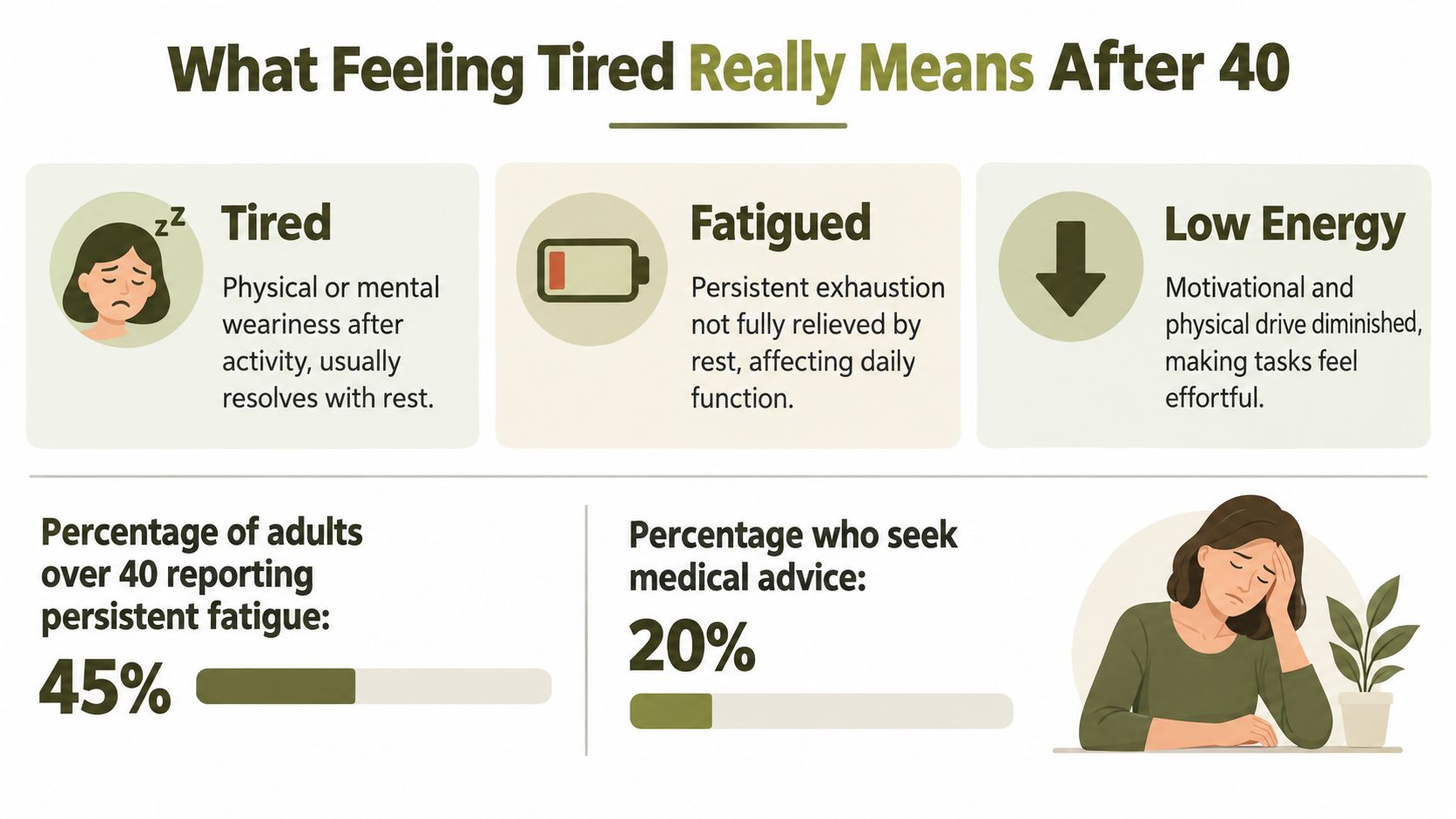
These labels overlap, but the pattern helps guide the next question. Someone who feels sleepy after a late night may need more consistent sleep. Someone who wakes unrefreshed, struggles to stay awake, and has loud snoring may need evaluation for a sleep disorder. Someone who has little motivation alongside persistent sadness may need a mood assessment.
Midlife fatigue is common, but that doesn't make it harmless
A CDC analysis of the United States National Health Interview Survey found that 13.5% of adults aged 18 and older felt very tired or exhausted most days or every day during the previous three months in 2022. In the 45 to 64 age group, the reported burden was 15.3% among women and 9.7% among men. The same analysis reported 20.3% among women aged 18 to 44 and 11.0% among men aged 18 to 44. These figures come from the CDC's National Health Interview Survey analysis.
That context is useful for people in their 40s. Fatigue is widespread enough to be a population-level concern, especially among women, but common symptoms still deserve individual evaluation.
Women going through the menopausal transition may notice tiredness alongside memory difficulties and concentration problems. In a 2024 UK clinic cohort of 978 perimenopausal and menopausal women, 96% reported feeling tired or lacking energy, while 93% reported memory problems and 91% reported difficulty concentrating. Those findings are described in this overview of the UK clinic cohort and related fatigue research. They don't prove that hormones explain every person's fatigue, but they show why cognitive complaints and energy changes should be considered together.
If mental cloudiness is part of your experience, Longwelle's guide to brain fog can help you describe the symptom more precisely before discussing it with a professional.
Why Your 40s Can Feel More Exhausting Than Your 20s
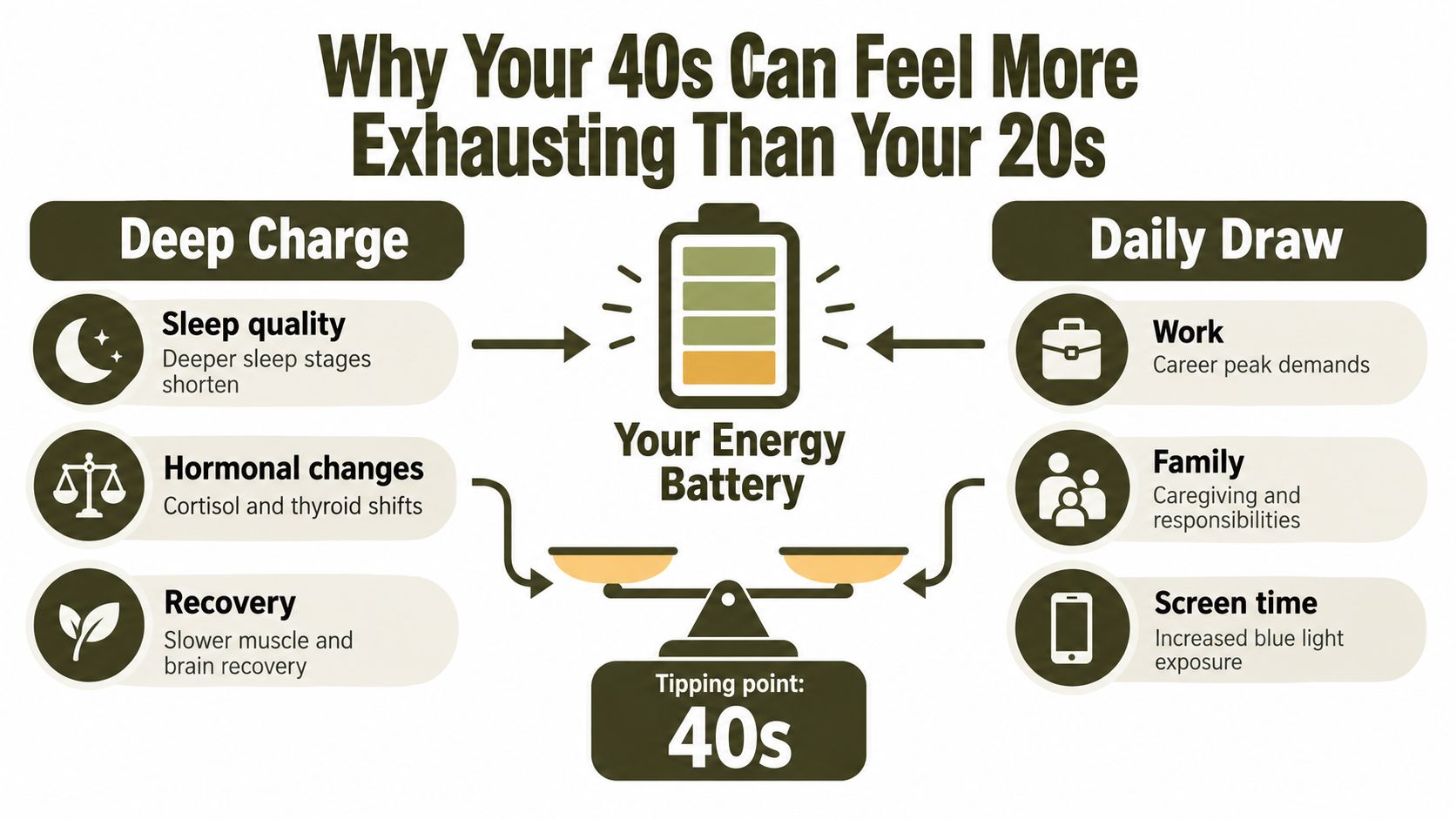
You may finish a demanding workday, manage family responsibilities, and still spend a familiar amount of time in bed. Yet you wake feeling as though recovery never finished. In your 40s, fatigue often reflects the interaction between a higher daily load, fragmented sleep, and accumulated recovery debt, rather than aging alone.
Your energy system works like a battery. Midlife can increase the daily draw while making a full recharge less consistent. Sustained attention at work, caregiving, evening screen use, and stress can keep your nervous system alert when your body is trying to wind down. You may sleep for a reasonable duration but wake more often or spend less time in restorative sleep.
The interaction between recovery debt and daily load
Sleep debt involves more than feeling sleepy after one short night. A controlled sleep-disturbance review linked sleep debt with a delayed afternoon-evening cortisol timing of nearly 1.5 hours and a salivary cortisol decline between 16:00 and 21:00 that was about six times slower than in the fully rested state. The findings are summarized in this review of sleep disturbance and endocrine recovery.
Irregular bedtimes, repeated short sleep, and late-night light exposure can make the shift from activation to recovery harder. Caffeine may help you function temporarily, but it does not repay the underlying debt.
Sleep quality matters separately from time in bed. Less restorative sleep leaves less reserve for a demanding day, like starting work with a partly charged battery. That combination explains why you can say, “I slept enough,” and still feel depleted.
What to track instead of guessing
For a short period, record:
- Sleep timing: Note bedtime, wake time, and schedule changes across the week.
- Sleep continuity: Record awakenings, restless periods, snoring, morning headaches, and whether you feel restored.
- Daily load: Mark demanding workdays, caregiving, travel, and emotionally difficult events.
- Energy rhythm: Rate alertness at waking, midday, afternoon, and evening on the same simple scale.
- Recovery inputs: Track movement, meals, hydration, caffeine, and time outdoors.
Fatigue should not automatically be dismissed as age. The National Institute on Aging guidance on fatigue notes that tiredness can reflect underlying medical conditions. A broader guide to longevity offers context for viewing sleep, activity, nutrition, and recovery as connected parts of health.
Common and Often Missed Causes of Midlife Fatigue
Fatigue usually has more than one plausible explanation. A late bedtime, high stress, and low activity may coexist with a sleep disorder or thyroid problem. The task is to compare patterns rather than select the most appealing explanation.
Lifestyle contributors often include inconsistent sleep timing, insufficient recovery, prolonged mental load, low activity, inadequate nutrition, and heavy reliance on caffeine. Health-related contributors include obstructive sleep apnea, thyroid disease, anemia, medication effects, depression or anxiety, long COVID, and hormonal transitions.
Obstructive sleep apnea deserves particular attention because sleep can be repeatedly interrupted without the person fully remembering it. A peer-reviewed review links severe OSA with higher general, physical, and mental fatigue, reduced physical activity, and lower serum testosterone. It also describes how sleep fragmentation and low oxygen levels can affect gonadal function. You can review the mechanism in this peer-reviewed review of obstructive sleep apnea, fatigue, and testosterone.
Triage Patterns for Midlife Fatigue
| Pattern You Notice | Possible Contributor Category | Helpful Next Question to Ask |
|---|---|---|
| You wake unrefreshed, snore, have morning headaches, or someone notices breathing pauses | Sleep-related | “Should I be assessed for obstructive sleep apnea or have a sleep study?” |
| Fatigue appears with cycle changes, night sweats, disrupted sleep, memory concerns, or concentration problems | Menopausal transition | “Could perimenopause or menopause-related changes be contributing, and what evaluation fits my symptoms?” |
| Exertion causes unusual weakness or breathlessness, or you look pale | Anemia or iron-related | “Should we check a CBC, iron status, and ferritin?” |
| You feel cold, slowed down, constipated, or notice changes in weight or mood | Thyroid-related | “Would thyroid testing help rule out dysfunction?” |
| Fatigue began after an infection and persists with reduced stamina or post-exertional worsening | Post-infectious or long COVID-related | “Could this pattern require evaluation for long COVID or another post-infectious problem?” |
| Low mood, loss of pleasure, anxiety, hopelessness, or withdrawal accompanies the exhaustion | Mood-related | “Can we assess depression or anxiety alongside physical causes?” |
| Symptoms began after a new prescription, dose change, or supplement | Medication-related | “Could any medication or supplement be affecting sleep, alertness, or energy?” |
The table doesn't diagnose a condition. It helps you bring a clearer description to a clinician, which is more useful than saying only, “I'm tired.”
Key Labs and Biomarkers Worth Discussing With Your Clinician
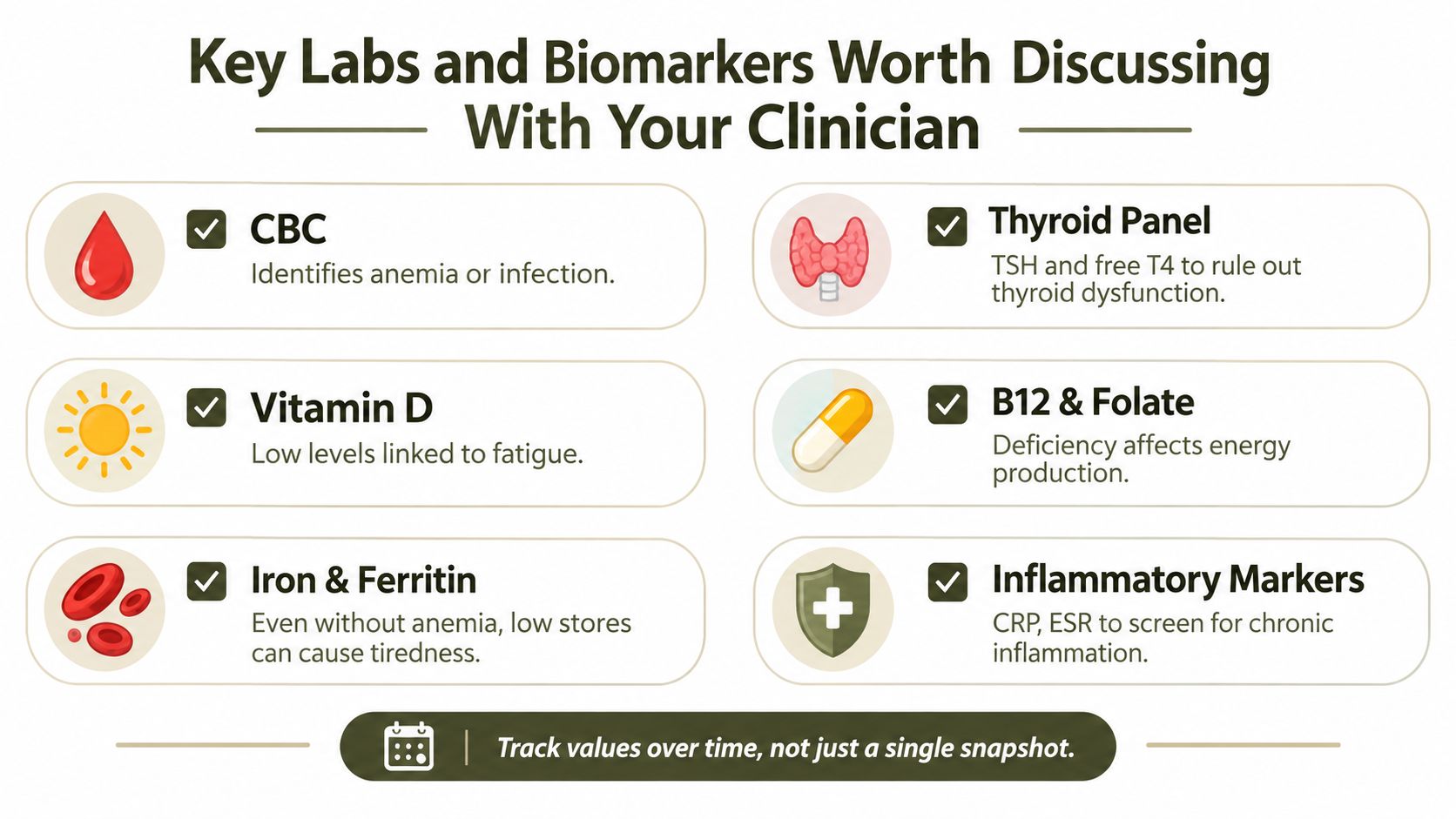
If fatigue is disrupting work, exercise, or time with family, start with the pattern rather than ordering every available test. Your symptoms, medical history, medications, examination, and sleep quality determine which checks make sense. A broad panel is not automatically better, and a value outside the reference range does not explain fatigue on its own. Your clinician must interpret each result in context.
Match the test to the question
Ask whether these categories fit your symptoms and history:
- Complete blood count: A CBC can look for anemia and other blood-related clues.
- Thyroid function: TSH and free T4 may help assess thyroid dysfunction when the symptom pattern supports it.
- Iron status: Iron and ferritin provide information about available and stored iron, particularly when blood loss or dietary risk is relevant.
- Vitamin status: B12, folate, and vitamin D may be considered when diet, absorption, neurological symptoms, or other risk factors point in that direction.
- Metabolic markers: Glucose-related measures, kidney and liver function, and electrolytes may matter based on your health history.
- Inflammation and illness context: CRP or ESR may be considered when symptoms suggest inflammation. Persistent symptoms after an infection may call for a more targeted evaluation.
These tests are filters, not verdicts. The NIA's fatigue guidance describes fatigue as potentially accompanying sleep apnea, thyroid disease, anemia, chronic illness, depressive symptoms, and long COVID. That range is why fatigue deserves an evaluation broader than hormones or supplements alone.
Track trends, not isolated results
Bring a symptom timeline to the appointment. Record when fatigue began, whether it fluctuates, what follows exercise, how restorative sleep feels, recent infections, medication changes, and menstrual or reproductive changes where relevant.
A laboratory result is a snapshot, while repeated measurements, when clinically appropriate, can show whether a marker is stable, changing, or responding to treatment. Pair those results with functional observations, such as morning alertness, concentration, afternoon energy, and your ability to exercise. A nurse practitioner or physician can help decide which markers deserve follow-up and what change would matter for you.
Practical Strategies to Restore Steady Energy
Start with the largest likely drain, not the most fashionable intervention. If your sleep schedule changes constantly, regularity may matter more than buying another supplement. If you wake with headaches and never feel refreshed, a sleep assessment is more appropriate than extending your bedtime.

Build a recovery floor
Choose one behavior and track it before adding another.
- Stabilize your schedule. Keep waking and bedtime more consistent, including on days off. A regular rhythm gives your body a clearer recovery signal.
- Protect sleep opportunity. Move bedtime earlier rather than relying on a late-morning catch-up whenever possible. If your sleep is unrefreshing despite adequate opportunity, investigate the quality of sleep.
- Use light strategically. Get outdoor light earlier in the day and reduce bright, stimulating screen exposure near bedtime. This supports the transition between alertness and sleep.
- Move without punishing yourself. Start with a walk, gentle mobility, or manageable resistance training. The aim is to improve capacity, not create another recovery burden.
- Eat for steadiness. Build meals around a source of protein, fiber-rich plants, and enough fluid. Notice whether a very heavy or highly refined lunch reliably precedes your afternoon crash.
- Place caffeine thoughtfully. Use it to support alertness, not to conceal a pattern of inadequate sleep. If afternoon caffeine seems to delay sleep or make it lighter, move the last serving earlier.
- Schedule downshifting. A short breathing practice, quiet walk, stretching, or device-free transition after work can help separate daytime demand from nighttime recovery.
A busy professional might begin by recording sleep timing and moving bedtime earlier, then add a brief walk after lunch once that routine feels automatic. Another person may start with a clinician visit because snoring and morning headaches make sleep fragmentation more likely than simple sleep shortage.
For a structured evening sequence, use a consistent night routine that reduces decisions and gives your body repeated cues for rest. Longwelle offers a brief assessment, personalized educational guidance, biomarker tracking, optional licensed nurse practitioner consultations, habit recommendations, an AI health coach, and progress tracking. It's one option for adults who want to connect daily routines with measurable health information rather than rely on vague energy advice.
Red Flags and When to Seek Personalized Guidance
Fatigue calls for prompt medical attention when it appears with chest pain, severe shortness of breath, fainting, confusion, unexplained weight loss, rapidly worsening weakness, or other acute symptoms. Persistent low mood, loss of interest, hopelessness, or thoughts of self-harm also require timely professional support. Seek evaluation when tiredness steadily worsens or prevents you from working, exercising, driving safely, or managing basic responsibilities.
Don't wait for a perfect symptom diary. Bring whatever information you have, including sleep observations, medication and supplement lists, recent illnesses, mood changes, menstrual or reproductive changes where relevant, and the times of day when energy drops.
A practical plan can be simple:
- Describe the pattern: Explain when fatigue began, what makes it worse, and whether rest helps.
- Check likely categories: Discuss sleep, mood, thyroid function, anemia, medication effects, nutritional status, and post-infectious symptoms.
- Choose measurable markers: Track sleep continuity, wake-time alertness, afternoon energy, activity tolerance, and clinically relevant laboratory results.
- Review progress: Reassess after a reasonable interval instead of changing several interventions at once.
You don't have to accept exhaustion as your new baseline, and you don't have to solve it through guesswork.
Longwelle can help you begin with a 3-minute longevity assessment, personalized healthspan insights, structured routines, biomarker tracking, and optional access to licensed nurse practitioners. Visit Longwelle to turn persistent midlife fatigue into a clearer, measurable plan for better sleep, recovery, and daily energy.