Learn
Why Am I So Tired After Eating Causes and Fixes
Wondering why am I so tired after eating? Learn what causes post-meal fatigue, when it's normal, and how to feel more energized after meals.
You finish lunch, sit back down at your desk, and your brain suddenly feels wrapped in cotton. The tab you were just working in looks oddly uninviting. Your motivation drops. Your eyelids get heavy. You might even think, “Why am I so tired after eating if I slept fine last night?”
That question gets more common in midlife. After 40, people often start paying closer attention to energy, recovery, blood sugar, sleep quality, and how meals affect the rest of the day. A post-lunch slump can feel random, but it usually isn't. It's a pattern.
Sometimes that pattern is completely ordinary. A large lunch, an early afternoon meeting, and a rough night of sleep can stack together and make anyone feel flat. Other times, the crash feels too strong, too frequent, or too disruptive to brush off.
The useful frame is this. Post-meal tiredness is a signal, not a diagnosis. Your body may be responding to meal size, meal composition, timing, sleep debt, stress, medications, or a deeper issue that deserves attention.
Many articles stop at “food coma” and leave it there. That's not enough. What you want to know is whether your experience is normal, what mechanism is most likely involved, and what to change first without guessing.
By the end of this article, you'll be able to look at your own post-meal fatigue more clearly. You'll understand why it happens, how to spot the clues that matter, and which small experiments can help you feel steadier after eating.
Table of Contents
- Introduction Why Post Meal Tiredness Feels So Common
- How Eating Shifts Your Brain and Body Toward Rest
- Common Reasons You Feel Tired After Eating
- When Post Meal Fatigue Is Normal and When to Look Closer
- Practical Ways to Feel More Energized After Meals
- Biomarkers Tests and When to Talk With a Clinician
- Your Next Steps to Steadier Energy After Eating
Introduction Why Post Meal Tiredness Feels So Common
A lot of adults know this moment well. Lunch ends, and within a short time your body feels heavier than it did before you ate. Not sick. Not exactly sleepy in the bedtime sense. Just slower, foggier, and less mentally sharp.
That feeling can be frustrating because eating is supposed to give you energy. So when the opposite happens, it's easy to assume something is wrong with your metabolism, your willpower, or your food choices.
Usually, it's more nuanced than that.
The lived experience is real
For one person, the crash shows up after a sandwich, chips, and a sweet drink. For another, it happens after a “healthy” grain bowl that still leaves them yawning by mid-afternoon. Someone else feels fine after breakfast and dinner but gets hit hard only after lunch.
Those details matter. The timing, the meal, and the intensity tell you more than the symptom alone.
Mild post-meal sleepiness can be part of normal physiology. A repeated, overwhelming crash is a different pattern.
That's why “Why am I so tired after eating?” isn't really a single question. It's several questions hiding inside one search:
- Is this normal: Do many people get a dip after meals?
- Is it the food: Does meal size or meal composition explain it?
- Is it my schedule: Does lunch collide with your body's natural low point?
- Is it a health clue: Should frequent crashes push you to check blood sugar, sleep, thyroid, or iron status?
Midlife makes patterns easier to notice
In your 20s, you might power through a heavy lunch and barely think about it. In your 40s and beyond, the same lunch may expose weak spots more clearly. Poor sleep, lower stress resilience, less daily movement, and changes in glucose handling can all make the after-meal dip feel louder.
That doesn't mean every slump is a medical problem. It means your body is giving clearer feedback.
A calmer way to approach this is to stop asking for one universal cause. Start asking which inputs reliably lead to your version of the crash. Once you see the pattern, the fixes get more practical.
How Eating Shifts Your Brain and Body Toward Rest
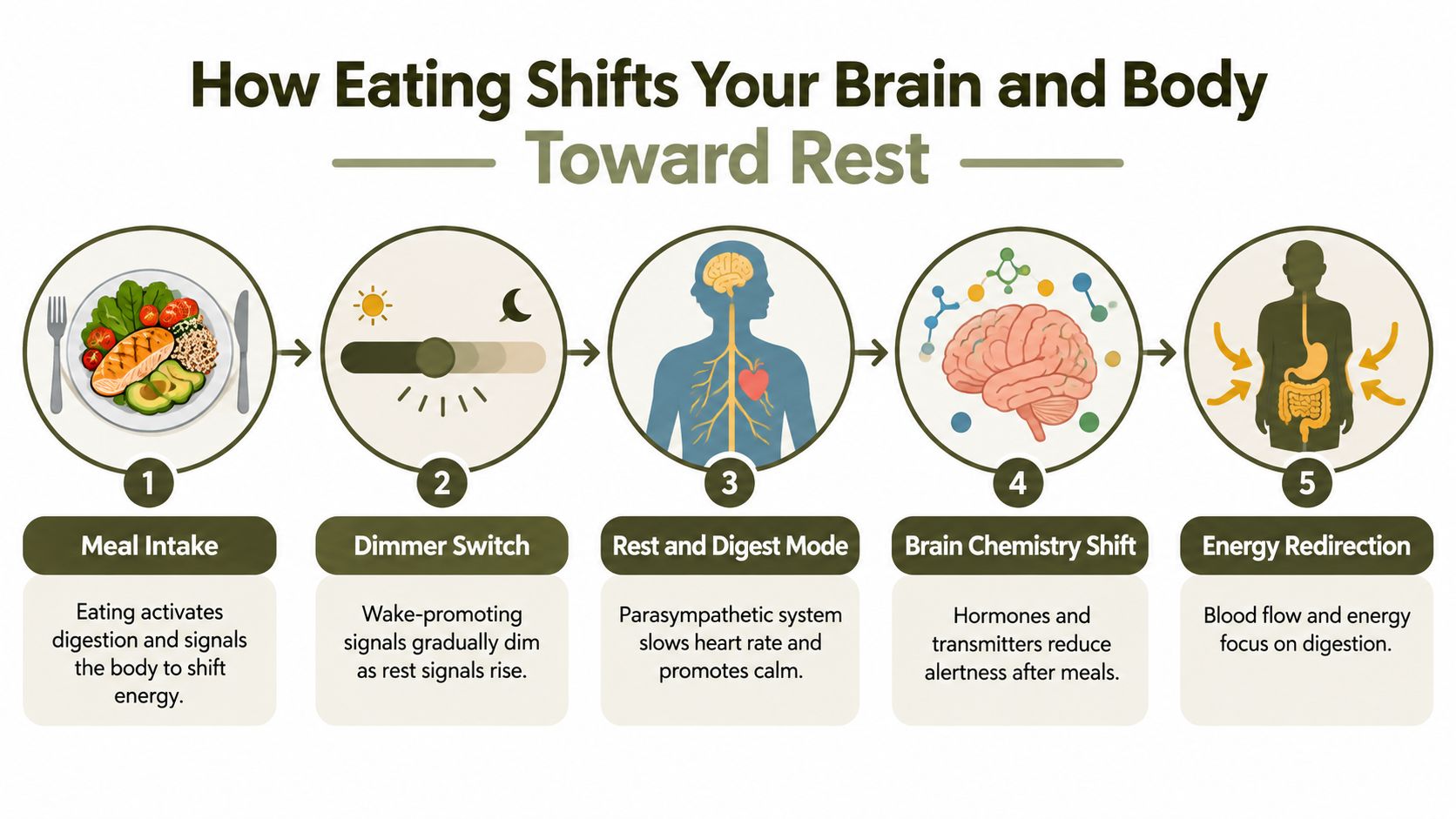
Your body doesn't treat eating as a passive event. The moment you start a meal, it begins reallocating attention and energy toward digestion, absorption, storage, and satiety. That shift can reduce alertness even if you were feeling fine beforehand.
Researchers measured this directly in healthy adults in a classic physiology study and found that mean sleep latency became shorter after meals, with 12.6 ± 3.8 minutes after meals versus 14.3 ± 4.1 minutes before meals, and the effect was strongest for meals eaten between 11:00 and 14:00 in the 1998 Journal of Applied Physiology study on post-meal sleepiness.
Food can measurably lower alertness. It's not just “in your head.”
Your alertness system gets turned down a notch
Think of wakefulness like a dimmer switch, not an on-off button. One of the systems involved in keeping you alert uses orexin neurons in the hypothalamus. Orexin helps support wakefulness, motivation, and mental engagement.
After a meal, satiety signals from the gut and nutrients in the bloodstream tell the brain that fuel has arrived. A neurohormonal review describes feeding as sending signals through the vagus nerve and blood-borne metabolites that shift activity in appetite and satiety pathways, ultimately reducing orexinergic drive to the cortex in the review of feeding, autonomic tone, and orexin signaling.
In plain language, eating can turn the brightness down on your alertness system.
Your nervous system shifts into rest-and-digest mode
Meals also push the body toward parasympathetic activity, often called rest-and-digest mode. That doesn't mean you instantly become sleepy, but it does mean the body is prioritizing calm, digestive work over peak vigilance.
If you already deal with sluggish thinking, this can overlap with what many people describe as mental haze. Longwelle's guide on brain fog can help you separate post-meal drowsiness from broader attention and clarity problems.
A few clues make this easier to understand:
- Bigger meals send bigger satiety signals: More volume and more calories can create a stronger “settle down” response.
- Timing matters: Midday meals often hit harder because they overlap with a natural circadian lull.
- Composition matters: The body doesn't react the same way to every plate.
The meal itself changes the strength of the dip
In paired studies of healthy volunteers, a high-fat, low-carbohydrate breakfast made participants feel more sleepy and less awake 2 to 3 hours later, and fatigue ratings were higher 3 hours after that meal than after a low-fat, high-carbohydrate meal in the study on meal composition, sleepiness, insulin, and cholecystokinin.
That doesn't mean high-fat meals are always “bad” or carbs always “good.” It means your post-meal state is shaped by physiology, not just calories.
If you tend to feel wrecked after eating, it often helps to think less in moral terms and more in systems terms. Your meal is sending signals. Your body is responding. The goal is to learn which signals lead to your particular slump.
Common Reasons You Feel Tired After Eating
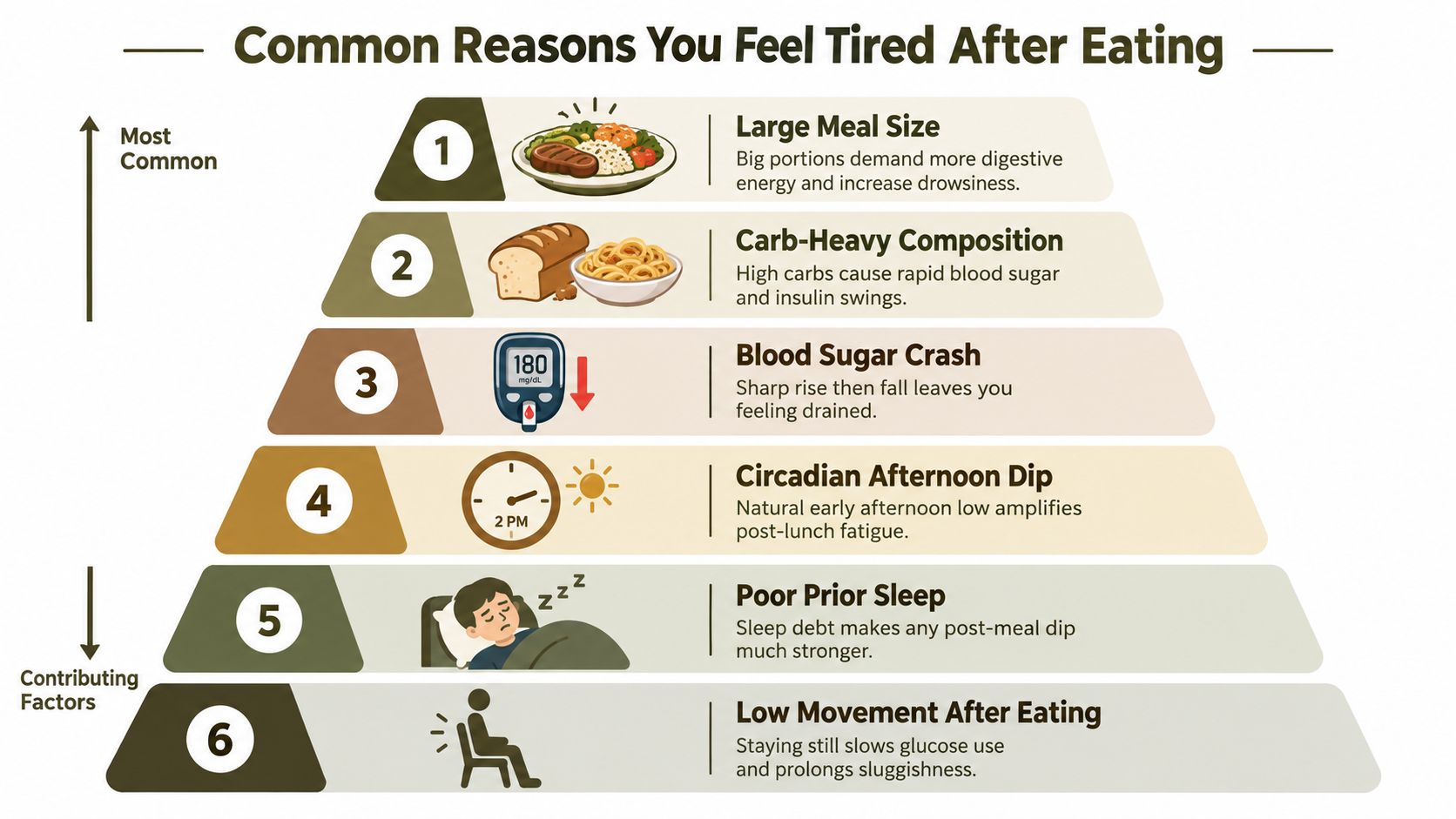
Most post-meal fatigue isn't caused by one thing. It's usually a stack. A large lunch lands during an early afternoon circadian dip. The meal is easy to overeat because you were stressed and under-fueled all morning. Then you sit still for hours. The result feels dramatic, even if each factor alone would have been manageable.
That's why broad advice like “eat healthier” often falls flat. You need to know which category your tiredness fits most often.
Meal size and meal makeup
The most obvious driver is too much food at once. Large meals create a stronger satiety response and tend to make the body feel slower afterward. If your crash is worst after restaurant lunches, holiday meals, or heavy takeout, size is probably part of the story.
Composition matters too. Some people feel dull after refined, carb-heavy meals. Others feel more sedated after rich, high-fat meals. The useful question isn't “Which macro is bad?” It's “Which meal pattern reliably changes my energy?”
Look for clues like these:
- Big portions: You feel physically heavy, full, and mentally flat.
- Refined starches or sugary drinks: Energy rises quickly, then drops.
- Very rich meals: Sleepiness builds more gradually and lingers.
Glucose swings and inflammatory signaling
A lot of people assume the problem is simple low blood sugar. That's too narrow.
A review on postprandial fatigue notes that fatigue after carbohydrate meals was not explained by insulin alone or by low glucose at the time symptoms occurred, and it also describes evidence that calorie-rich meals can increase systemic cytokines, with IL-1 at least partly involved in postprandial fatigue in lean and obese individuals in the review of postprandial fatigue, cytokines, and metabolic factors.
That matters because it changes the practical takeaway. Your crash may come from a mix of glycemic load, meal size, immune signaling, and your individual response.
Practical rule: If a certain meal knocks you down repeatedly, don't assume there's one hormone to blame. Treat it like a pattern worth testing.
Timing, sleep debt, and what surrounds the meal
Lunch often gets blamed because lunch is commonly eaten near the natural afternoon dip. If your body already wants a slight decrease in alertness, a heavy meal can amplify it.
Poor sleep makes the same lunch feel much worse. So does alcohol with the meal, dehydration, or sitting still afterward. These aren't side issues. They often determine whether a normal dip stays mild or turns into a crash.
A quick pattern map can help:
| Clue you notice | What it may suggest |
|---|---|
| Mostly happens after lunch | Circadian timing may be amplifying the effect |
| Happens after oversized meals | Portion size is likely a major driver |
| Happens after sweets, white bread, or a big starch load | Glycemic load may be contributing |
| Happens even after modest meals | Look at sleep, medications, digestion, or health issues |
| Comes with bloating or GI discomfort | Food intolerance or slow gastric emptying may be relevant |
Other contributors people overlook
Some cases have less to do with the meal and more to do with the background conditions around it.
- Medications: Some medicines can make any post-meal dip feel stronger.
- Alcohol: Even a small amount can add sedation.
- Slow gastric emptying or food intolerance: If the slump arrives with bloating, nausea, or cramping, digestion may be part of the picture.
- Underlying conditions: Thyroid issues, iron deficiency, and sleep disorders can make normal digestion feel disproportionately exhausting.
If you're asking, “Why am I so tired after eating?” the most useful answer may be, “Because these three factors keep showing up together.”
When Post Meal Fatigue Is Normal and When to Look Closer
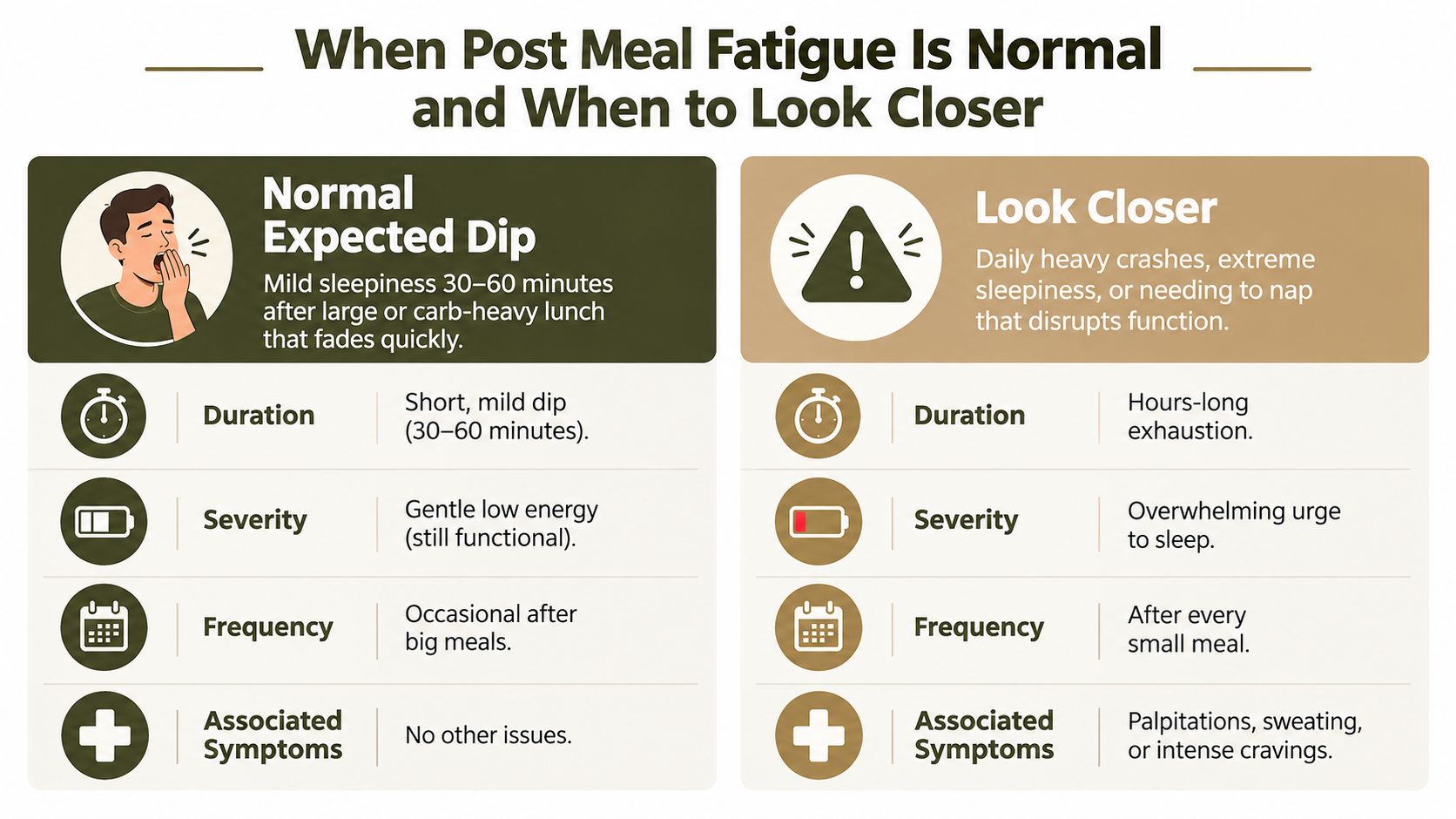
A mild dip after a large lunch is usually not alarming. A daily crash after ordinary meals deserves more attention. The difference is less about one symptom and more about the pattern around it.
The Cleveland Clinic notes that a mild dip can be expected after eating, while a heavier crash may point to factors such as meal size, glycemic swings, slow gastric emptying, iron deficiency, thyroid issues, or sleep disorders in its guide to food coma and when post-meal sleepiness may need a closer look.
A normal dip usually looks like this
You notice a short-lived drop in energy after a heavy or carb-dominant meal. You still function. You may feel less sharp for a while, but the feeling passes without derailing your day.
Common features of a normal dip include:
- Predictable timing: It tends to happen after the meals you'd expect
- Mild severity: You feel slower, not incapacitated
- Short duration: It fades as digestion moves along
- No broader symptom cluster: No repeated dizziness, palpitations, or feeling unwell
A pattern worth investigating looks different
The signal gets louder when the fatigue feels out of proportion to what you ate. If small meals trigger major sleepiness, if you need to lie down often, or if the crash interferes with work, driving, exercise, or concentration, don't wave it away as normal aging.
A closer look also makes sense if the tiredness comes with other changes, such as cravings, shakiness, sweating, bloating, lightheadedness, or signs of poor nighttime sleep.
Here's a simple comparison:
| Pattern | More likely normal | More reason to look closer |
|---|---|---|
| Meal trigger | Big or rich meals | Small or average meals |
| Impact | Annoying but manageable | Disrupts work or daily function |
| Frequency | Occasional | Frequent or near-daily |
| Extra symptoms | None | Noticeable physical symptoms alongside fatigue |
Personal responses vary more than most articles admit
One under-discussed point is personalized glucose response. Two people can eat the same lunch and feel completely different afterward. One stays steady. The other gets foggy and flat. That's one reason rigid food lists often disappoint.
Don't ask only whether a food is “good” or “bad.” Ask how your body responds to that meal in that context.
Pattern tracking becomes more useful than internet guessing. If you know which meals, times, and conditions produce the crash, the next step becomes clearer.
Practical Ways to Feel More Energized After Meals
You don't need a dramatic reset to improve post-meal energy. Small, repeatable adjustments usually work better than extreme food rules. The goal is to reduce the size of the dip, not chase perfect alertness after every meal.
A helpful place to start is one meal per day, not your entire diet.
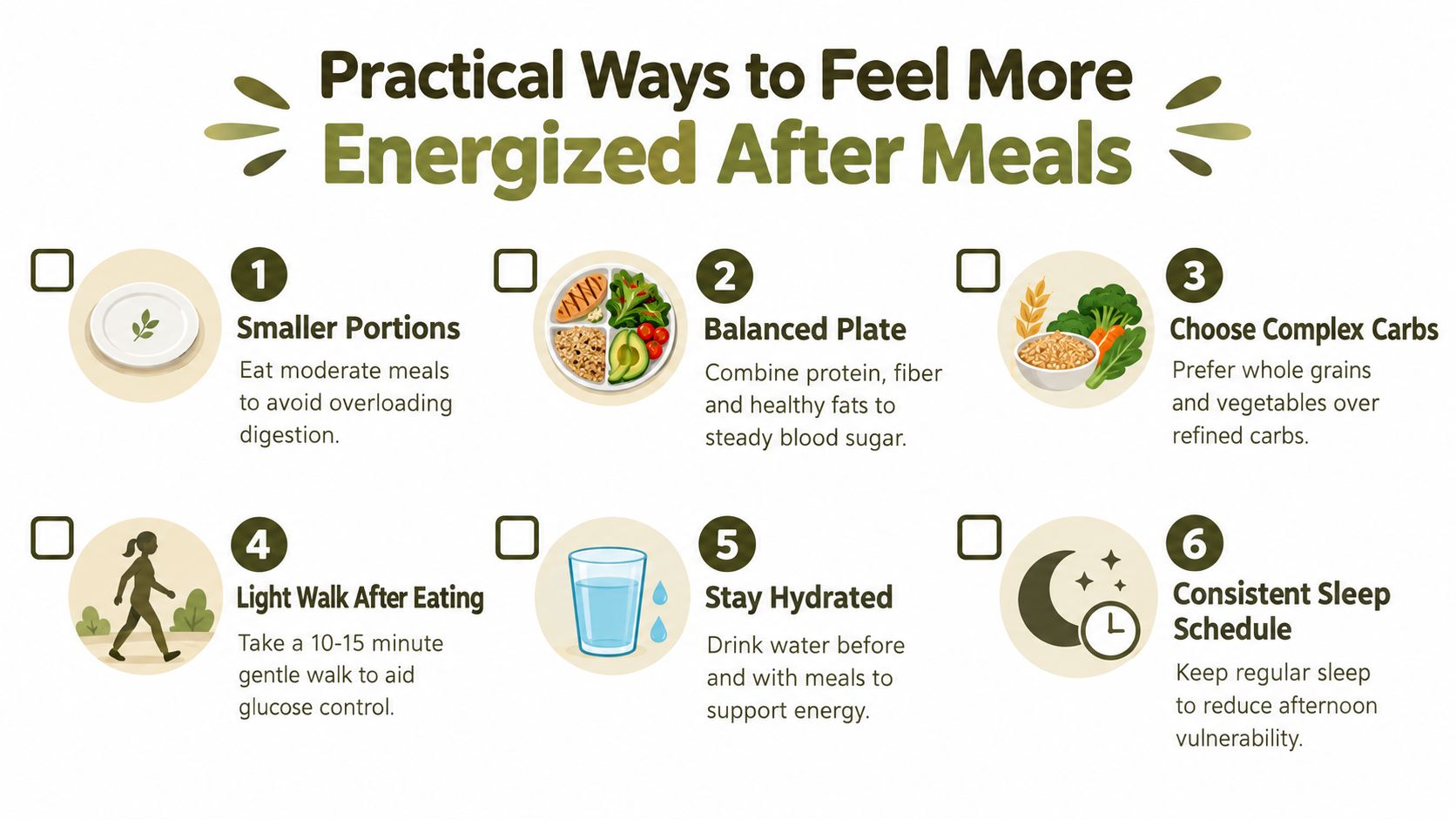
Start with the meal itself
Use your next workday lunch as a test. Keep the portion moderate. Build the plate around protein, fiber, and less refined carbohydrate, then notice your energy over the next few hours.
A practical checklist:
- Shrink the portion slightly: If lunch leaves you heavy, eat a bit less than usual before changing every ingredient.
- Balance the plate: Include protein, vegetables or other fiber-rich foods, and a sensible amount of starch instead of making the meal mostly bread, pasta, or rice.
- Lower the glycemic load: Choose less processed carbs when possible, especially if sweets or refined grains trigger a crash.
These changes aren't about deprivation. They're about sending a milder signal.
Change what happens after the meal
A short walk after eating is one of the simplest tools because it supports glucose handling and often improves how alert people feel afterward. If you usually sit immediately after lunch, even gentle movement can change the rest of the afternoon.
This video gives a useful overview of practical strategies:
Try a few of these for a week:
- Walk briefly: A gentle walk after the meal can soften the slump.
- Get light exposure: Step outside if you can, especially after lunch.
- Hydrate earlier: Don't wait until the crash starts to realize you're underhydrated.
- Avoid stacking sedatives: Alcohol at lunch and a big meal are a rough combination if you need mental sharpness afterward.
If you want alternatives to relying on caffeine or sugary drinks to push through, Longwelle's guide to a healthy energy drink can help you think more clearly about what supports stable energy versus what just masks the dip.
Work with your schedule, not against it
Some people do better when lunch is lighter and dinner is the more substantial meal. Others feel steadier with a slightly earlier lunch or a split lunch, where one larger meal becomes two smaller eating points.
Test the timing if your slump is strongly linked to the early afternoon.
A good experiment beats a strong opinion. Change one variable, keep it for several days, and watch what happens.
You can also use a simple tracking note:
| What to record | Example |
|---|---|
| Time you ate | 12:15 pm |
| What you ate | Chicken, vegetables, rice, sparkling water |
| How much | Light, moderate, heavy |
| Energy after | Clear, mild dip, strong crash |
| What followed | Walked, sat at desk, coffee, stressful meeting |
Don't ignore sleep and baseline fitness
Sometimes the meal isn't the main problem. It's just exposing low reserves. If you're underslept, under-moved, and stressed, digestion becomes the moment your body stops pretending it has plenty of energy.
That's why consistent sleep, regular activity, and better recovery habits matter so much here. They raise the floor, so the same meal hits less hard.
Biomarkers Tests and When to Talk With a Clinician
If the pattern is frequent or disruptive, subjective tracking may not be enough. That's when objective data can help separate a normal dip from a bigger issue affecting energy regulation.
Which biomarkers may help clarify the pattern
A clinician may consider labs related to glucose regulation, iron status, and thyroid function if your symptoms fit that picture. In some cases, sleep-related evaluation matters more than food analysis, especially if you wake unrefreshed, snore, or feel tired across the whole day.
The point isn't to order everything. It's to match testing to the pattern.
A useful discussion with a clinician often includes:
- Meal timing and severity: Which meals trigger the fatigue, and how intense is it?
- Associated symptoms: Shakiness, sweating, palpitations, bloating, brain fog, or cravings
- Sleep quality: Whether poor nighttime sleep could be lowering your threshold
- Trend over time: Whether this is new, worsening, or affecting function
Tracking beats guessing
One isolated lab result rarely tells the whole story. Trends, context, and symptom patterns are more informative than a single snapshot.
For adults who want a structured way to look at midlife energy patterns, Longwelle offers a brief assessment, educational guidance, coordination of lab work and biomarker monitoring under medical supervision, and optional nurse practitioner consults to help interpret what those results may mean in context.
That kind of approach can be useful when your question isn't just “What should I eat?” but “What is my body consistently telling me?”
When to speak with a clinician sooner
Consider getting professional input if the fatigue is new, severe, frequent, or paired with other concerning symptoms. The same goes if it's affecting work performance, driving safety, exercise tolerance, or your ability to stay awake after ordinary meals.
You don't need to self-diagnose. You do need to notice the pattern and bring clear observations.
Your Next Steps to Steadier Energy After Eating
If you've been wondering why you're so tired after eating, the most useful answer is usually not a single cause. It's a combination of meal signals, timing, sleep status, and your own metabolic response.
That's good news, because patterns can be changed.
Start simple. Pick one meal, ideally lunch. Make it a bit smaller, build it around protein and fiber, and take a short walk afterward. Track how you feel for a week. Don't overhaul everything at once.
If the crashes improve, you've learned something valuable. If they don't, that's useful too. It tells you to look beyond generic food advice and consider sleep quality, digestion, medications, glucose handling, or basic labs.
The bigger goal isn't to eliminate every dip in energy. It's to build steadier days, clearer afternoons, and better confidence in what your body responds to. If you want extra structure between your own experiments and a clinical visit, a tool like Longwelle's AI health coach can help you turn observations into more consistent routines.
Small adjustments, observed carefully, tend to beat random supplement hopping every time.
If post-meal fatigue keeps showing up, Longwelle offers a practical next step with a brief longevity assessment, educational guidance, biomarker tracking, and optional nurse practitioner support. It's designed to help adults over 40 connect symptoms like energy crashes to patterns in sleep, meals, and measurable health markers so the next move is clearer.