Learn
Why Am I Always Tired and Cold and What Helps Now
Why am I always tired and cold? Learn common causes, red flags, labs to check, and evidence-informed steps to restore energy and warmth.
You wake up already tired, pull on a sweater because the room feels colder than it should, and tell yourself it's probably stress, age, or not sleeping well enough. Then the pattern repeats. When tiredness and cold sensitivity show up together, they're often more than an inconvenience. They can be a clue that your body is struggling with energy delivery, heat production, or both.
That matters because this combination doesn't point to one single answer. Hypothyroidism is one of the most common medical explanations, and public-health guidance lists feeling extremely tired and feeling cold more than usual among its typical signs. Iron deficiency can do the same thing by limiting oxygen delivery to tissues. Sleep fragmentation can leave you drained, and midlife hormonal shifts can make temperature regulation feel less predictable. The mistake is assuming this is just normal aging and guessing with supplements.
A better approach is to think in layers. First, understand how the body makes heat and energy. Then compare the most likely causes, look at the clues your symptoms already give you, and discuss the right biomarkers with a clinician instead of chasing every possible cause at once. That keeps the process focused, practical, and much less frustrating.
Table of Contents
- Why Feeling Tired and Cold at the Same Time Deserves Attention
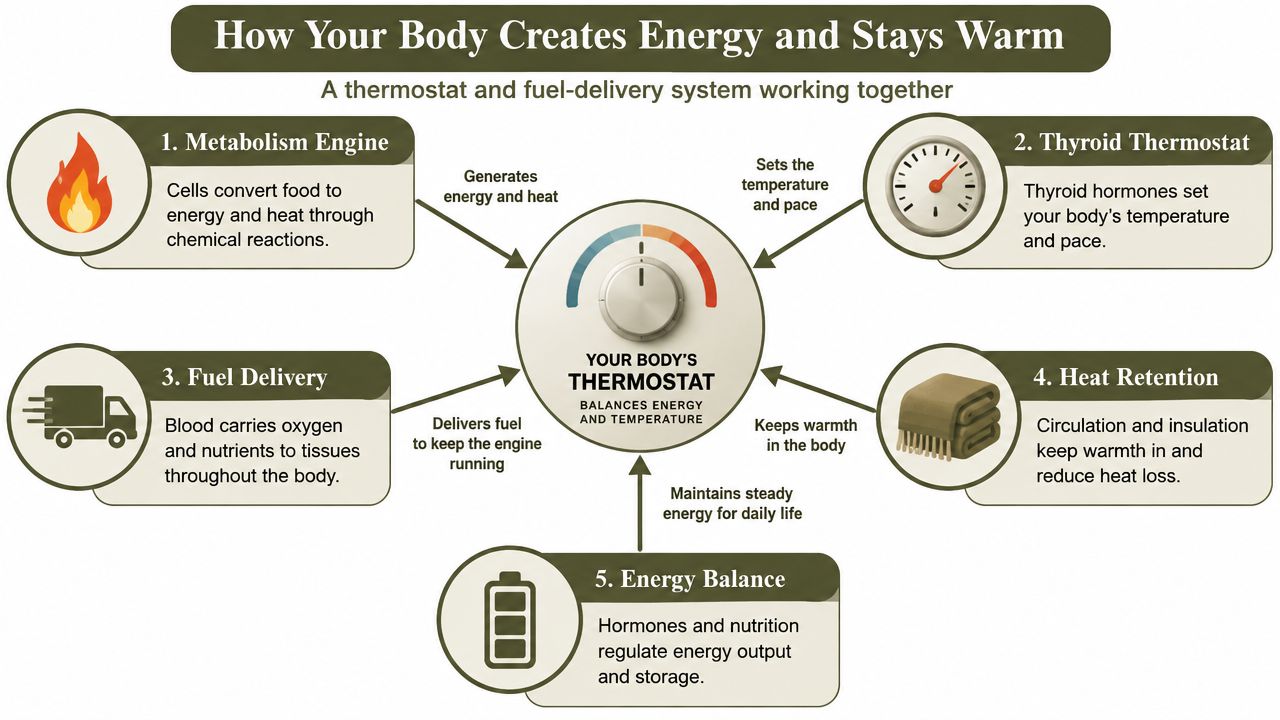
- How Your Body Creates Energy and Stays Warm
- Common and Often Missed Reasons You Feel Tired and Cold
- How to Tell Which Pattern Fits Your Symptoms
- Labs and Biomarkers Worth Discussing With Your Clinician
- Evidence Informed Ways to Restore Energy and Warmth
- When to Seek Care and How Biomarker Guided Monitoring Helps
Why Feeling Tired and Cold at the Same Time Deserves Attention
A lot of adults brush off this pairing because it starts gradually. You need an extra blanket. Then you start skipping exercise because your body feels flat, slow, and chilled in a room that should feel fine. By the time the pattern is obvious, it has usually been building for a while.
That slow build matters. Hypothyroidism often develops gradually, so people can feel off long before they connect the dots. An NIH-linked review describes overt hypothyroidism as uncommon but not rare, which is part of why the pattern is easy to miss.
Why the pair matters more than either symptom alone
Fatigue alone can come from stress, poor sleep, low intake, or illness. Feeling cold alone can happen when you are underdressed or sitting still for too long. Together, they point more clearly toward a body system that is struggling with metabolism, oxygen transport, or recovery during sleep.
Your body is trying to do two jobs at once, and one is slipping.
A simple way to picture it is this. Energy delivery is like a supply chain, and temperature control is like the building's heating system. If the thyroid dial runs low, heat production can slow. If iron stores are low, tissues may get less oxygen support than they need. If sleep is fragmented, the body never fully resets, so daytime energy and temperature control can both feel worse. Midlife hormonal shifts can add another layer, making the whole pattern less predictable.
Practical rule: when tiredness and coldness keep showing up together, treat it as a system problem, not a character flaw.
The NIH-linked review and public guidance both point to this combination as a reason to pay attention to the thyroid, but thyroid disease is only one part of the picture. The goal is not to label yourself from a symptom list. It is to notice that the same pattern can come from several overlapping systems, then check the most likely ones in a focused way.
How Your Body Creates Energy and Stays Warm
You notice it first in ordinary moments. You step out of bed, and the room feels colder than it should. By midafternoon, your energy has dipped, and even a light task feels heavier than it ought to.
Those two symptoms often travel together because the body uses the same supply lines for both heat and energy. One system sets the pace of heat production. Another brings oxygen and nutrients to the cells that turn fuel into usable energy.
When either side slows down, you can feel both tired and cold.
The thermostat sets the pace
Your thyroid hormones act like the master dial for metabolic speed. When that dial is turned down, cells make energy less efficiently, and heat production can fall with it. That is why thyroid problems often show up as a paired complaint, low energy and cold intolerance together.
The fuel line has to keep moving
Energy production also depends on oxygen reaching the tissues. Iron helps build hemoglobin, the part of red blood cells that carries oxygen. When iron stores run low, the body may still have blood on board, yet the delivery system is strained. The result can feel like a weak engine on a cold morning, slow to start and quick to fade.
The NHS describes iron deficiency anemia with a familiar symptom cluster, including lack of energy, palpitations, shortness of breath, and pale skin (NHS tiredness and fatigue guidance). That is the fuel-delivery problem in plain language.
Sleep keeps the system reset
Sleep is part of the repair crew. It helps regulate hormones, restore energy balance, and keep the body from running on fumes the next day. If sleep is fragmented, you may spend enough time in bed and still wake up under-recovered.
That is why poor sleep can look like a thyroid issue or an iron problem. The clue is often not dramatic insomnia. It is the quieter pattern, where you sleep but never feel restored.
Common and Often Missed Reasons You Feel Tired and Cold
Some causes are obvious, and some hide in plain sight because they show up as overlap, not as a single clean symptom. A person can have low iron stores, fragmented sleep, and a sluggish thyroid signal at the same time, so the body feels both underpowered and underheated.
The usual suspects
Thyroid dysfunction stays near the top because it changes how fast the body makes and uses energy. The shift can build slowly, especially in midlife, so people often write it off as stress, getting older, or just being busy. When the internal thermostat runs low, warmth and stamina both drop.
Iron deficiency and anemia matter for the same reason, oxygen delivery. Iron helps carry oxygen to the tissues, so low stores can strain the system before anemia is obvious. The result can feel like a weak engine that starts slowly and fades early, with symptoms such as lack of energy, palpitations, shortness of breath, and pale skin (NHS tiredness and fatigue guidance). That overlap is why one explanation often misses the full picture.
The less obvious drivers
Sleep problems are often missed because people think only loud snoring or obvious insomnia counts. Sleep fragmentation can still leave someone unrefreshed, even if they were in bed long enough. Clinical summaries also point to sleep disorders as hidden drivers of fatigue, which makes sleep worth checking when the daytime slump does not line up with the rest of the picture (Rupa Health summary).
Low caloric intake can add another layer. If meals have gotten smaller, appetite has changed, or stress has pushed eating off schedule, the body has less fuel to burn and less heat to make. Midlife women can also run into this pattern when perimenopausal bleeding lowers iron stores before anemia is obvious (Jumpstart MD discussion).
A slow change deserves attention.
When tiredness and coldness keep building, the question is not just which symptom is louder. It is which system is slipping first, temperature control, oxygen delivery, sleep recovery, or hormonal signaling. That is why the same person can feel wiped out, chilly, and unable to bounce back after normal activity.
Why real-world evaluation often needs more than one answer
The overlap is the point. People with cold intolerance may also have a thyroid disorder, anemia, or both, while fatigue can come from more than one pathway at once. A single label can miss the part that keeps the body running cold and low on energy, which is why a stepwise check works better than guessing.
How to Tell Which Pattern Fits Your Symptoms
The fastest way to make progress is to stop asking, “What single thing is wrong?” and start asking, “Which pattern fits my body best?” The clues around your symptoms matter. So does your history.
| Cause Cluster | Typical Clues Beyond Tired and Cold | History to Note |
|---|---|---|
| Thyroid dysfunction | Slow thinking, dry skin, constipation, hair thinning, weight changes, sluggish recovery | Symptoms that crept in over months, family history, prior thyroid issues |
| Iron deficiency or anemia | Breathlessness with effort, palpitations, pale skin, brittle nails, reduced exercise tolerance | Heavy periods, low iron intake, blood loss, prior anemia |
| Sleep-related fatigue | Unrefreshing sleep, snoring, morning headaches, daytime sleepiness | Waking often, partner notices snoring, irregular sleep schedule |
| Hormonal shifts in midlife | Hot and cold swings, sleep disruption, cycle changes, mood shifts, new fatigue pattern | Perimenopause, irregular periods, recent change in cycle timing |
The point of a table like this isn't to self-diagnose. It's to help you show up to a clinician conversation with details that matter. If you've had heavy periods, mention that. If you snore or wake up unrefreshed, say that clearly. If your skin, hair, or digestion have changed too, those clues help sort the picture.
A useful example is the person who feels exhausted, cold, and short of breath on stairs. That pattern points more toward iron-related problems than simple sleep loss. A different person might feel cold, foggy, and constipated with dry skin, which makes thyroid dysfunction more likely. Sometimes both are present, and that's when symptoms can feel especially stubborn.
For a related discussion of brain fog and concentration, you can also read this overview on brain fog.
Labs and Biomarkers Worth Discussing With Your Clinician
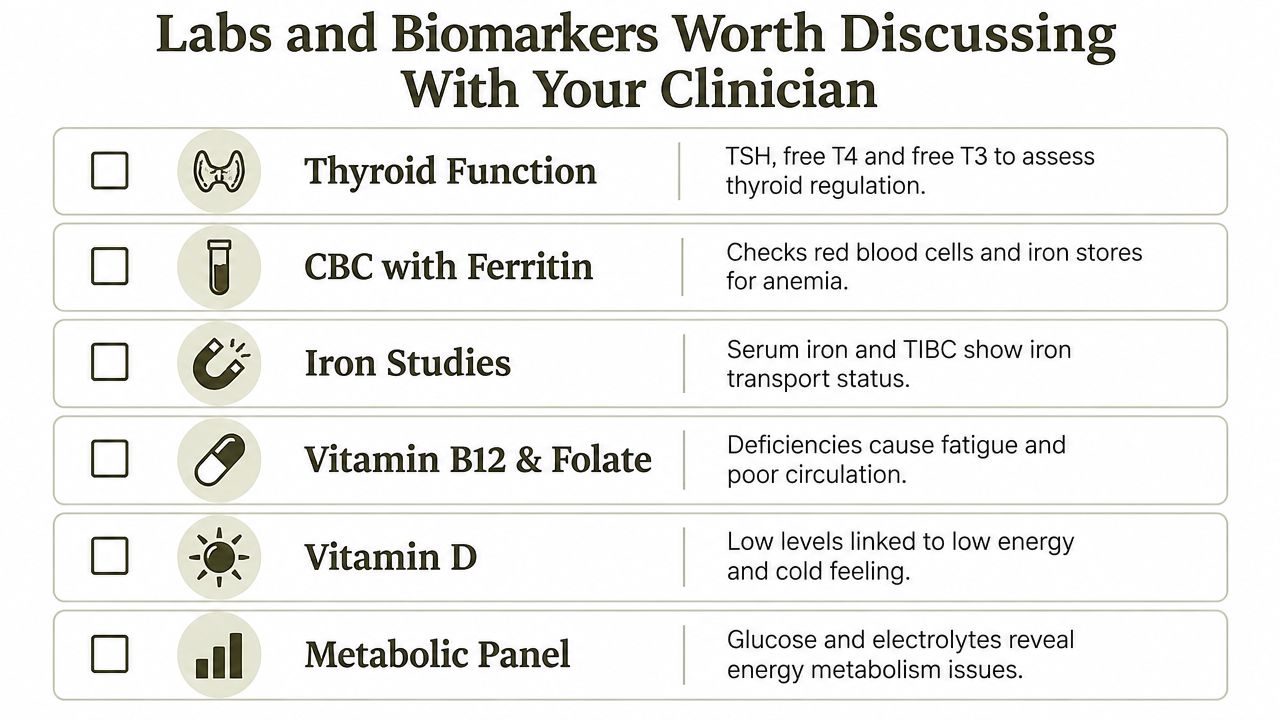
Symptoms point to the body system that may be under strain. Biomarkers help show whether the problem is iron supply, thyroid signaling, sleep disruption, or something else affecting energy and heat production. That is why the discussion should begin with targeted testing, not a random panel.
What to ask about first
A focused workup often starts with thyroid function, a CBC with ferritin, and iron studies if blood loss or low intake is possible. Depending on the pattern, clinicians may also discuss vitamin B12, vitamin D, and a metabolic panel. If snoring, unrefreshing sleep, or frequent waking is part of the picture, a sleep evaluation belongs in the conversation too.
The key biomarker is ferritin. Guidance commonly treats ferritin below about 30 ng/mL as low iron stores, and symptoms can appear even when hemoglobin is still normal on a standard CBC (blood-analysis guidance). That is why a normal CBC does not always end the workup.
Why borderline results matter in midlife
If bleeding has been heavier during perimenopause, ferritin may deserve attention before anemia shows up on routine labs. In practice, that means asking whether ferritin should be checked alongside the CBC, not after it. Borderline results are easier to interpret when they are read together, because hemoglobin, ferritin, and the symptom pattern each tell a different part of the story.
Clinical shortcut: if the symptoms fit iron deficiency, check ferritin, not just hemoglobin.
Re-testing after treatment matters too. You want to see whether the biomarker moved in the right direction and whether the symptoms changed with it. A single result is only a snapshot.
If you are tracking health markers over time, Longwelle's AI health coach can help organize symptoms, lab follow-up, and routine changes between visits.
Evidence Informed Ways to Restore Energy and Warmth
Small daily changes won't replace medical evaluation when a real deficiency or thyroid problem is present, but they can reduce strain while you wait for answers. The goal is to support the same systems that are already under pressure, energy production, sleep recovery, and steady thermoregulation.

Build the day around steadier fuel
Start with regular meals that contain protein and enough calories to keep you from running cold. If you've been skipping breakfast or eating lightly during stress, the body may respond like it's conserving fuel. Warm foods, soups, eggs, yogurt, beans, and oatmeal can all help make that pattern easier to sustain.
Movement matters too, but not as punishment. Even brief walks, light strength work, or getting up from a desk often can help circulation and keep your body from settling into an energy-saving mode. If winter light and low movement are part of your routine, a structured morning plan like this daily routine guide can help you keep the basics consistent.
Protect sleep like it's part of treatment
Sleep fragmentation can make every other problem feel worse. Keep a consistent wake time, dim lights at night, and cut off caffeine early enough that it doesn't bleed into the next day. If snoring, gasping, or repeated waking is part of the picture, that's a medical clue, not just a bad habit.
Keep the room cool, but not so cool that you're shivering through the night. Recovery works better when sleep is stable, not when your body is constantly fighting the environment.
Use tracking instead of guessing
Pick one or two changes and watch what happens over two to four weeks. Note whether your energy, warmth, sleep quality, or exercise tolerance improves. If nothing shifts, that's useful data too, because it suggests the next layer of evaluation matters more than another supplement.
Longwelle's habits-first approach fits this kind of tracking, since it emphasizes routines, biomarkers, and follow-up rather than random trial and error.
When to Seek Care and How Biomarker Guided Monitoring Helps
If your fatigue is worsening, your cold intolerance is interfering with daily life, or you're also dealing with chest pain, shortness of breath, or significant weight change, don't wait on self-experimentation. Persistent symptoms deserve a clinician visit, especially when they're affecting work, sleep, or basic day-to-day function.
Biomarker-guided monitoring helps because it shows whether the pattern is changing, not just whether one lab was normal once. That matters when symptoms are subtle and gradual. A single test can miss the bigger story, but repeat measures plus symptom tracking can show whether iron is recovering, thyroid treatment is working, or sleep changes are helping.
If you want a more guided way to sort through the pattern, a brief assessment and structured follow-up can make the process easier. You can use tools like the Longwelle longevity assessment to organize symptoms, lab discussions, and next steps without having to piece it all together alone.
If you're tired of guessing why you feel tired and cold, Longwelle helps you turn symptoms into a clearer plan with a brief assessment, biomarker tracking, and practical guidance you can use. Visit Longwelle to explore a structured next step for energy, sleep, and midlife health.