Learn
What Is the Best Wake Up Routine After 40
What is the best wake up routine after 40? Learn evidence-based habits for light, sleep, movement, and breakfast that boost energy and clarity in midlife.

Most advice about mornings is too shallow. It tells you to drink water, get sunlight, and avoid your phone, as if the same script works for a rested morning person and a sleep-deprived night owl who woke in the middle of their biological night.
That's the wrong starting point.
What is the best wake up routine after 40? It's not the routine that looks clean on paper. It's the one that matches your chronotype, sleep quality, and level of sleep inertia. If you wake up groggy, that doesn't automatically mean you need more discipline. Sometimes your body is waking at the wrong biological time, or waking from poor sleep, and your morning feels bad because the night before set it up that way.
Research supports that more personalized view. Morning sleep inertia is linked with factors like evening chronotype, insomnia, daytime sleepiness, anxiety, and shorter sleep, while waking during the biological night tends to produce worse impairment than waking during the biological day, according to a large study on sleep inertia and related factors in adults (sleep inertia and chronotype findings).
For adults over 40, this matters even more. Midlife often brings lighter sleep, more fragmented nights, earlier waking, and less margin for sloppy routines. A useful wake-up plan doesn't start with copying someone else's ideal morning. It starts with understanding what kind of sleeper you are, what your body is doing at wake time, and which morning inputs help.
Table of Contents
- Why the Best Wake Up Routine Starts the Night Before
- The Biology of Waking Up After 40
- Morning Light, Done Right
- Hydration, Movement, and Breakfast Sequencing
- Sample Routines for Common Midlife Goals
- Personalizing the Routine With Biomarkers and Nurse Practitioner Input
- How to Adopt a New Routine Without Burning Out
- Putting It All Together This Week
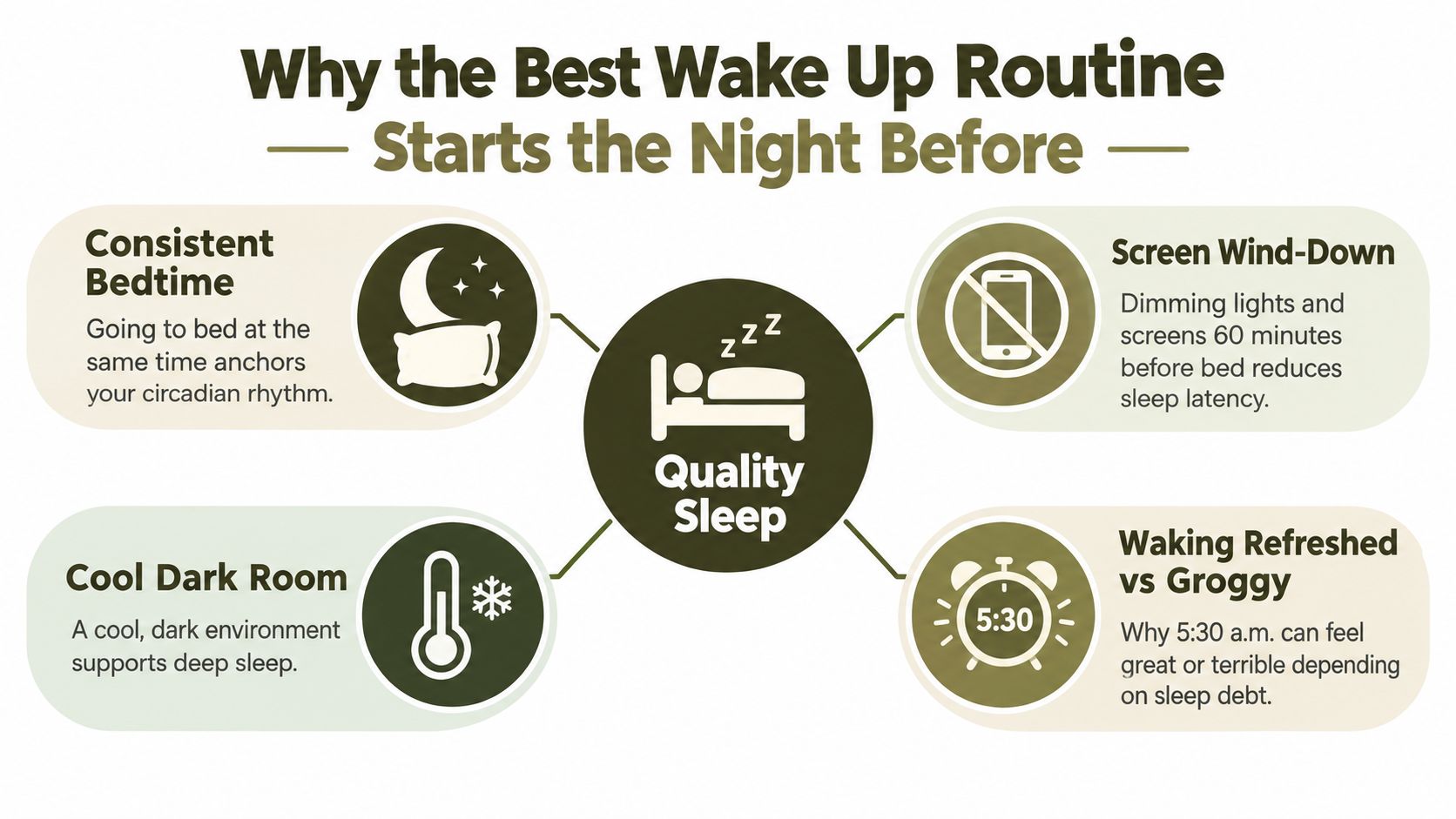
Why the Best Wake Up Routine Starts the Night Before
The popular template goes like this: wake up, chug water, stand in the sun, and power through. That advice isn't useless. It's just incomplete.
If you wake at 5:30 feeling crushed and wake at 7:30 feeling clear, those are often two different biological situations, not two different levels of motivation. A wake-up routine can't fully rescue a night that was too short, too irregular, or badly timed for your body clock.
Audit the night that produced the morning
After 40, many people notice that they can't “get away with” the same habits they used to. Late screens, alcohol near bedtime, irregular bedtimes, and a warm bedroom can all make the next morning feel heavier. The fix usually isn't a more heroic alarm. It's a better runway into sleep.
A wake-up routine is only as good as the sleep it follows. If your schedule swings on weekdays and weekends, your brain never gets a clean signal for when to expect sleep and when to expect alertness.
Practical rule: If your mornings are unreliable, stop adding morning hacks for a week and audit your evenings instead.
The strongest anchor is often your wake time
Many people obsess over the perfect bedtime. In practice, a stable wake time often matters more because it gives your circadian system a repeatable anchor. Once wake time becomes steadier, bedtime usually starts to move in the right direction on its own.
A good pre-sleep setup is boring on purpose:
- Dim the environment: Lower household light and screen brightness in the last stretch of the evening.
- Cool the room: A cooler sleep setting tends to support easier sleep onset and less tossing around.
- Reduce decision load: Put clothes out, prep breakfast basics, and decide on tomorrow's first movement before bed.
- Keep wake time steady: Even if bedtime wasn't perfect, getting up at a similar time helps prevent your rhythm from drifting.
If your evenings need structure, Longwelle has a practical guide to building a night routine for better recovery and sleep consistency. That's often where a major morning breakthrough starts.
The Biology of Waking Up After 40
Waking up isn't like flipping on a kitchen light. It's more like starting an older car on a cold morning. The engine turns over first, then the rest of the system catches up.
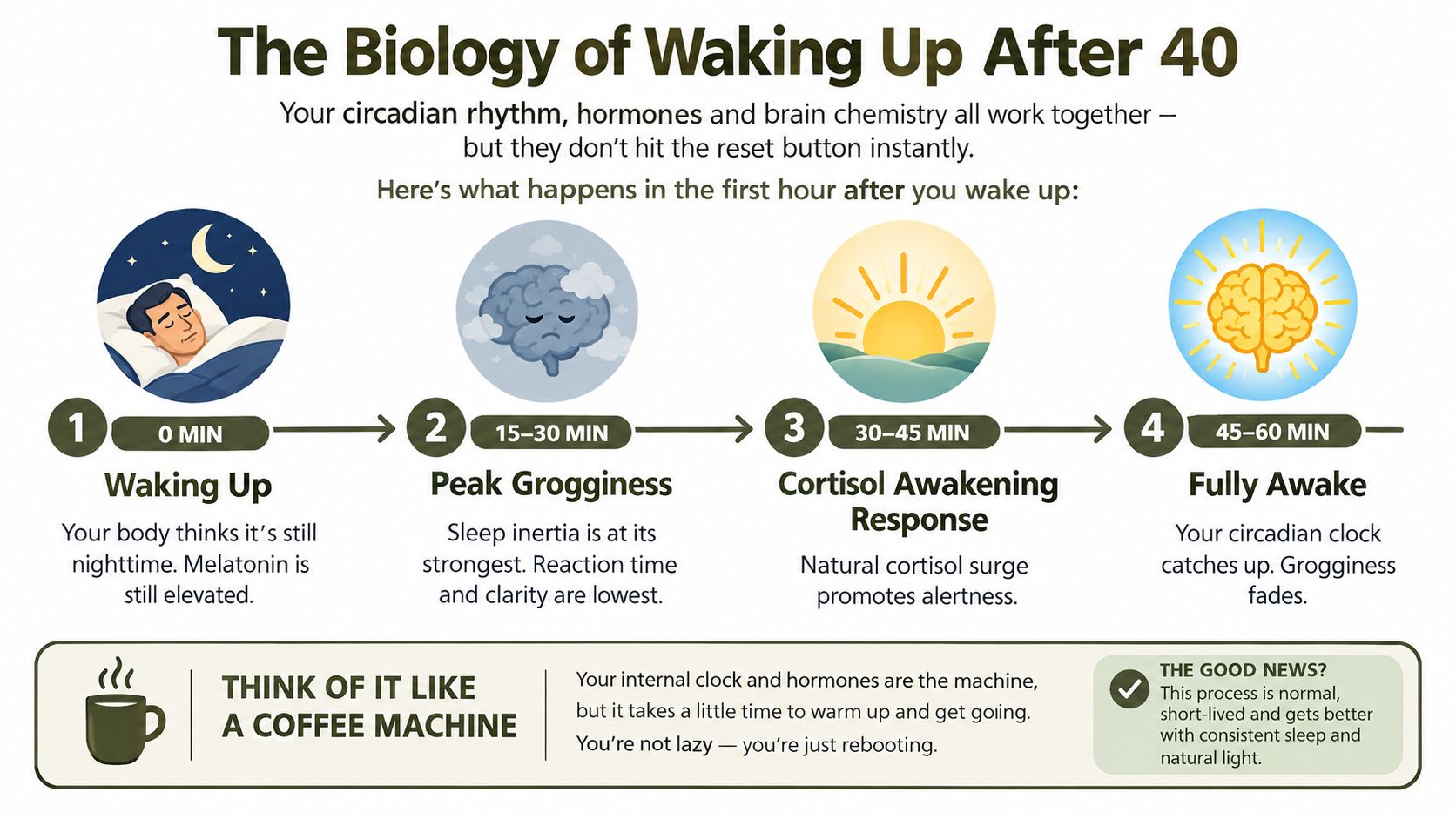
That lag is called sleep inertia. In plain language, it's the foggy transition period after waking when your brain is awake enough to move, but not yet fully online.
Why grogginess can last longer than you think
A controlled study found that alertness and cognitive processes were impaired immediately after awakening, and those effects lasted well over two hours, according to research on sleep inertia and morning sleepiness in daily life (sleep inertia and morning light study).
That finding explains a common confusion. People often assume that if they're still foggy after showering or coffee, something is wrong. Sometimes nothing is wrong. You're still moving through a normal but unpleasant transition, especially if you woke abruptly or at a bad biological time.
Your body clock cares about timing, not effort
Your brain's internal clock uses light and regular timing cues to decide when to promote sleep and when to promote alertness. If you wake while your body still “expects” darkness, you can feel as if your mind is stuck in night mode.
Adults over 40 often become more sensitive to poor timing because sleep gets less forgiving. You may wake earlier, wake more often, or lose some of the deeper, more restorative sleep that used to buffer a rough night.
For readers who keep asking why they feel wiped out even after a decent time in bed, this deeper fatigue picture is worth exploring in Longwelle's guide on why you might still feel so tired.
Later in the morning, another signal starts to rise. Cortisol, which has a natural morning surge, helps move you toward alertness. But that surge works better when your wake time is regular and your light exposure supports it.
A short visual walkthrough helps make that sequence easier to grasp.
If you're waking during your biological night, the right question isn't “How do I force myself awake?” It's “Why is my timing off in the first place?”
Morning Light, Done Right
Morning light is one of the few wake-up tools with strong circadian evidence behind it. But the internet usually flattens that into a slogan: get sunlight immediately. The answer is more specific.
Morning light works best when you think about timing, brightness, and context. For some people it sharply improves the transition into the day. For others, especially if sleep is already fragmented or the light dose is weak, the effect is smaller than expected.
What the evidence actually supports
In a systematic review, blue light in the morning produced an average melatonin phase advance of 84 ± 51 minutes during treatment, compared with 48 ± 47 minutes for amber light, and wake-up time on post-treatment days was about 21 minutes earlier in the blue-light group (systematic review on morning light and circadian phase shift).
That's why morning light belongs near the top of the list for adults trying to wake earlier or feel less out of sync. It doesn't just make a room brighter. It gives your circadian clock a clearer “day has started” message.
Another review found that morning light can suppress melatonin, raise cortisol by more than 50% in the early-morning transition, and support alertness after sleep loss. That same review suggests a practical target of 10 to 30 minutes of outdoor or similarly bright light within the first hour after waking, especially for people dealing with delayed schedules or heavy morning grogginess (review on morning light, cortisol awakening response, and practical exposure targets).
Where people get light wrong
The common mistake is assuming any bright-looking environment counts. It often doesn't.
| Light Source | Approx. Lux | Recommended Duration |
|---|---|---|
| Outdoor morning light | Qualitatively highest practical option | 10 to 30 minutes |
| Bright indoor light near windows | Lower and variable | Longer exposure may be needed |
| Tinted car commute | Reduced effective light | Usually not ideal as your main light dose |
| Standard room lighting | Much lower than outdoor light | Not a reliable replacement |
| Light box or similarly bright artificial light | Can be a reasonable substitute when outdoor access is limited | Aim to match a bright, structured morning exposure |
Window light is better than darkness, but it usually won't match being outdoors. Sunglasses very early can blunt the dose you're trying to get. A gray day outside can still deliver a stronger signal than many indoor spaces.
The newer wrinkle is that light isn't a universal anti-grogginess fix. A NASA real-world study published in 2025 found that light exposure at habitual wake time was less effective than expected, and in that experiment the light condition even performed worse than control on one reaction-time measure. The same report also points to newer evidence suggesting that timing and dose matter more than generic “get sunlight right away” advice, with some research indicating benefit from moderate natural light entering before wake time (NASA study on wake-time light exposure and anti-grogginess effects).
So the useful rule is simple. Start with outdoor light early, but personalize from there if it doesn't help.
Hydration, Movement, and Breakfast Sequencing
Most morning routines get cluttered. They pile up water, workouts, supplements, coffee, and breakfast without asking what order makes sense.
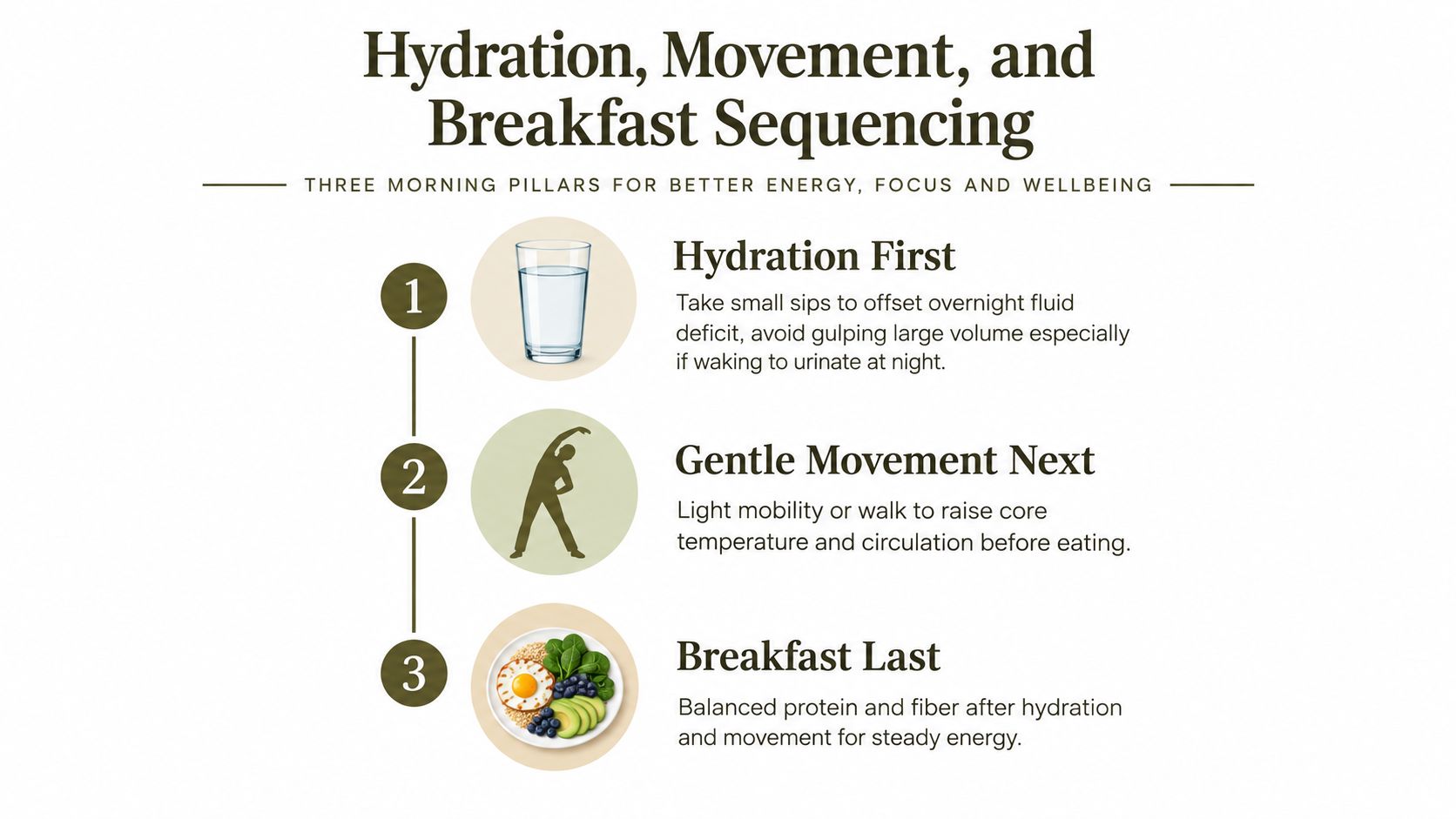
A better approach is to think in sequence, not just ingredients.
Start gentle if your brain is still foggy
When you first wake up, especially if you deal with strong sleep inertia, your body may not want a lot all at once. Small sips of water are often easier than forcing down a large amount immediately. If you woke to urinate during the night, that's another reason not to overdo fluids in one shot.
Movement next. But movement doesn't have to mean a hard workout.
- For heavy grogginess: Try a short walk, joint circles, light mobility, or a few minutes of easy stairs.
- For stable sleepers: A more deliberate exercise block can work well, especially if mornings are when you'll do it.
- For poor recovery days: Keep the goal to circulation and alertness, not performance.
Breakfast changes the feel of exercise more than people expect
Evidence suggests that a short morning bout of exercise can help mood and cognition, but breakfast changes the tradeoff. One controlled study found that a small breakfast of about 118 kcal before morning exercise improved mood and post-exercise appetite control. Another study found that a low-glycemic breakfast plus 30 minutes of aerobic and coordinative exercise improved arithmetic performance and reaction time versus fasting and inactivity. A newer systematic review found breakfast didn't consistently change the cognitive benefits of acute exercise in healthy adults, which suggests the more dependable practical effects are on energy, mood, and appetite rather than universal cognitive gains (review on breakfast timing, exercise, mood, and cognition).
That tells me something useful for adults over 40. Don't turn breakfast into ideology.
A workable rule: If fasted exercise leaves you shaky, flat, or ravenous later, a small pre-exercise bite may suit you better than forcing a fasting routine that only looks efficient.
A simple sequence for many people is light, then water, then easy movement, then breakfast once your system is fully awake. Coffee can fit after that, especially if you notice that caffeine on an empty, groggy system makes you jittery rather than sharp.
Sample Routines for Common Midlife Goals
The best wake-up routine isn't one routine. It's a framework you adjust based on what kind of morning you need.
Some people want steady energy. Others care most about mental clarity. Others just need to function after a rough night without making the next night worse.
Three sample wake-up routines for midlife goals
| Time Block | Steady Energy | Cognitive Clarity | Sleep Recovery |
|---|---|---|---|
| Wake | Get up at a consistent time and avoid checking your phone | Get up and keep the environment quiet and bright | Get up without rushing and keep expectations low |
| First part of the morning | Get outside for morning light, then have water | Get light exposure and protect the first block from email and noise | Use gentle light and small sips of water |
| Next step | Take an easy walk or do light mobility | Sit down for your hardest thinking task while your mind is clearing | Do low-intensity movement such as a short walk |
| Food timing | Eat a steady breakfast after movement | Delay exercise until after your first focus block if that helps mental output | Eat a protein-forward breakfast once appetite appears |
| Caffeine | Use it after light and movement if it works well for you | Keep it paired with focused work, not doomscrolling | Use less if you're already overstimulated from poor sleep |
How to choose the right version
The steady-energy routine fits people who don't want dramatic peaks and crashes. They usually do well with a calm start, outdoor light, a walk, and breakfast that doesn't leave them hungry again too soon.
The cognitive-clarity routine works for people whose brain feels best before the world starts making demands. If that's you, don't waste your clearest early block on inbox maintenance. Use light to wake up, then aim your best attention at one meaningful task before exercise or social input pulls you off course.
The sleep-recovery routine matters most after a bad night. That morning is not the time to prove toughness. Keep the first hour simple. Light. Water. Gentle movement. A straightforward breakfast. The goal is to reduce friction and avoid digging the hole deeper.
Bad sleep changes the assignment. A smart routine adjusts to that instead of pretending every morning should feel the same.
Personalizing the Routine With Biomarkers and Nurse Practitioner Input
Generic morning templates fail because they treat all fatigue as the same problem. It isn't.
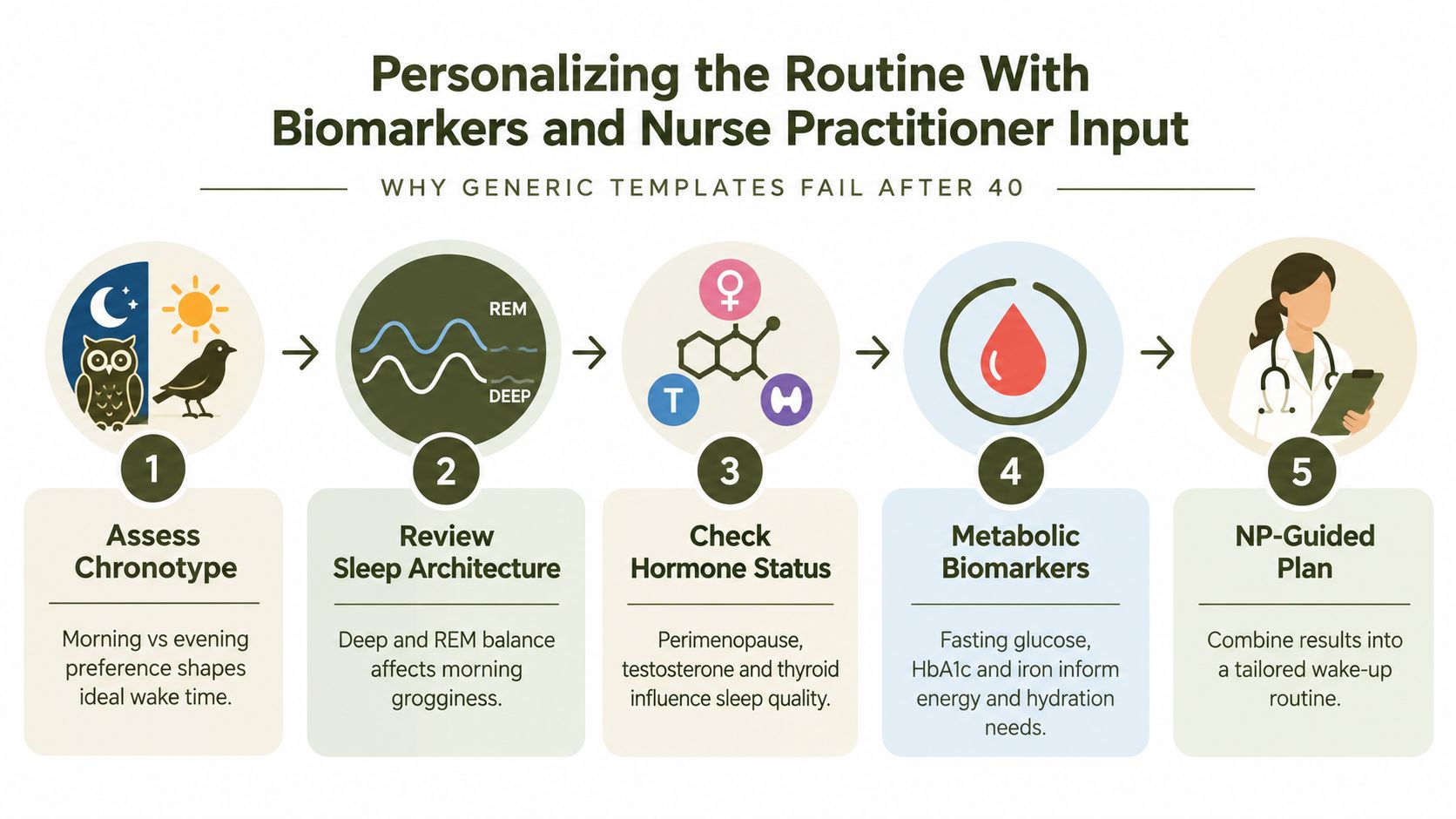
One person wakes groggy because they're a late chronotype living on an early schedule. Another wakes tired because their sleep is fragmented. Someone else feels wired and flat because stress, hormonal shifts, or metabolic issues are affecting both sleep and morning energy.
What data can actually help
Not every tool is necessary. But some forms of feedback can make a routine more accurate:
- Sleep tracking: Useful for spotting patterns like frequent wake-ups, short sleep, or irregular timing.
- Heart rate and recovery trends: These can hint when your body is under strain and a hard morning workout may backfire.
- Glucose patterns: Helpful if your breakfast or caffeine timing seems to create crashes.
- Basic lab work: Thyroid markers, iron status, and vitamin D can matter when “I'm tired every morning” keeps showing up.
- Symptom logs: Mood, alertness, appetite, and wake quality still matter, even if you use devices.
Why clinician input matters after 40
Data helps, but interpretation matters more. A nurse practitioner can put the pieces together and help you distinguish a routine problem from a health issue that deserves more attention.
For example, if your data shows broken sleep and early waking, the answer may be to adjust evening light and stress load before chasing an aggressive 5 a.m. routine. If your glucose swings after a sweet breakfast, breakfast composition may matter more than adding supplements. If your wearable keeps showing poor recovery, you may need lighter morning exercise on certain days rather than a rigid daily workout goal.
If you want that kind of personalization between self-tracking and medical care, Longwelle offers an AI health coach that supports science-informed routines and guidance. It's one way to organize patterns before or between clinician conversations.
The bigger point is simple. The best wake-up routine after 40 is often measured, adjusted, and individualized, not copied.
How to Adopt a New Routine Without Burning Out
People rarely fail because the routine was bad. They fail because they changed too much at once.
Adults over 40 usually have jobs, families, travel, stress, and nights that don't always cooperate. Your routine has to survive real life, not just ideal Tuesdays.
A simple two-week rollout
For the first week, pick one anchor behavior. Morning light is the strongest candidate for you because it supports both wakefulness and circadian timing. Put your walking shoes, jacket, or porch key where you can't miss them the night before.
In the second week, keep that anchor and add two small layers: hydration timing and a brief movement block. Not a full program. Just enough to make the routine feel coherent.
Try this:
- Week one: Get light exposure soon after waking every day, including weekends.
- Week two: Keep the light habit, add water soon after waking, and add a short movement block.
- Keep friction low: Put the phone outside the bedroom, set clothes out, and leave a glass or bottle ready.
Use a short weekly review
You don't need a detailed spreadsheet. You do need feedback.
A five-minute Sunday check-in works well:
- Energy score: Rate your average morning energy on a simple personal scale.
- Sleep consistency: Notice whether wake time stayed fairly stable.
- One friction point: Maybe late screens crept back in or weekends drifted.
- One experiment: Move bedtime earlier, take light outside instead of by a window, or shorten the workout.
The three failure modes I see most are familiar. Late-evening screen rebound. Weekend oversleep that knocks Monday off track. All-or-nothing thinking that makes one bad morning feel like a full reset.
When life gets chaotic, don't add more. Drop back to your single anchor and rebuild from there.
Putting It All Together This Week
Here's the cleanest way to answer the question, what is the best wake up routine.
It's the routine that aligns wake time, light exposure, and first movement with your chronotype and the sleep you got, not the sleep you hoped to get. A good morning routine isn't a performance. It's a biological handoff from sleep to alertness.
If you make one change this week, make it this: get outdoor light within the first part of your morning on a consistent schedule, including weekends. That single habit does more to support your body clock than most stacked morning tricks.
The simplest sequence to keep
When your mornings feel complicated, use this order:
- Light first
- Water next
- Then movement
- Then breakfast when your body is ready
That sequence won't solve every morning. But it gives your brain and body the right signals in the right order.
The reframe that matters
The best wake-up routine after 40 is not a script you perform no matter what. It's a set of inputs you tune week by week.
Some mornings call for a walk and focused work. Some call for gentleness because the night was rough. Some call for stepping back and asking whether the fix belongs in the evening, your schedule, or a deeper health review.
That's the shift many individuals need. Stop asking, “What do successful people do in the first 10 minutes after waking?” Start asking, “What helps my brain and body wake well?”
If you answer that clearly, your routine gets simpler. And it starts working.
Longwelle helps adults over 40 turn broad wellness advice into a more personalized plan with education, biomarker tracking, and optional nurse practitioner guidance. If you want help translating your sleep patterns, energy dips, and daily habits into a routine that fits your biology, visit Longwelle.