Learn
What Is a Biometrics Screening: A Practical Guide
What Is a Biometrics Screening. Learn what a biometrics screening is, what it measures, why it matters for preventive care, and how to use your results
You may have first heard the phrase biometric screening while signing up for workplace benefits, standing beside a wellness booth in an office lobby, or completing paperwork before a clinic visit. Someone records your height and weight, wraps a cuff around your upper arm, and perhaps uses a finger stick to check glucose or cholesterol. The process feels quick and administrative, yet those measurements can become the starting point for questions about blood pressure, metabolism, heart health, and long-term risk.
So, what is a biometrics screening in practical terms? It's a compact health snapshot, not a pass-or-fail exam and not a diagnosis. The useful question isn't whether one result looks perfect. It's what the result can teach you, what needs follow-up, and how the numbers change when you measure them again under comparable conditions.
Table of Contents
- Where Biometric Screenings Show Up
- What a Biometric Screening Really Is
- What the Screening Measures and Why
- Reading the Numbers Without Panic
- How Screenings Fit Into Preventive Care and Longevity
- Where Screenings Help and Where They Fall Short
- Turning Your Results Into a Personal Baseline
Where Biometric Screenings Show Up
You may encounter a biometric screening while checking in for a workplace wellness event. A temporary station might be set up in a conference room or lobby. After a short consent form, a technician may measure your blood pressure, record your weight, and ask whether you have eaten. Some programs provide results on the spot, while others send them through a benefits portal.
The same term appears in several settings:
- Primary care intake: A clinic may record height, weight, BMI, waist circumference, and resting blood pressure before your appointment.
- Health insurance incentives: An insurer may include screening in a wellness or preventive-health initiative.
- Population-health programs: Employers and health organizations may collect comparable measurements from participants to establish baselines and track changes.
- Longevity or wellness onboarding: A program may start with basic measurements and add laboratory testing later.
The physical process is usually straightforward. You may see a clipboard, a digital scale, a blood-pressure cuff, and a small lancet for a finger-stick sample. The equipment is familiar, but the scope of the screening isn't universal. One program may measure only body size and blood pressure. Another may add glucose and lipid testing. A clinical program may use a broader panel and repeat measurements over time.
That difference matters because biometric screening does not name one standardized exam. It describes a flexible bundle of measurable health signals, selected by the employer, insurer, clinic, or wellness provider. Treat the first screening as the opening entry in an ongoing biomarker conversation, rather than a one-time pass-or-fail event. The next useful question may be which result deserves confirmation or tracking.
Practical rule: Before attending, ask which measurements are included, whether fasting is required, how results are delivered, and who can see them.
Afterward, separate three questions: what was measured, what the result might mean, and what should happen next. The answers will depend on the program and your health context. A screening can still provide a useful starting point, even when it does not address every health question. Follow-up gives that initial snapshot meaning.
What a Biometric Screening Really Is
A biometric screening gives you a brief, structured view of selected health signals. It usually combines noninvasive body measurements with blood tests such as height, weight, BMI, waist circumference, resting blood pressure, glucose, and lipids, as described in this overview of employer biometric screening.
Its main purpose is to identify a result that may deserve attention. A screening works like a photograph: it shows what was happening at one moment, but it cannot explain every cause or capture every change. That snapshot can establish a baseline and suggest a useful follow-up question. It cannot, by itself, confirm a disease.
The word “biometric” means a measurable signal from the body. In this setting, the signal could be pressure inside your arteries, glucose circulating in your blood, or the relationship between your height and weight. The term does not imply that the test is unusual or automatically invasive.
Screening and diagnosis are different jobs
A screening looks for a signal worth examining. A diagnostic workup investigates what caused it and whether a specific condition is present. That investigation may involve repeat testing, medical history, symptoms, medications, a physical examination, and professional interpretation.
For example, a high blood-pressure reading may reflect stress, recent activity, caffeine, an unsuitable cuff, or a persistent pattern. Glucose results can also vary according to how and when the sample was collected. An unexpected result calls for a conversation with a qualified clinician, not a self-diagnosis.
The program itself shapes the experience. Screenings may occur at a workplace, clinic, pharmacy, or through a validated home-monitoring arrangement. The included measurements, preparation instructions, and result delivery can differ. The University of Rochester's screening guidance shows why the instructions for your specific program matter, especially around fasting and access to results.
A single number becomes more useful when you record the conditions, keep the result, and compare later measurements with appropriate clinical guidance. That turns one brief assessment into the beginning of an ongoing biomarker conversation.
What the Screening Measures and Why
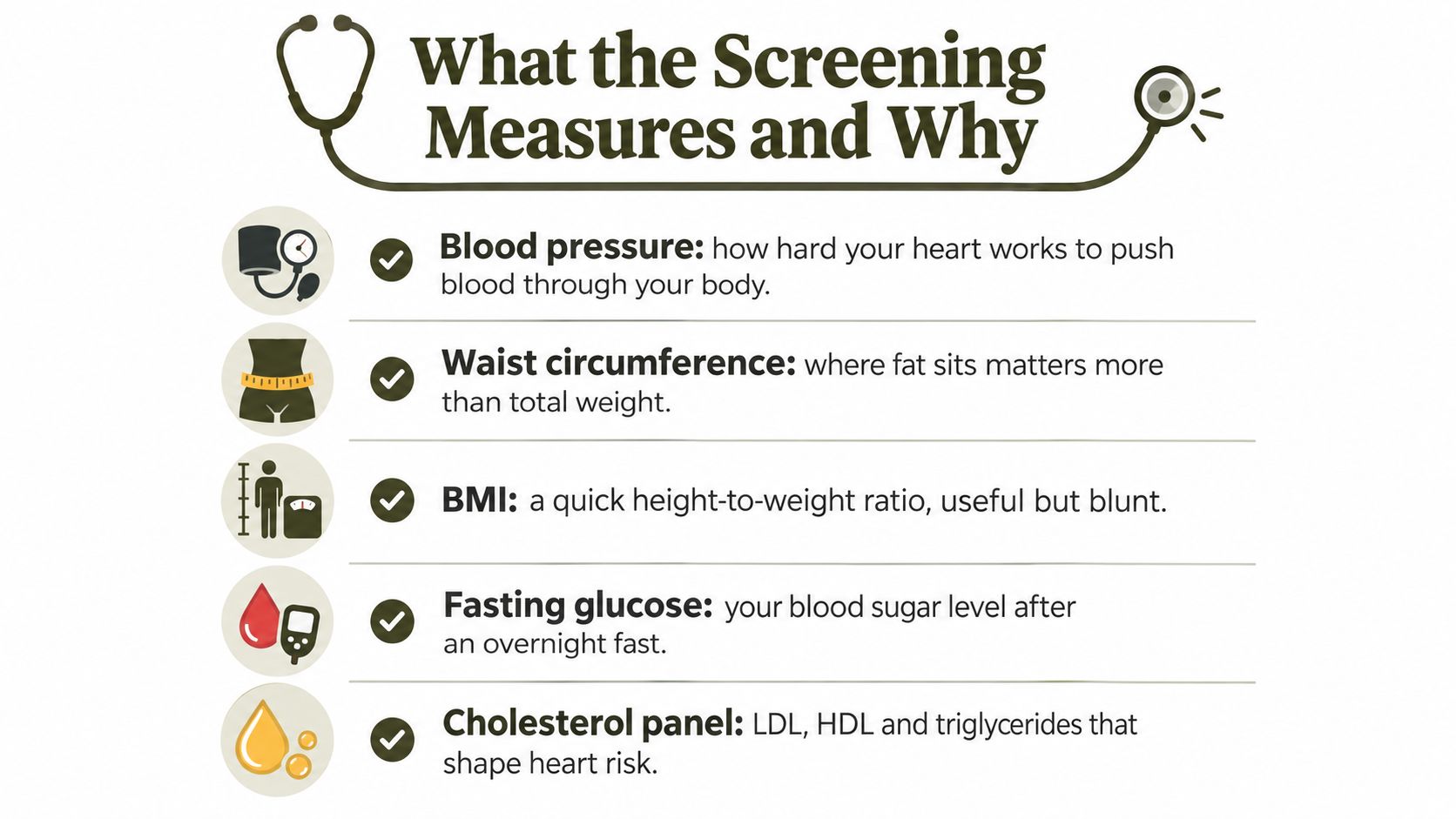
A screening may look like a short appointment, yet each measurement offers a different clue. Together, they create a starting snapshot, not a complete description of your health. The exact combination varies by program, so check which measures are included and how the results will be used.
Blood pressure
Blood pressure records the force of blood moving through your arteries. The upper number reflects pressure during a heartbeat, while the lower number reflects pressure between beats. Persistent elevation can increase the heart and blood vessels' workload, but a single reading may be affected by recent activity, stress, caffeine, or an unsuitable cuff.
A quiet rest period and a correctly sized cuff improve the usefulness of the reading. A raised result is a reason to repeat it under suitable conditions and discuss the pattern with a qualified clinician.
BMI and waist circumference
BMI compares weight with height. It can provide a quick population-level view, but it cannot distinguish muscle from fat or fully describe body shape and fat distribution.
Waist circumference supplies a different clue. Fat held around the abdomen can have different metabolic implications from weight distributed elsewhere, so waist measurement can add context to BMI. Neither measure reveals complete body composition, fitness, or health on its own.
Glucose and longer-term blood sugar markers
Glucose shows the amount of sugar in your blood when the sample is collected. Fasting glucose is measured after an overnight fast when the program requires it. HbA1c, if included, reflects average blood sugar exposure over a longer period, so it answers a different question from a single glucose reading.
The collection method also matters. A finger stick and venous blood draw can produce results that require different technical interpretation for glucose and lipids. This explanation of how collection method affects glucose and lipid interpretation covers why the method belongs in your record.
Lipids
A basic lipid profile may include total cholesterol, LDL, HDL, and triglycerides. These markers help assess cardiovascular risk, but they do not predict an individual outcome by themselves. A clinician may consider age, blood pressure, smoking history, family history, medication, and other factors alongside the results.
Some programs add resting heart rate or broader laboratory panels. A longer panel is not automatically better. Its value depends on the question it is meant to answer and the follow-up available.
If tiredness has prompted you to review your numbers, a basic screening may not explain it. Fatigue can have many possible causes, so this guide to possible reasons you may feel tired can help you prepare broader questions for a clinician. Your results become more useful when you keep them, note the collection conditions, and compare them with later measurements.
Reading the Numbers Without Panic
A screening report may highlight results with colors or labels. Seeing “borderline” in a bright warning color can feel more serious than it is, especially if you do not know which reference ranges the program uses. Treat the table as a prompt for a conversation, not a pass/fail verdict.
| Measurement | Optimal | Borderline | High Concern |
|---|---|---|---|
| Fasting glucose | Below 100 mg/dL | 100 to 125 mg/dL | 126 mg/dL or higher |
| Blood pressure | Below 120/80 mmHg | 120 to 129 and below 80 mmHg | Starting at 130/80 mmHg |
These are common reference points for fasting glucose and blood pressure, not a personal diagnosis. Different screening programs may group results differently or use different labels. Fasting status, recent exercise, stress, cuff size, posture, and the quality of the measurement can all affect interpretation. A result becomes more useful when you know how it was collected and whether it appears again under similar conditions.
BMI and waist circumference do not fit neatly into one universal table. Their meaning can vary with body composition, age, sex, ethnicity, medical history, and the purpose of the screening. A clinician may use them as pieces of context rather than as standalone judgments.
A result outside a reference range is a reason to ask a better question, not a reason to assign yourself a disease.
If a value looks high or unexpected, save the original report and ask what confirmation makes sense. The next step could be a repeat measurement, a review of medications and habits, or a clinical test. If you already have a diagnosis or take medication for blood pressure, glucose, or cholesterol, your personal targets may differ from a general screening table. The goal is to turn one reading into an informed, ongoing biomarker conversation.
How Screenings Fit Into Preventive Care and Longevity
You receive a screening report that says your numbers are acceptable, then wonder what to do with it. Its greatest value may be the starting point it provides. A personal baseline gives you a reference for later measurements, so you can compare actual changes instead of relying on a vague memory that a result was “fine” or “a little high.”
Preventive care often begins with noticing gradual movement before symptoms appear. Blood pressure, glucose, and lipids can shift without obvious signs. One screening may capture only a small signal. Repeated measurements can show whether that signal remains stable, improves, or continues in an unfavourable direction.
A trend is more informative than a snapshot
Suppose an initial result is unremarkable but close to a clinical threshold. Record the value, note how it was collected, and ask when another check would be appropriate. If a later result moves similarly, the pattern gives you and your clinician a firmer basis for deciding what deserves further attention.
A single high reading can also be misleading. Stress, recent activity, or less consistent measurement conditions may affect it. A repeat reading in calmer, more comparable circumstances may look different. Tracking results over time lowers the emotional weight of one number while keeping persistent changes visible.
The conversation needs context
A longevity-focused view places biometric data within a wider health picture. Sleep, movement, nutrition, stress, medications, family history, symptoms, and personal goals can all affect how a clinician understands the same laboratory result in different people.
Programs also vary. One screening may include a broader panel, use different reference categories, or offer different follow-up options. Ask what the program measured, how the result was obtained, and which next step fits your situation.
A screening works best as the start of a conversation with a clinician, not as its conclusion. A practical guide to longevity can help you view healthspan as an ongoing process, while a qualified healthcare professional provides medical interpretation.
The useful question is, “Did I pass?” It is also, “What does this establish, what should I watch, and what action is appropriate if the pattern changes?”
Where Screenings Help and Where They Fall Short
You leave work with a printed health report after a short appointment. It may show several useful measurements, yet still leave you wondering what they mean and what should happen next. That tension captures the value and limits of biometric screening.
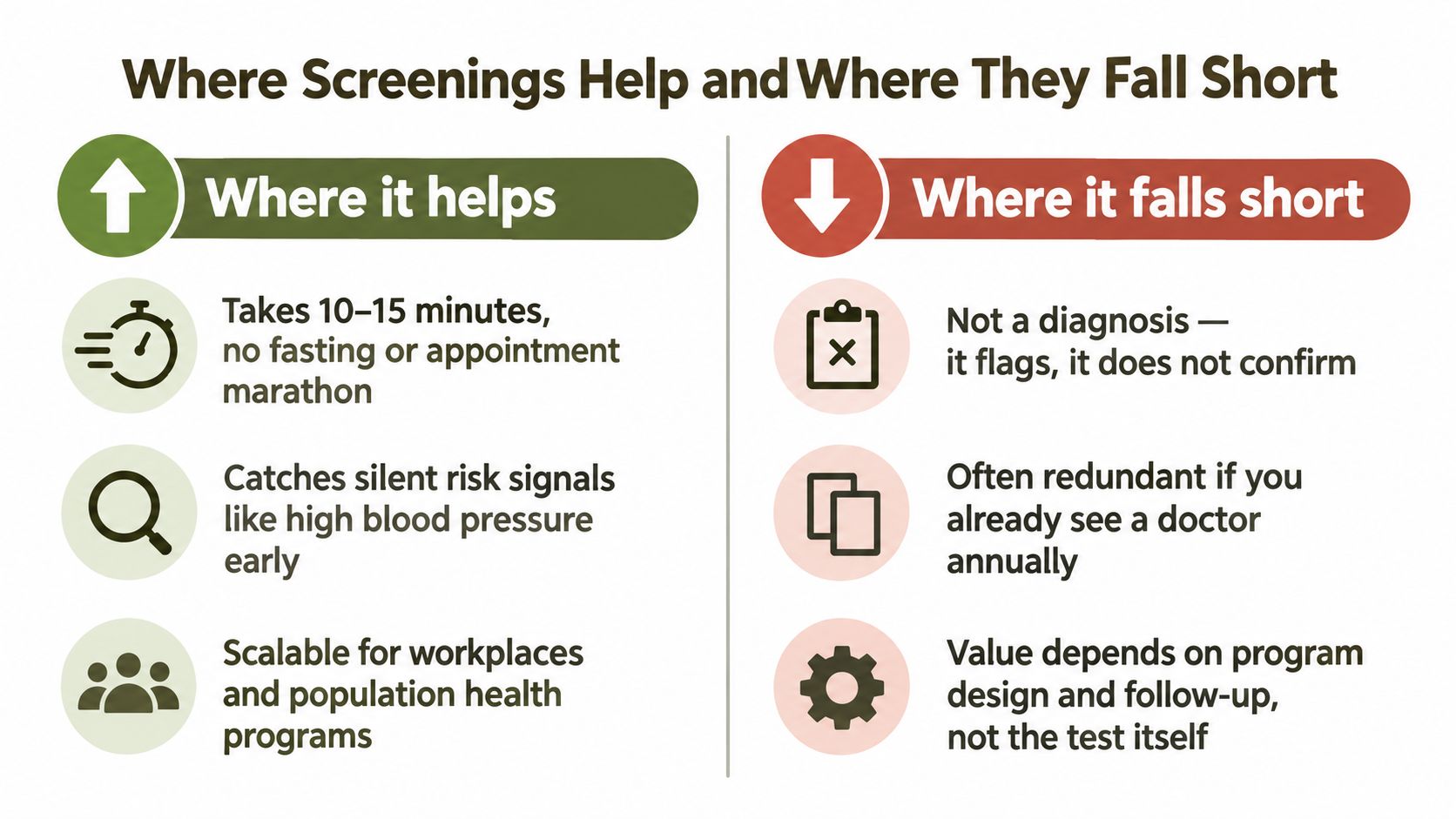
A screening can make basic measurements convenient, repeatable, and comparable across a group. An employer or community program can offer the same core checks to many participants in one setting. You may receive a useful starting point without arranging a separate appointment for every measurement.
Convenience does not make screening better than a physical examination. If your clinician already checks your blood pressure, body measurements, and relevant laboratory markers, the screening may repeat information you already have. Its added value comes from filling a gap, creating a comparison, or connecting you with appropriate follow-up.
Where the format helps
- Speed: One compact appointment can collect several foundational measurements.
- Accessibility: A workplace or community location may reach people who have not arranged routine preventive care.
- Comparability: Similar measurements over time can make meaningful changes easier to notice.
- Population visibility: Employers and health programs can see broad patterns and design support around them.
These benefits make screening a useful entry point, not a health verdict.
Where the format falls short
- Limited depth: A basic panel cannot explain every symptom, diagnosis, or risk factor.
- No complete examination: Screening usually lacks the detailed history, physical examination, and clinical reasoning of a full visit.
- Program variation: Fasting rules, included tests, collection methods, privacy practices, and follow-up differ between programs.
- False reassurance: A reassuring snapshot does not show that every part of your health is secure.
The discussion of what biometric screening can and can't do reinforces the central point: screening is not diagnostic and does not replace a clinician visit. Some programs may pause screenings temporarily or offer alternative ways to complete them. The label alone cannot tell you how useful a program will be.
Before relying on a report, ask what was measured, how it was collected, how your information is protected, and what follow-up is available. A useful screening begins an ongoing biomarker conversation. It does not deliver a one-time pass or fail result.
Turning Your Results Into a Personal Baseline
The report matters most after the appointment. Treat it as a health record, not a temporary scorecard.
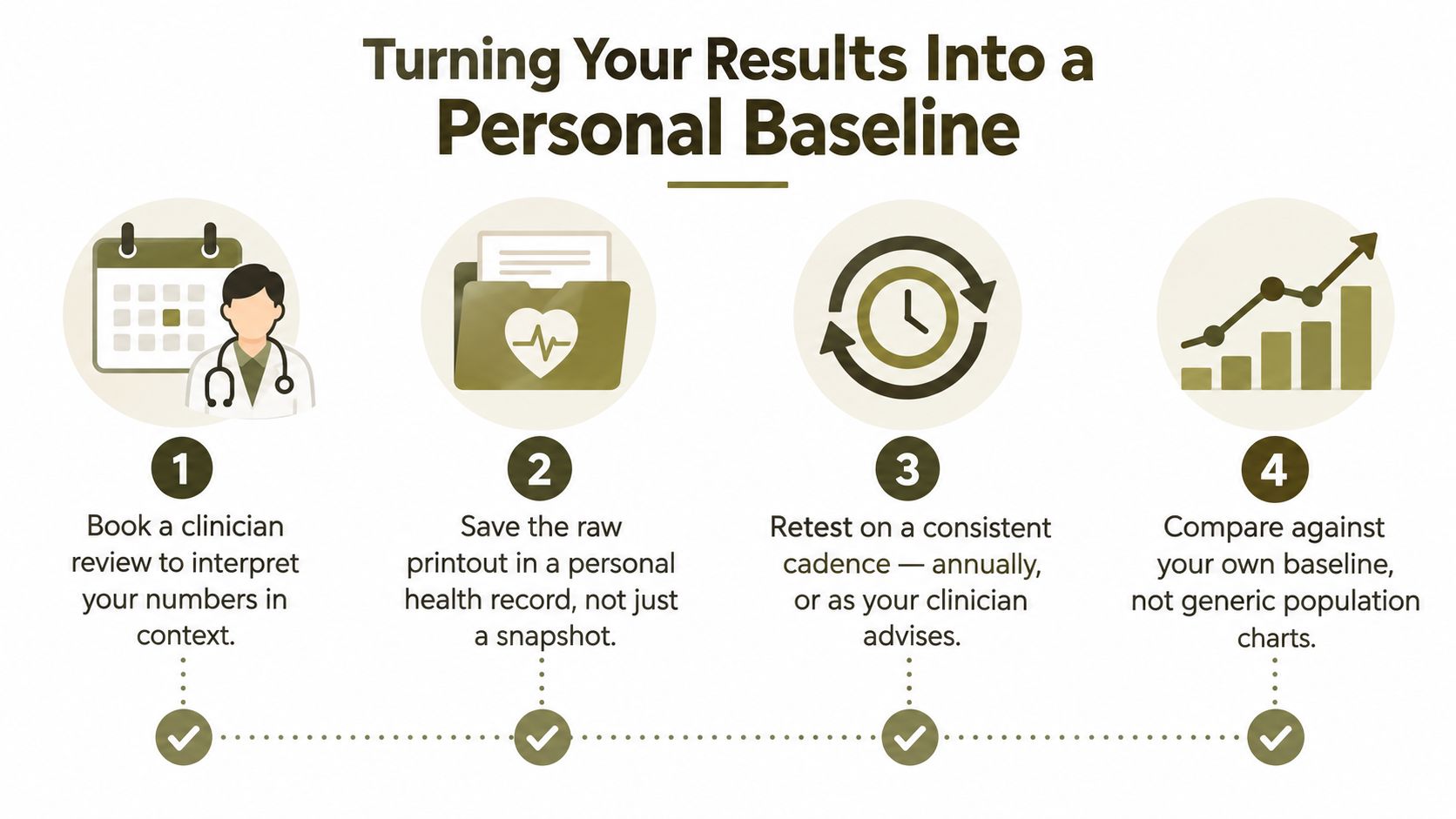
- Arrange a clinician review. Ask which findings need confirmation, whether your collection conditions affected interpretation, and when you should repeat the test.
- Save the raw numbers. Keep the actual values, dates, units, and notes about fasting, exercise, illness, and medications. A color-coded “normal” label loses useful detail.
- Choose a consistent follow-up rhythm. Retest annually, semi-annually, or according to your clinician's advice. Consistency makes comparisons more meaningful.
- Watch the change. Compare the new result with your own baseline instead of reacting to every small movement on a generic chart.
A clinician may use the baseline to decide whether deeper laboratory work, lifestyle changes, home monitoring, or additional evaluation makes sense. A structured wellness program can also use it to organize habits and follow-up, but it shouldn't turn a screening into a substitute for medical care.
Between appointments, an AI health coach may help you record questions, notice patterns in habits, and stay consistent with routines. It can't diagnose a condition, but it can make the practical work of tracking and preparing for a clinician conversation easier.
Your first screening doesn't tell you your health story. It gives you a dependable opening page. The true value develops when you preserve the result, interpret it responsibly, and return to the same questions over time.
Longwelle helps adults build a practical longevity baseline through personalized assessments, biomarker tracking, educational guidance, and optional consultations with licensed nurse practitioners. If you want support turning screening results into clear next steps and consistent habits, visit Longwelle to get started.