Learn
How to Break Bad Habits After 40
Learn how to break bad habits with an evidence-based program built for midlife adults: trigger mapping, replacement design, tracking, and relapse prevention.
The popular advice is simple: summon enough willpower, endure the discomfort for 21 days, and the bad habit will disappear. That advice fails many adults over 40 because it treats an automatic behavior as a character defect and a long-term pattern as a short challenge.
Research from University College London offers a more useful timeline. In a study that tracked participants for 84 days, the average time for a daily behavior to become automatic was 66 days, with individual formation times ranging from 18 to 254 days. A later review of 20 studies involving 2,601 participants found that health habits commonly took about 2 to 5 months to become automatic, with observed times ranging from 4 to 335 days. The University of Surrey's summary of the research makes the practical point clear: habit change needs sustained repetition, not a brief burst of motivation.
Midlife adds complications that generic habit advice often ignores. Stress, fatigue, poor sleep, time pressure, and demanding work or family responsibilities can return you to an old routine before you've had time to think. A workable plan therefore needs more than intention. You need to map triggers, redesign the cue-response loop, install a replacement, monitor progress, and prepare for relapse when your energy is low.
Table of Contents
- Why Willpower Alone Fails to Break Bad Habits
- The Habit Loop and Why Old Patterns Return
- Mapping Your Triggers Before You Change Anything
- Designing Replacements and Restructuring the Loop
- Tracking Progress With Behavioral Metrics and Biomarkers
- Preventing Relapse When You Are Tired and Stressed
- Your First 90 Days of Habit Change
Why Willpower Alone Fails to Break Bad Habits
Willpower is useful for making a decision, but it's a poor long-term strategy for interrupting an automatic behavior. If your phone is beside you during a stressful workday, snacks are visible after dinner, or alcohol is part of your usual decompression routine, the environment keeps presenting the same invitation. You may resist once or several times, then respond automatically when exhaustion reduces your attention.
The 21-day rule creates a second problem. It encourages people to interpret a lapse as proof that they're failing, when the underlying pattern may need more repetition. The evidence supports planning for weeks or months, with considerable variation between people and behaviors, rather than promising yourself a fixed deadline.
Practical rule: Treat motivation as a starter, not as the engine. Build a system that still functions when motivation is absent.
The midlife relapse equation
A bad habit often returns through a predictable combination:
- Stress narrows your choices: The behavior that once provided relief becomes easier to select than an unfamiliar replacement.
- Fatigue reduces deliberate control: After a demanding day, adding several decisions to your routine can make the old option feel automatic.
- Poor sleep increases vulnerability: When recovery is poor, the cue has a clearer path to the familiar response.
- Time pressure removes preparation: If the replacement isn't ready, the old habit wins by being available immediately.
This doesn't mean you're powerless. It means you should stop designing plans for your most energetic day and start designing them for the evening after a difficult week.
A realistic program begins with observation rather than prohibition. Record what happens before the habit, identify the reward you're seeking, and then alter the surroundings and response that keep the loop alive. The target isn't moral perfection. It's a repeatable arrangement in which the unwanted behavior becomes harder to start and the replacement becomes easier to complete.
The Habit Loop and Why Old Patterns Return
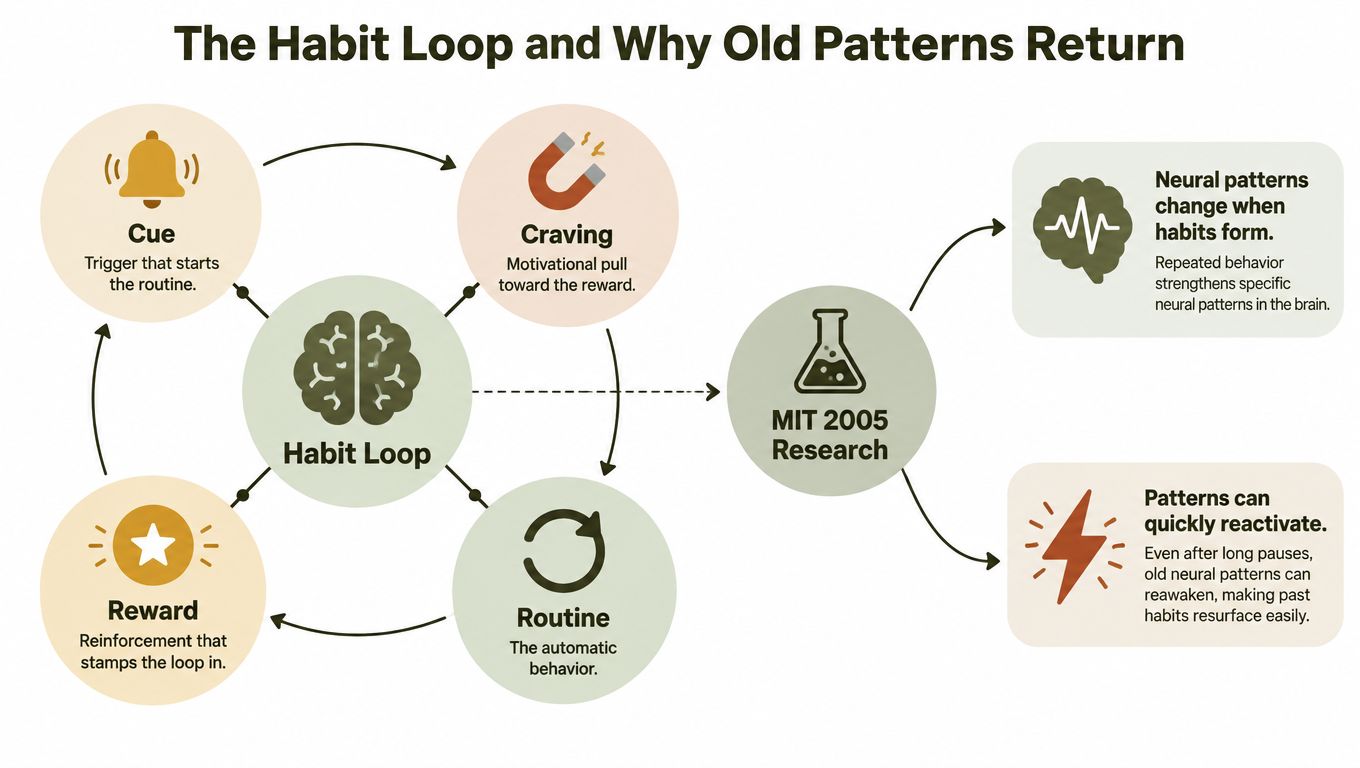
A habit is best understood as a cue, a response, and a reward. The cue can be external, such as a location, time, object, notification, or person. It can also be internal, such as boredom, tension, loneliness, or the physical sensation of fatigue. The response is the behavior itself, while the reward is what makes the response worth repeating, often relief, stimulation, comfort, or escape.
The reward matters because removing the behavior without addressing its function leaves a gap. Someone who scrolls after a demanding day may not be seeking information. They may be seeking mental distance. Someone who snacks after dinner may be responding to fatigue, ritual, or a desire for a satisfying transition out of work mode. A replacement that ignores the reward will feel like deprivation.
Why suppression is unreliable
MIT researchers reported in 2005 that habit formation changes specific neural activity patterns, and that those patterns can quickly re-emerge when an old cue or context returns. MIT's account of the habit research helps explain why a behavior can feel absent for a long time and then suddenly return in a familiar setting.
Later Duke research used a lever-pressing experiment in mice. The animals that were most successful at stopping showed weaker activity in neural cells associated with initiating the learned response, often called go-cells. The implication is practical: successful change depends on altering cue-response circuits, not merely fighting the urge after it has gathered force.
This is why a person can stop checking social media at home yet restart during a commute, or avoid late-night eating while traveling but resume it in the kitchen after a stressful day. The old pattern hasn't been erased. A returning context can reactivate it.
Changing the cue and the response is usually more durable than arguing with the urge.
Use the loop as your unit of analysis. Ask what starts the behavior, what you do next, and what immediate benefit keeps it in place. Then intervene before the automatic motor sequence begins, not only after the craving has become intense.
Mapping Your Triggers Before You Change Anything
Willpower is a poor starting point for habit change. Before changing the behavior, spend one week identifying the conditions that make it more likely. Do not use this period to perform perfectly or punish yourself. Observe the sequence closely enough to capture what memory usually compresses into “I just did it.”
Record each occurrence, and each noticeable urge:
- The setting: Where were you, and who was present?
- The timing: What time was it, and what happened immediately beforehand?
- Your emotional state: Were you bored, tense, lonely, frustrated, or mentally depleted?
- Your physical state: Were you hungry, tired, restless, or uncomfortable?
- The urge: What sensations appeared in your body, and how strong was the pull?
- The reward: What did the behavior provide within the next few minutes?
Awareness training works by making the early sequence visible: the context, warning signs, urge, and point at which the behavior begins. The review of habit reversal therapy describes this observation process as the foundation for later behavior change. You need that detail before choosing an intervention.
A worked example
Consider a professional trying to stop after-dinner snacking. The apparent problem is food, yet the audit may reveal a narrower pattern: the person closes a laptop, stands in the kitchen, and reaches for a snack while mentally exhausted, without a defined end to the workday.
| Trigger Category | Example From Audit | What It Points To |
|---|---|---|
| Environmental | Snack food is visible beside the kitchen counter | Remove the visual cue and add friction |
| Emotional | The urge follows a tense email exchange | Build a decompression response |
| Physiological | The person is tired and has not eaten a satisfying evening meal | Review meals, sleep, and recovery |
| Temporal | The behavior starts shortly after work ends | Attach a replacement to the workday transition |
| Social | A partner brings snacks into the room | Agree on a shared evening routine |
Look for recurring combinations, not isolated incidents. A single habit can have several entry points, and stress, fatigue, or poor sleep may make the same cue harder to resist on different days. That is why a midlife plan should record recovery factors alongside the visible trigger. If urges remain intense despite adequate tracking and reasonable changes to sleep, meals, and routines, discuss the pattern with a nurse practitioner, particularly when medication, mood, or another health issue may be involved.
Environmental cues call for relocation or removal. Stress cues call for a brief calming action. Physiological cues may require changes to meals, sleep, or medical care.
End the audit with one precise sentence: “When this cue happens in this context, I perform this behavior because it gives me this immediate reward.” That statement gives you a workable target. “I need more discipline” does not.
Designing Replacements and Restructuring the Loop
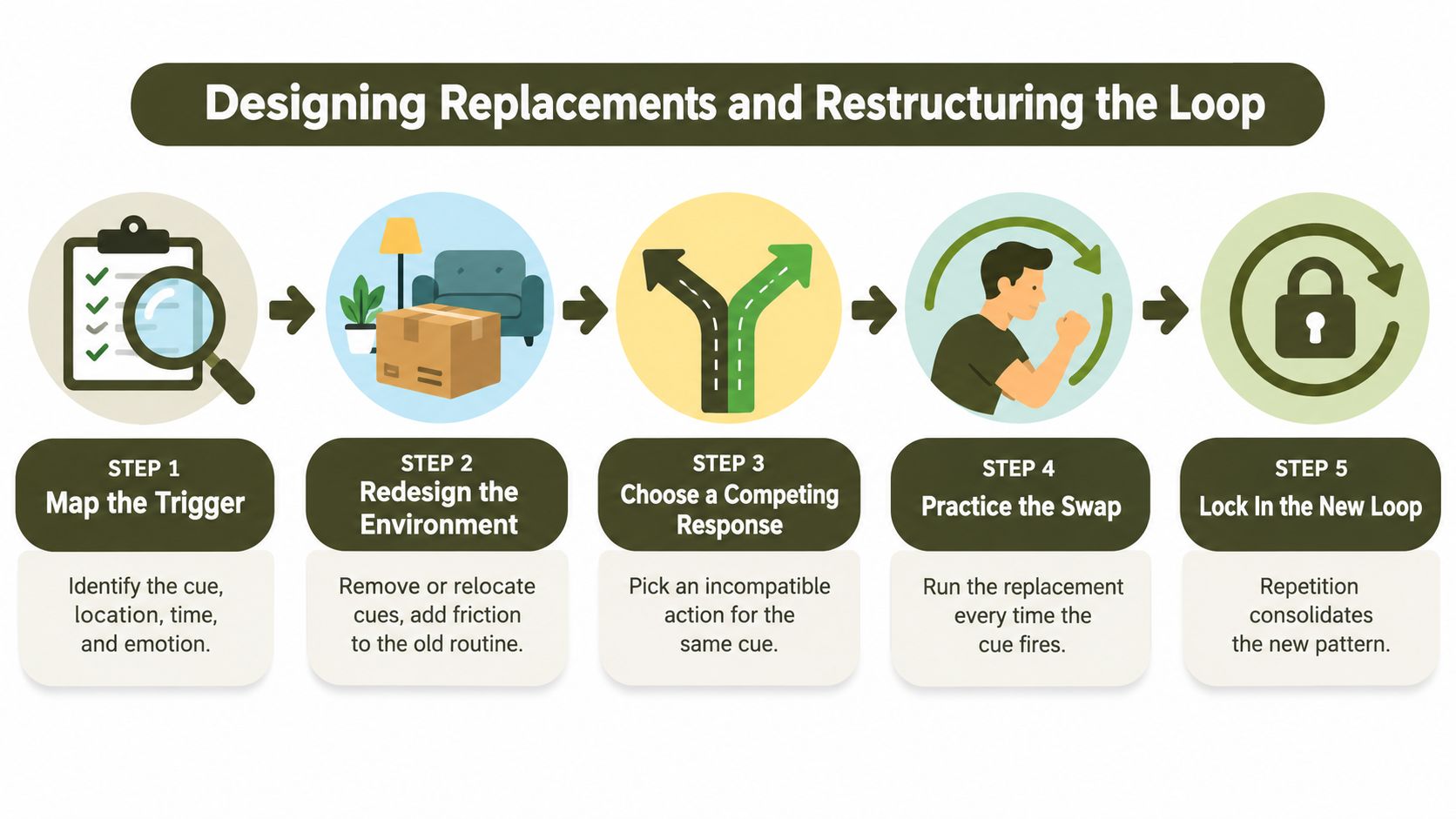
Willpower is a poor replacement strategy. Once a cue appears, the more reliable approach is to redesign the sequence so the old response becomes harder and a competing action becomes easier. A workable plan changes three conditions: reduce exposure to the cue, add friction before the unwanted behavior, and rehearse a response that can provide a similar immediate reward.
Habit reversal therapy offers a precise model. After awareness training, the person performs a competing response, an action that cannot occur at the same time as the unwanted behavior, and holds it long enough to interrupt the automatic motor sequence. A meta-analysis of 18 studies with 575 participants found a large overall effect compared with controls, with an effect size of d=0.80. In a nail-biting clinical study, nail length increased 22% after treatment compared with 3% in placebo, and the treatment group retained a 19% increase at follow-up. The published review of the evidence provides the details.
Build the replacement from the loop outward
Suppose difficult work triggers social media use. Set up the environment before the urge arrives:
- Move the cue: Remove the app from the home screen, silence nonessential notifications, and keep the phone out of reach during focused work.
- Add friction: Log out or use a device setting that creates an extra step before access.
- Choose the competing response: Stand up, place both feet on the floor, take several slow breaths, and write the next physical work action on paper.
- Attach the response: Begin immediately after noticing the cue, before scrolling starts.
- Preserve the reward: If social media provided a break and reduced mental strain, the replacement should interrupt the work briefly without consuming the rest of the work period.
Specific actions are easier to practise and measure than intentions. “Relax” gives you no observable response. “Stand, breathe, drink water, and write the next action” defines the sequence clearly.
Start smaller than your ambition suggests. A micro-habit is the entry point that makes repetition possible on ordinary days. If the replacement is a daily walk, place the shoes by the door and begin with the smallest version you can reliably complete. Expand only after the cue-response connection is stable, especially during weeks marked by poor sleep or high stress.
Attach the replacement to an existing routine when possible. After brushing your teeth, prepare the next morning's water bottle and place walking shoes near the door. Longwelle's morning routine guidance can help you use predictable anchors instead of relying on motivation.
Don't delete a reward pathway and leave an empty space. Replace the behavior that delivers relief, stimulation, connection, or transition.
A healthier replacement can still fail if it offers no immediate reason to repeat it. If the old routine helped you shift out of work mode, the new routine should create that transition. If it relieved tension, include a physical or sensory action that changes your state. Matching the original function reduces the sense of deprivation and makes the competing response more repeatable.
Midlife clients often need a second version for depleted days. Poor sleep and accumulated stress can make the same cue harder to resist, so define a shorter replacement rather than abandoning the plan. A brief walk, slower breathing, or one written next action may preserve the loop when the full routine is unrealistic. If urges remain intense after reasonable changes to sleep, meals, and routines, discuss the pattern with a nurse practitioner, particularly when medication, mood, or another health issue may be involved.
Run the swap whenever the cue appears, including when the urge is mild. Repetition teaches the brain that the cue predicts a different response, while consistent tracking will show whether the replacement works under real conditions.
Tracking Progress With Behavioral Metrics and Biomarkers
Willpower is a poor progress measure. A better record shows what happens after a cue and whether your daily conditions are making relapse easier or harder. Track the response, the context, and the recovery factors that influence it.
Start with behavior. Count urges, record whether you completed the competing response, and note where and when the cue appeared. Time since the last slip can provide context, but it should not become the whole score. Recognizing an urge earlier and completing the replacement is meaningful progress, even if the old behavior occurs later.
Digital behavior-change programs commonly use self-monitoring, goal setting, and prompts or cues, according to this meta-analysis of multiple behavior-change interventions. The tool matters less than the visibility it creates. A paper form, spreadsheet, smartwatch, or phone note can work if recording takes little effort and captures the same measures consistently.
Use a two-layer scorecard
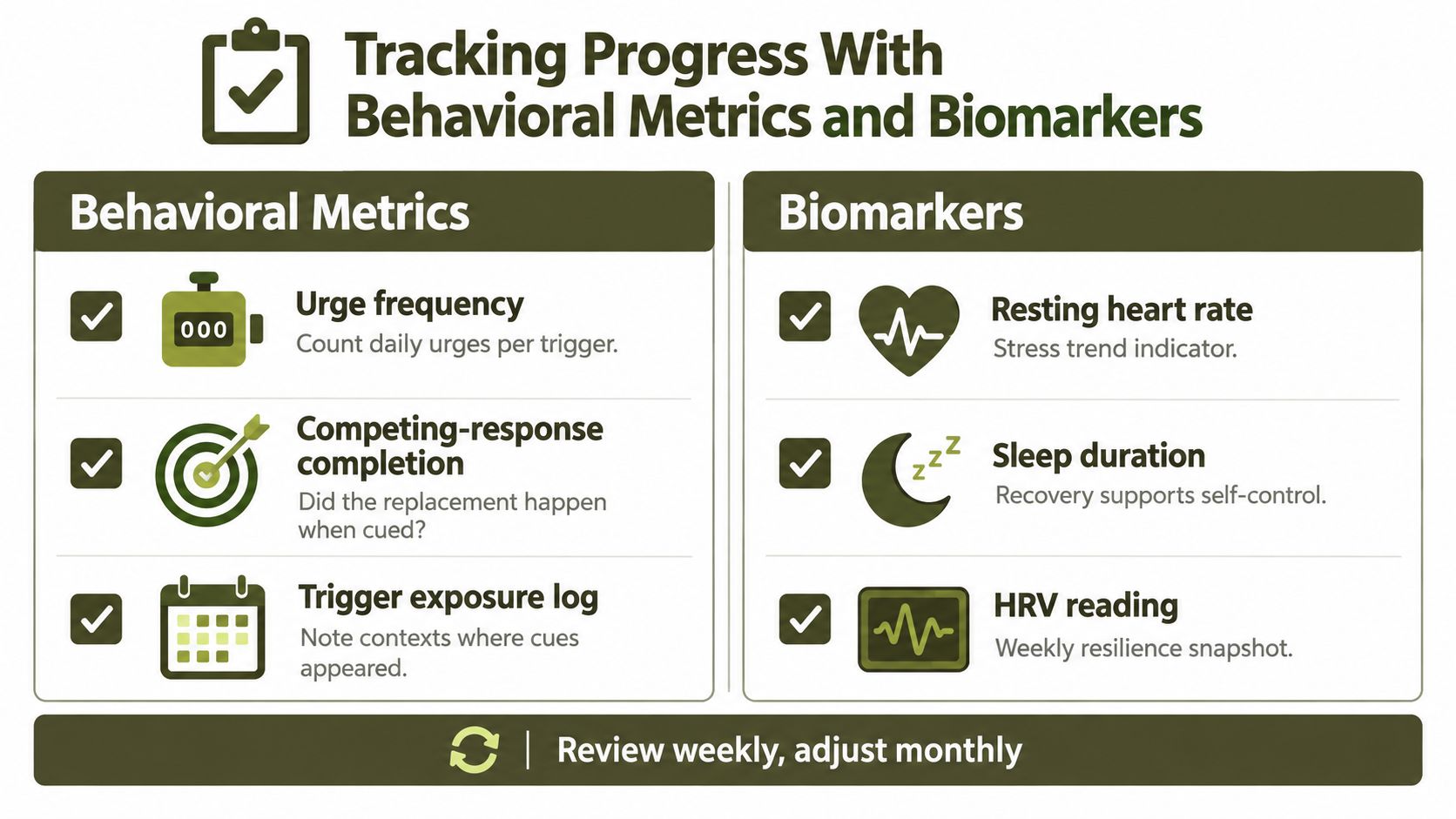
Behavioral measures show whether the loop is changing:
- Urge frequency: Count urges by trigger context instead of estimating from memory.
- Competing-response completion: Mark whether you used the replacement after the cue.
- Trigger exposure: Record the environments, times, and emotional states connected with the behavior.
- Slip recovery: Note how quickly you returned to the plan without extending one lapse into a longer episode.
Wellness markers show whether the program supports consistent action. Sleep duration and perceived sleep quality can reveal whether poor recovery comes before difficult evenings. Resting heart rate and HRV may provide useful personal trends, but consumer readings require context and are not a diagnosis.
Review the record weekly. Identify the cue that appeared most often, the replacement that failed under pressure, and any relationship between poor sleep, recovery, and difficult days. Change the environment or simplify the response before setting a harsher goal. If the pattern remains difficult despite reasonable adjustments, a nurse practitioner can help assess medication, mood, sleep, or other health factors.
Decide whether to change one habit or a connected cluster
One behavior at a time is a useful starting point when competing goals drain attention. It is not a universal rule. Research on interventions addressing multiple behavior changes suggests that coordinated behavior change can support chronic disease management, provided the plan does not become an overloaded list.
The practical distinction is between a connected cluster and several unrelated ambitions. Late-night scrolling, inconsistent sleep, and morning fatigue may reflect one recovery problem. Changing eating, exercise, alcohol use, work boundaries, and every digital habit at once creates more tracking demands and more opportunities to abandon the plan.
Choose the one or two behaviors most likely to improve downstream energy and sleep. Track each separately, then assess whether the combination is helping or creating excessive friction. For structured prompts and personalized wellness guidance between consultations, Longwelle's AI health coach can sit alongside a paper log or standard tracking app.
Preventing Relapse When You Are Tired and Stressed
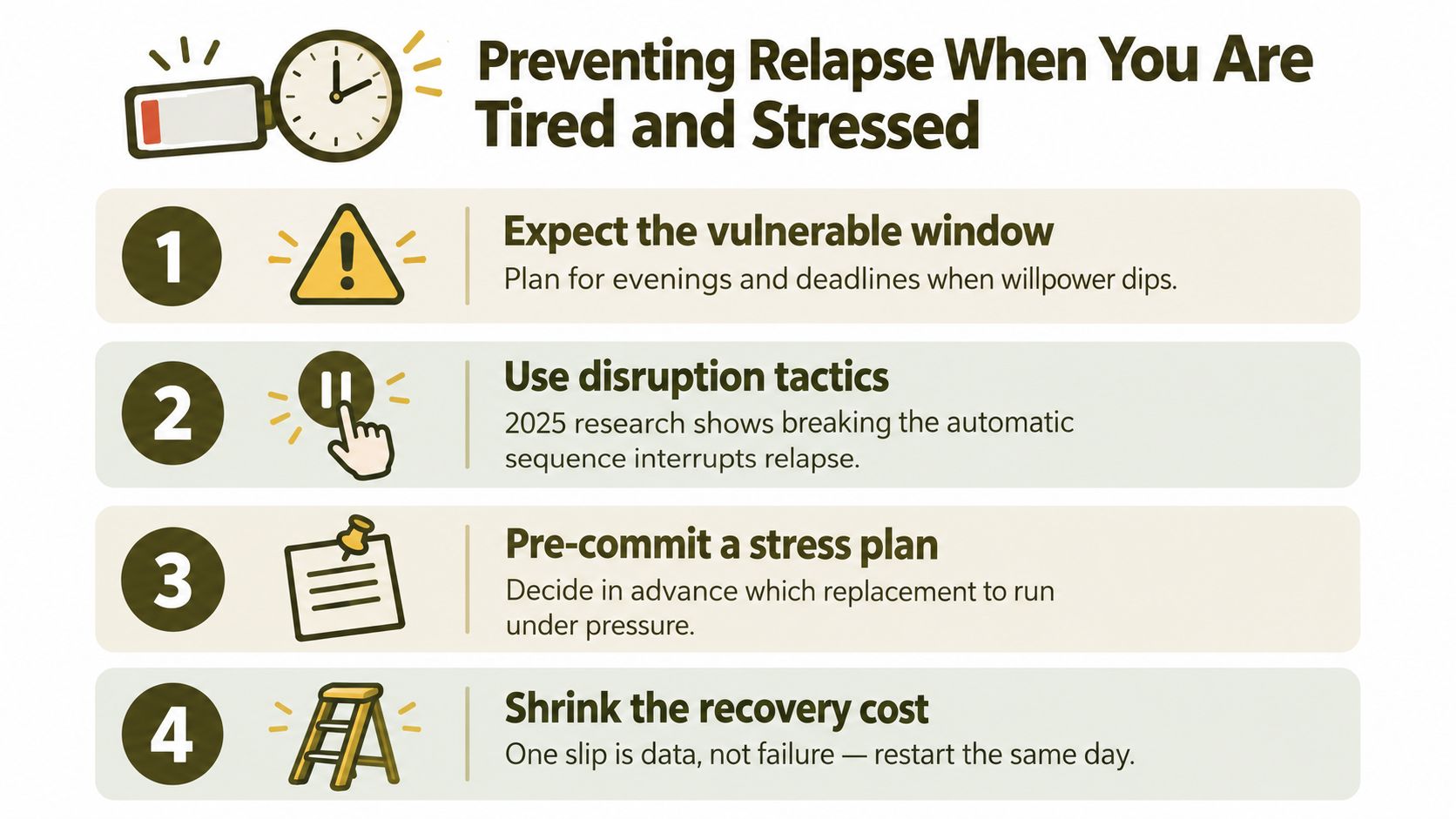
A relapse plan written during a calm morning often fails at the end of an exhausting day. Stress and fatigue narrow attention toward immediate relief. Any replacement that needs preparation, privacy, equipment, or several decisions is likely to disappear when pressure is highest.
Build the plan around disruption, not character. Remove visible cues, add friction to the unwanted response, and place a simpler substitute within reach. The 2025 research summary from Trinity College Dublin supports this practical approach to interrupting routines that return during stress or low energy.
Create a low-energy version
Write a fallback response for days when the full plan is unrealistic. If your usual replacement is a walk, the fallback could be putting on your shoes and stepping outside briefly. If your evening routine normally includes a complete wind-down, the fallback might be switching off the most disruptive screen and starting the next sleep-supporting action.
The fallback must be easy to complete while tired while still interrupting the old sequence. It keeps the new pathway active instead of asking you to make a fresh decision under strain.
Use a written if-then plan:
- If I notice the cue after a stressful meeting, then I will leave the room, drink water, and complete my competing response before deciding what happens next.
- If I sleep poorly, then I will use the low-energy version rather than canceling the routine.
- If I slip, then I will record the trigger and restart the replacement the same day.
Protect predictable danger windows
Your trigger audit should identify the times that need stronger design. Move or remove the cue before the vulnerable period begins. Put the replacement where you will use it, and ask people around you not to make the old behavior the default at that time.
One lapse provides information. Repeated lapses can recreate the old loop. Use a two-slip rule: one lapse prompts observation and an immediate return, while a second lapse in the same pattern triggers a plan review. Check for changes in sleep, workload, emotional strain, food, medication, or surroundings.
The question after a lapse isn't “Why am I like this?” It's “Which condition made the old response easier than the new one?”
Persistent fatigue deserves clinical attention as well as habit adjustments. If low energy, disrupted sleep, why you feel tired, mood changes, or physical symptoms repeatedly undermine your plan, discuss them with a licensed nurse practitioner or another qualified clinician. Seek professional input when fatigue remains unexplained, when you suspect a physiological contributor, or when the behavior involves substance dependence, withdrawal, compulsive eating, severe anxiety, or significant impairment.
A clinician can distinguish a routine-design problem from a condition requiring assessment and treatment. For midlife adults, bring a record of sleep quality, energy, trigger timing, behavior frequency, and available recovery trends. You are not diagnosing yourself. You are documenting the pattern clearly enough for a professional to interpret it responsibly.
Your First 90 Days of Habit Change
Use the first 90 days as a checkpoint, not a finish line. Health habits commonly take roughly 2 to 5 months to become automatic, with wide individual variation. The research review summarized by the University of Surrey supports planning for that longer timeline. Judge progress by the trend, not perfect adherence.
This week, choose one behavior that affects energy, sleep, or vitality. Audit its triggers, write the cue-response-reward sequence, select one competing response, change the environment, and begin a simple tracking sheet. Track objective markers such as sleep quality, energy, behavior frequency, and relevant biomarker trends. Keep the plan observable and easy to revise.
Expect the replacement to work in familiar settings, then fail after poor sleep or high stress. That failure identifies where the old response still has an advantage. Shrink the fallback response, adjust the environment, and record what changed. A monitored program makes relapse patterns easier to see than memory alone.
At the 90-day review, check whether urges are less intense, responses begin earlier, slips resolve faster, and sleep and energy support the routine. Motivation starts the process. Prepared surroundings, a workable replacement, and honest monitoring sustain it. If fatigue, disrupted sleep, mood changes, or physical symptoms continue to interfere, discuss the pattern with a licensed nurse practitioner or another qualified clinician.
Longwelle combines a brief longevity assessment with personalized guidance, biomarker tracking, structured routines, and optional consultations with licensed nurse practitioners. Visit Longwelle to build a monitored plan for energy, sleep quality, and healthy aging.